
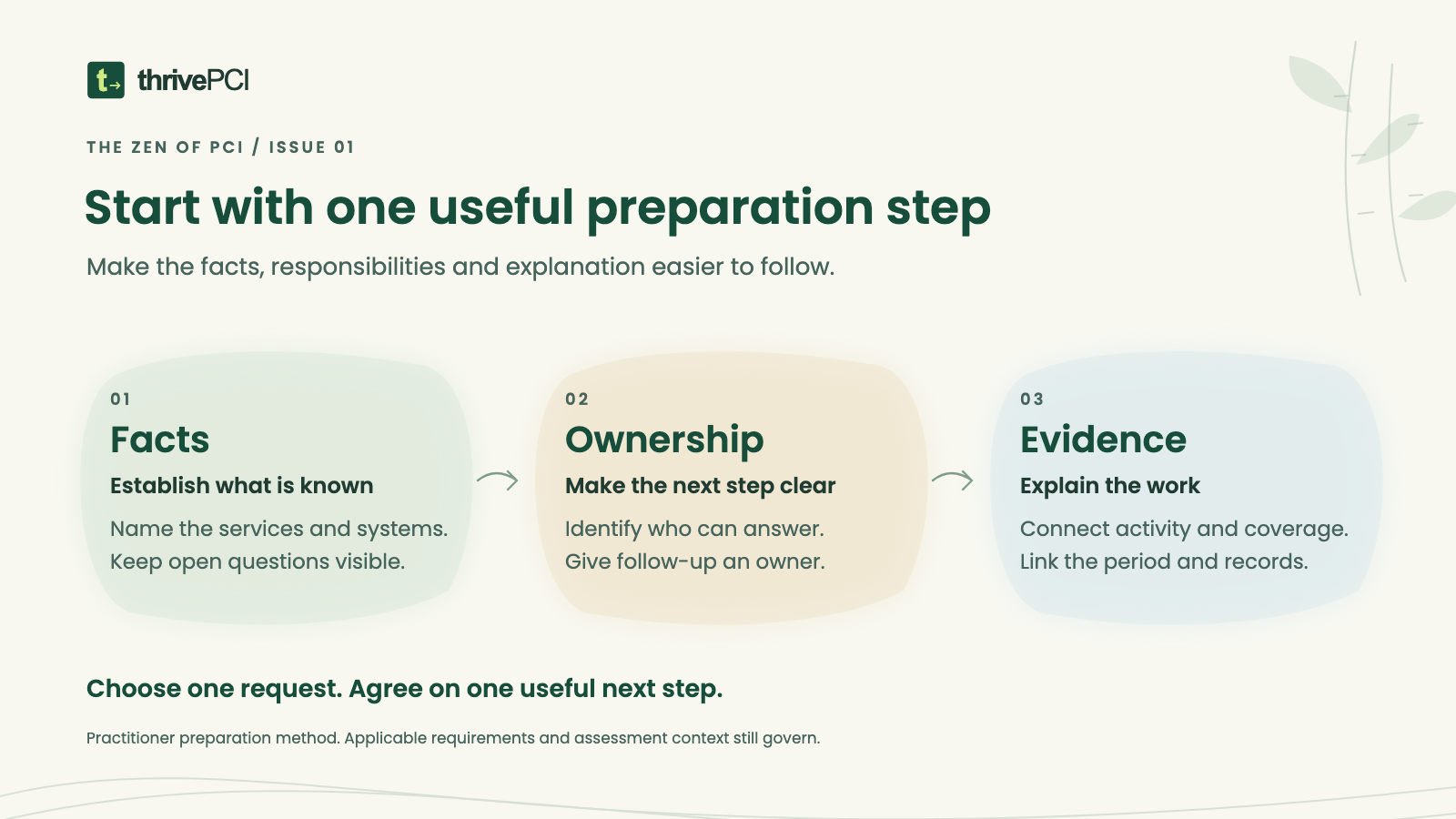
NEWSLETTER · ISSUE 01
A calmer start to assessment preparation
Assessment preparation can begin with a surprisingly ordinary question: can another person understand the work from the record we have kept?
A file may exist. A task may be marked complete. The team may remember the meeting. Yet someone reviewing the evidence still needs to understand what happened, which systems or people were covered, who made the decisions, and what remains open.
That is the work thrivePCI is being built to support.
thrivePCI is an independent PCI education and readiness resource for program leads, technical teams, business owners, and the people asked to provide evidence. Its purpose is practical: help teams turn obligations and unknowns into clear responsibilities, useful records, and habits they can sustain.
The Zen idea is simple. Give the work enough attention to see it clearly. Reduce unnecessary noise. Make the next responsible step easier to identify.
Start with a question you can answer
Consider a fictional team preparing an access-review response. It has a spreadsheet called “review complete.” Several people recognize the filename, but the accompanying explanation does not identify the population reviewed, the period, the reviewer, or the resulting actions.
A useful next move is to ask the activity owner to explain those details. Which accounts were included? What source established the population? What decisions were made? Where are the follow-up actions recorded? Which questions still need an answer?
Those questions give the team concrete work to do. They also help distinguish what the evidence demonstrates from what people have assumed it demonstrates.
Make the handoff useful
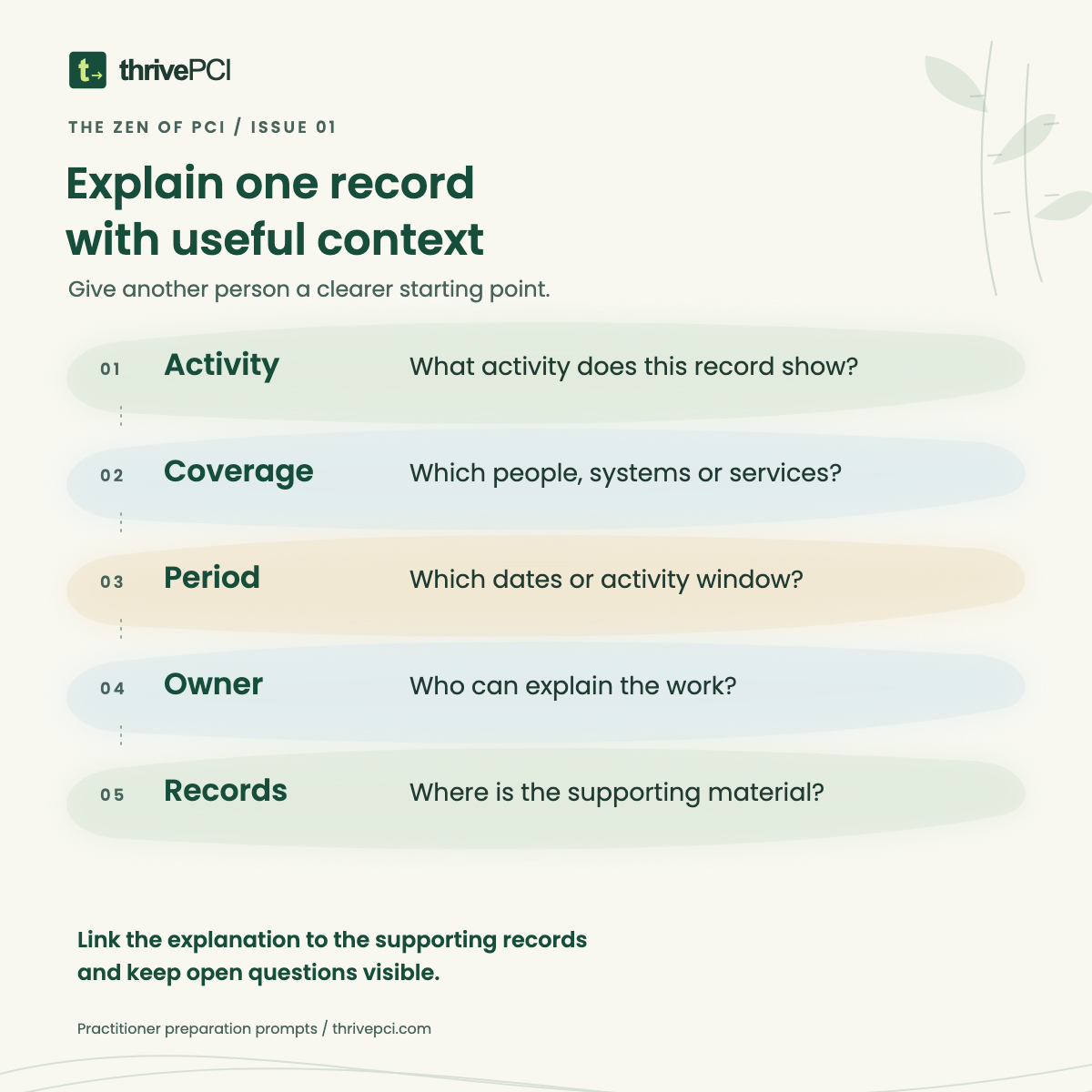
For one evidence request, try writing a short explanation that covers five things: the activity, its coverage, the relevant period, the responsible role, and the location of supporting records.
Then add the open items. If a record is incomplete, say what is missing and identify the person who can help resolve it. If the team is waiting for a decision, record who should make it and what information they need.
This is a preparation method. The applicable requirement, testing procedures, and assessment context still govern what must be evaluated. A well-organized explanation helps the responsible people examine the facts; it does not settle an assessment outcome on its own.
Give each activity its own clock
Timing deserves the same care. A requirement’s effective date, a recurring control interval, an event trigger, and an engagement’s requested evidence freshness can describe different things.
A monthly coordination meeting may help owners see upcoming work. The underlying activity still needs its own timing basis. Read the applicable requirement and testing procedures before choosing a date, and preserve any relevant event triggers alongside the calendar entry.
The free Assessment Cadence Atlas is designed to help teams work through those distinctions. Its workbook carries tranche dates and currency-day inputs into an evidence planner, while keeping requirement-level review visible.
Begin with one manageable piece
You do not need to reorganize the entire program in one sitting. Choose one request that regularly causes confusion. Find its owner. Ask for an explanation that connects the activity, coverage, period, and supporting records. Agree on the next action for anything still open.
That gives the next person a clearer starting point. Repeating the practice helps the team carry understanding forward between assessment cycles.
The free guided Assessment Preparation path brings this approach together: establish the facts, clarify ownership, organize evidence, understand timing, and prepare a useful handover. It provides a place to begin and links to related learning resources.
This newsletter will explore those everyday preparation decisions through practical examples and small exercises. We will look at how teams explain their work, handle uncertainty, and keep responsibilities visible as systems and services change.
If you are responsible for part of a PCI program, start with one question: which piece of work would be easier to prepare if everyone involved could explain it the same way?
Use that question with the free guided path below.
Begin with the free guided Assessment Preparation path (opens in a new tab)