
NEWSLETTER · ISSUE 06
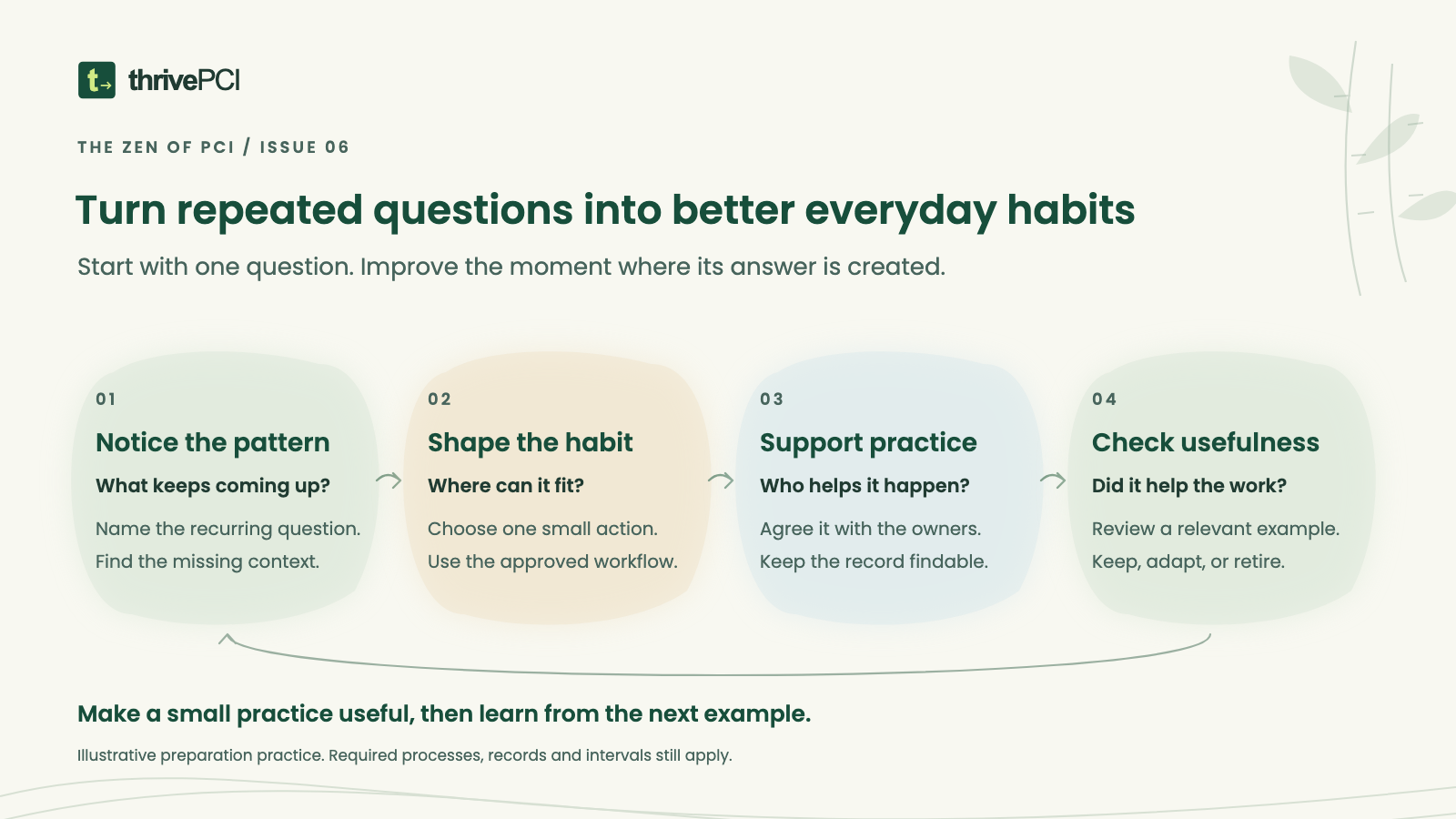
Turn repeated preparation questions into everyday habits
Some preparation questions return often enough to become familiar. Which record explains this? Who owns the next step? Does that answer still describe the service we use today?
Answering each question helps the person who asked. Looking at why it returns can improve the work for the next person, too.
A useful habit begins with a specific question, a natural moment in the workflow, and one small action people can carry out through the organization’s established process. Give it an owner and a way to check whether it helps.
Continue the fictional supplier-access example
Our fictional team has recorded an earlier account-removal outcome and routed a question about a proposed support integration to the appropriate roles. The earlier record remains available; the new question follows the established change process.
During preparation conversations, colleagues repeatedly ask which change record contains the current integration question and who will return with the answer. Each person can eventually find that information, but several searches and messages are needed.
The preparation lead asks the people doing the work to examine one recent handoff. They find that the record link and current owner are available, yet the handoff message does not consistently include them. That is a practical place to explore a small improvement.
Choose one recurring question
Write the question in the words people actually use. Ask the person receiving it what they need to know and where the explanation becomes difficult to follow.
Stay curious about the cause. A repeated question might reflect an unclear label, missing context, a permission problem, or a decision that remains unresolved. Some situations need a system change or an authorized decision before a new routine will help.
In this example, the team can address the missing handoff context within its existing tools. Other causes should follow the appropriate support or escalation route. Keep the improvement tied to the problem people have confirmed.
Find the moment that can carry the action
Look for a moment already present in the workflow: handing over a request, recording an approved decision, or updating an existing action record. Discuss the action with the people who will perform it and the owner responsible for that process.
The fictional team agrees to include the approved change-record reference and current question owner when sending an integration handoff. Sensitive details stay in the approved system. The message points the recipient to the explanation they are permitted to use.
Keep the action small enough to describe clearly. Agree what happens when the record or owner is missing. The person making the handoff should know where to ask for help rather than inventing an answer to complete a template.
Leave a habit note people can use
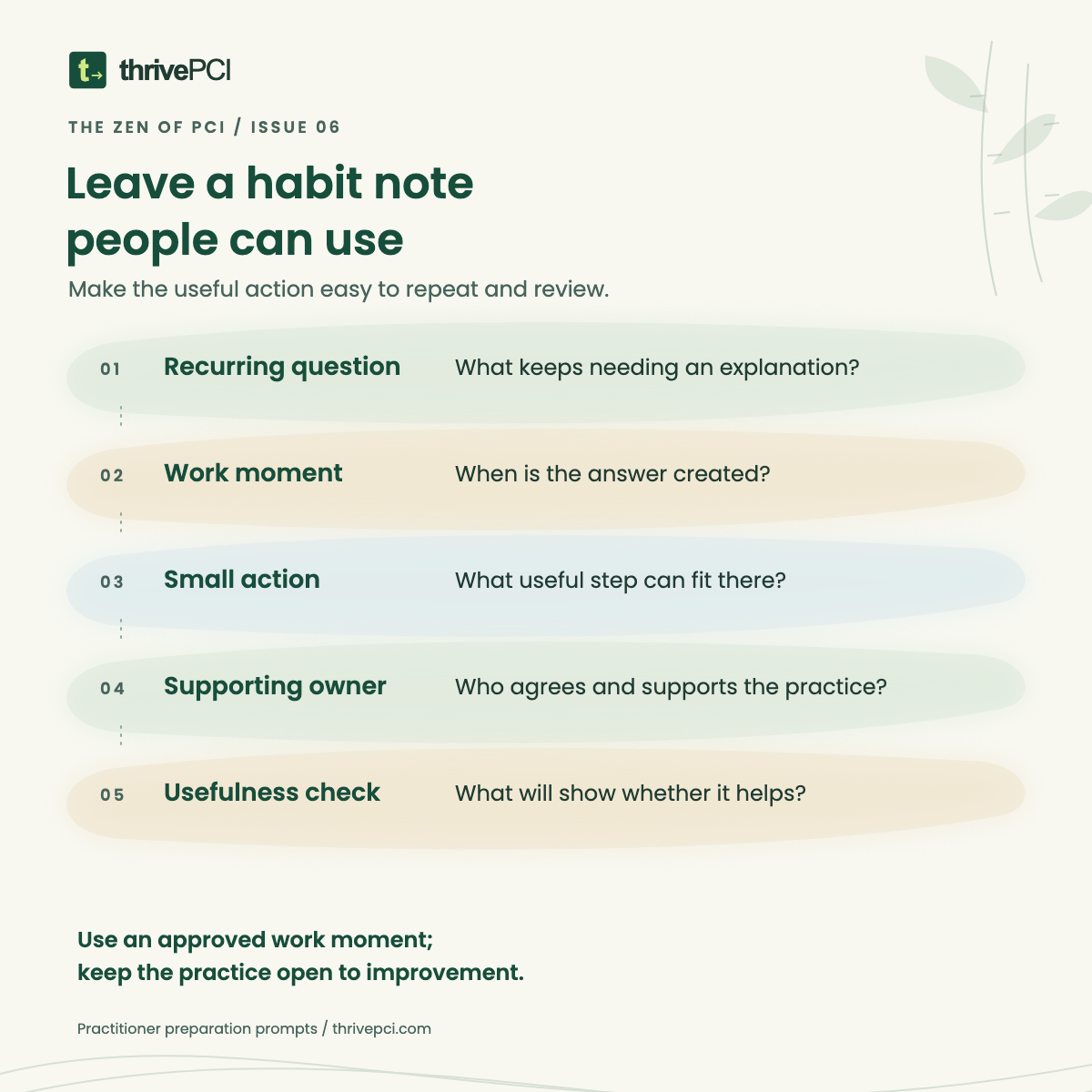
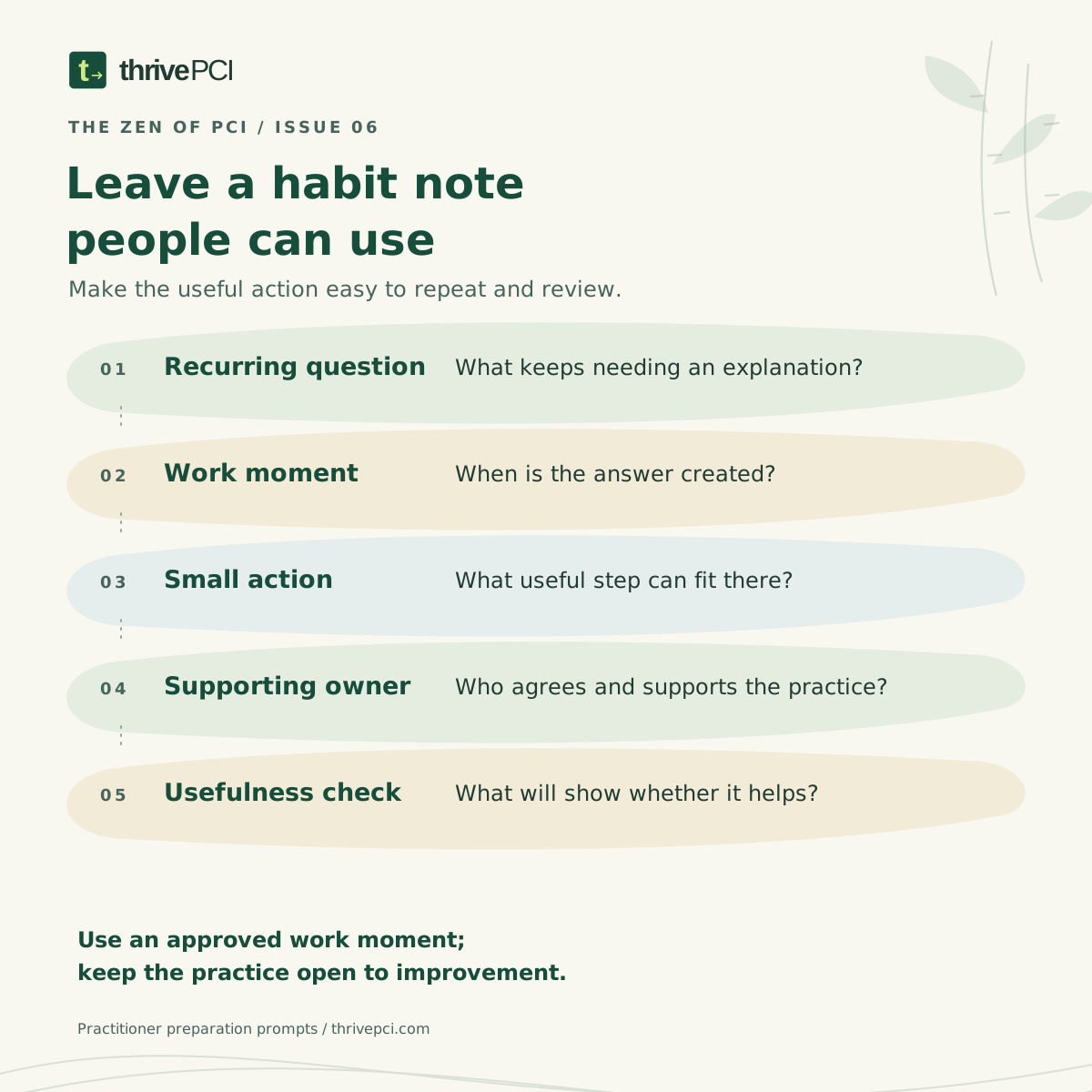
Try five prompts: Recurring question, Work moment, Small action, Supporting owner, and Usefulness check.
For the fictional team, the note might read: “People ask which record and owner explain the integration question. At the integration handoff, include the approved record reference and current owner. The service coordinator supports the routine. At an agreed follow-up, ask a recipient whether they could find the explanation and their next step.”
The supporting owner helps resolve practical obstacles and routes changes to the right authority. A habit note describes the agreed practice; it does not confer approval or replace the governing procedure.
Check whether the habit helps
Choose a modest check of usefulness. Can a recipient reach the correct record with their existing permissions? Do they understand who will respond? Which detail still needs clarification?
Listen to the people carrying out the action as well. A new field that creates duplicate work or exposes information to the wrong audience needs attention. Adjust through the established process, and retain the reason for the change where appropriate.
Fewer questions alone do not establish that the work is sound. People may stop asking because a route is difficult to use. Look at the explanation and the experience behind it.
Practice one useful improvement
Choose a fictional handoff and one recurring preparation question. Identify the work moment, agree a small action, name its supporting owner, and describe a usefulness check. Ask a colleague to try the handoff with placeholder records.
These are practitioner preparation prompts. Applicable PCI requirements, prescribed activities and intervals, review obligations, and assessment context continue to govern the underlying work. A helpful habit supports those processes; it does not establish compliance or a favorable assessment outcome.
Start with one question worth making easier to answer. The free thrivePCI Assessment Handover guide provides a place to rehearse that next small step.
Practice with the free Assessment Handover guide (opens in a new tab)