
NEWSLETTER · ISSUE 25
Check what was understood before moving on
Two people can leave the same conversation with different ideas about what happens next. One heard a request to describe a question. The other heard permission to resolve it. Both may have nodded, thanked the group, and believed the conversation was clear.
Checking shared understanding gives those differences somewhere useful to appear. Ask a specific question, invite people to describe the meaning in their own words, and compare the answers with the applicable reference. A difference is information the group can work with before it becomes an unsupported action.
In our fictional supplier-integration exercise, the new participant has found the current authorized guidance and an accepted support person. The optional wording trial remains closed. Its mixed observation is retained as history: someone found the next question but could not identify its responsible role. That earlier example does not replace the current guidance.
The participant restates the first question as, "Which role should we assign to resolve this handoff?" The support person had meant, "Which role is named, and where does the handoff still leave uncertainty?" The difference is small in wording and substantial in consequence. Identifying an ambiguity and assigning responsibility are different activities.
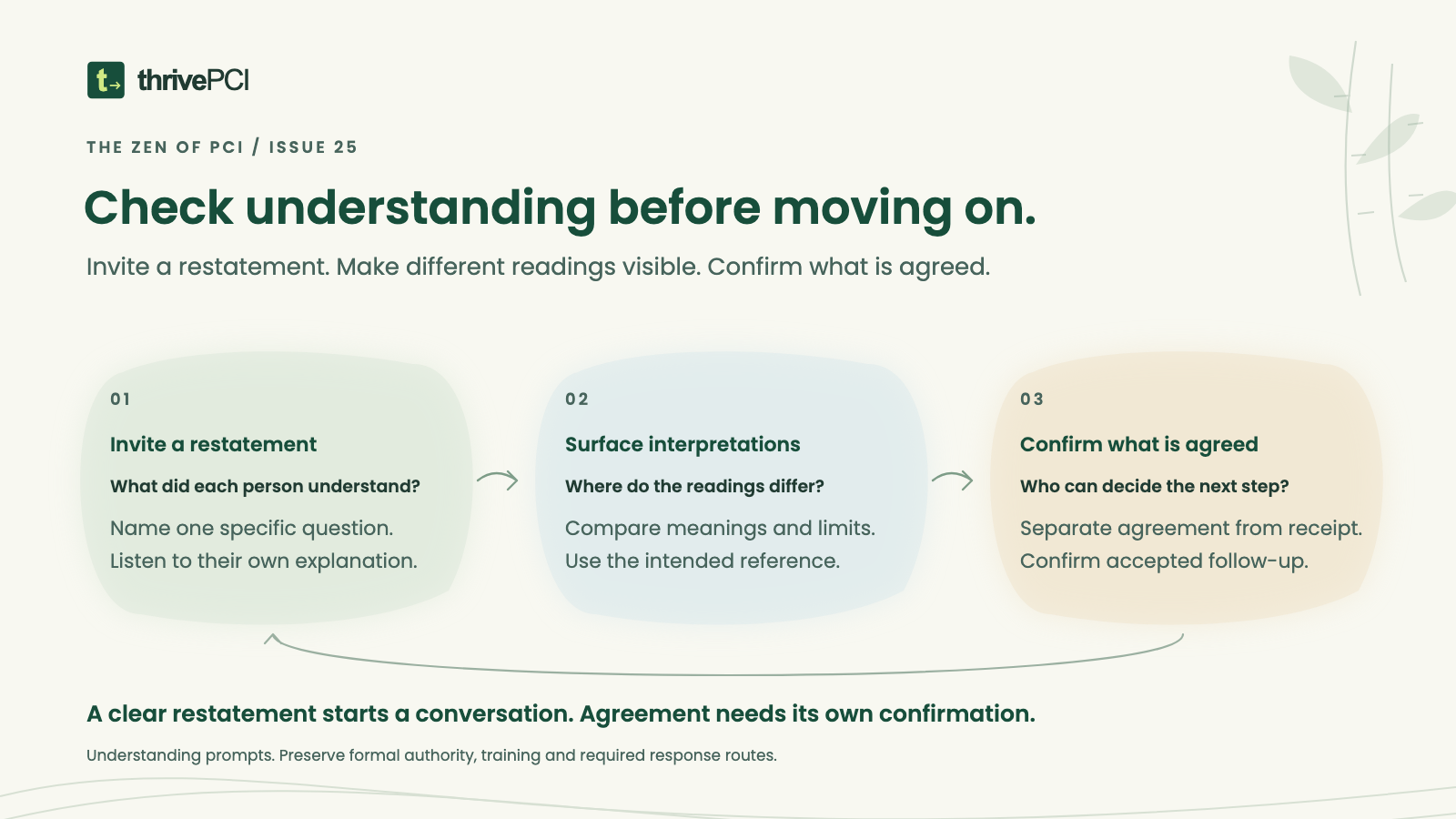
Invite a restatement
A broad "Does that make sense?" can be difficult to answer usefully. Try a question about the work: "How would you describe the question we are examining, and what would you do next?" Explain that the purpose is to find unclear wording together. Invite questions about assumptions, terms, and missing context.
Compare the restatement with the intended purpose. Ask which reference or phrase led to a different interpretation. The person explaining can also restate what they heard from the participant. Shared understanding is something both people help establish; a learner should not carry the whole burden of repairing an unclear explanation.
Leave an understanding note people can use
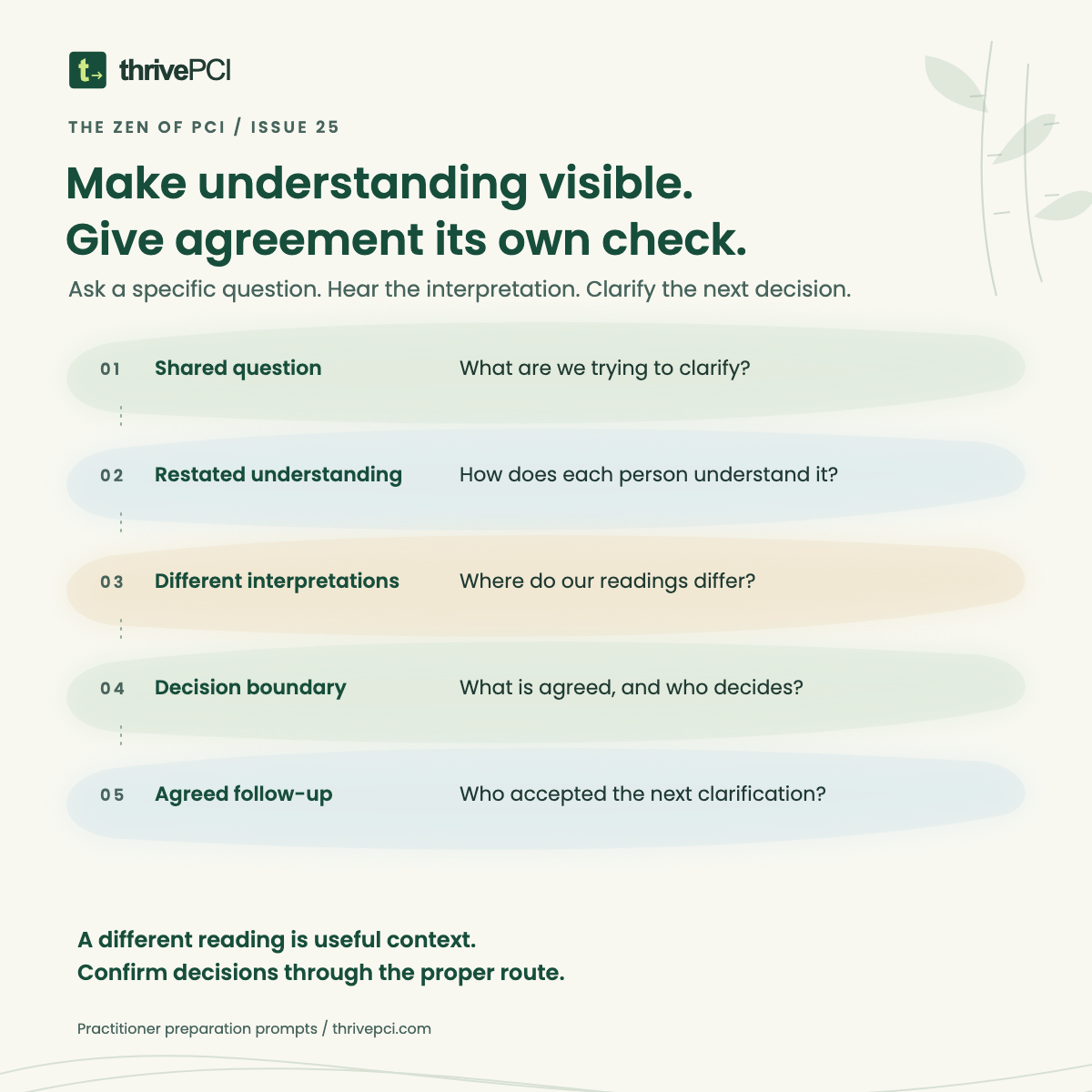
Use five prompts to keep the conversation specific and the next step honest:
Shared question: Write the bounded question everyone is trying to understand. Name the applicable current reference and its scope. In the fictional exercise, the question concerns the role named in the guidance and any remaining uncertainty in the handoff. Keep the closed trial's historical example clearly identified.
Restated understanding: Invite each relevant person to describe the meaning and likely next step in their own words. Capture enough to compare interpretations without making a transcript of the whole conversation. Acknowledging receipt, repeating a sentence, or giving a confident nod does not by itself establish understanding or agreement.
Different interpretations: Describe the difference without attaching blame. Here, one interpretation would identify an unclear responsibility; another would assign a role. Check the relevant wording and ask for clarification where needed. If the available reference cannot settle the question, keep the uncertainty visible and use the appropriate owner or escalation route.
Decision boundary: State what this conversation can establish and which decisions belong elsewhere. The underlying responsibility question, contributor capacity, and live integration decision remain separately unresolved or pending. A restatement does not demonstrate broad competence, approve a process change, establish control effectiveness, or transfer decision authority.
Agreed follow-up: Confirm what, if anything, was actually accepted, by whom, and through which normal process it will continue. Separate an accurate restatement from willingness or capacity to take an action. If a proposal needs approval, record it as a proposal and seek the required authorization before proceeding.
These prompts support everyday preparation. They replace no required training, operating record, access approval, or formal decision. They create no PCI interval and change no engagement deadline. Required controls and prescribed urgent response continue through their established routes.
Surface interpretations
Return to the fictional participant's answer. Thank them for making the interpretation visible. Clarify that the current task is to identify the named role and remaining uncertainty. Ask how they now understand that task and whether anything still points toward an assignment decision.
The group can agree on that bounded meaning while leaving a decision open. Someone may understand a proposed action accurately and still disagree with it, lack capacity, or need approval. Record the actual position rather than turning a smooth conversation into assumed commitment.
Confirm what is agreed
Practice with invented roles, a placeholder handoff, and fictional guidance. Give two partners slightly different interpretations of the same first question. Use the five prompts to compare them and clarify what each person believes should happen next.
Keep real evidence and sensitive details out. Leave one matter requiring the proper decision owner. Finish by asking each person what is understood, what is agreed, and what remains open. A useful check leaves room for an honest difference and a clear route to the next appropriate conversation.
Explore the free Program Maintenance guide (opens in a new tab)