thrivePCISite v0.43.62+20261122T201000Z · Published November 22, 2026

SCOTT REVIEW · NEWSLETTER ISSUE 17

Carry the decision into the right next action

One newsletter issue and 6 supporting posts. Two downloadable visuals illustrate the practice. These drafts promote the current free preparation resources and the request-details contact route. The copy buttons copy ready-to-edit text to your clipboard. Nothing here posts to LinkedIn.

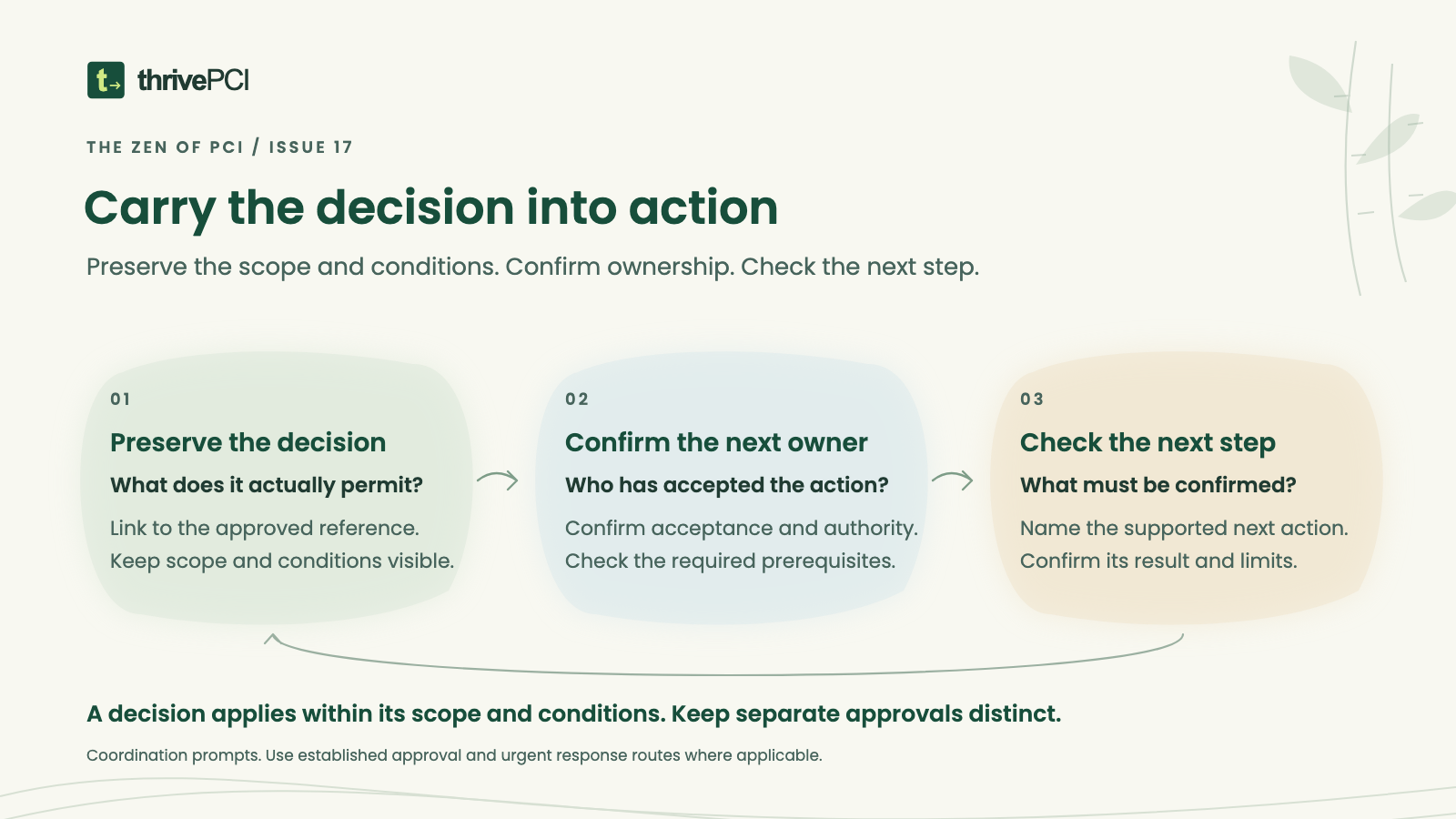
A decision-to-action handover preserves the decision reference, scope and conditions, accepted owner, next action, and confirmation. A conditional placeholder trial remains distinct from live integration permission.
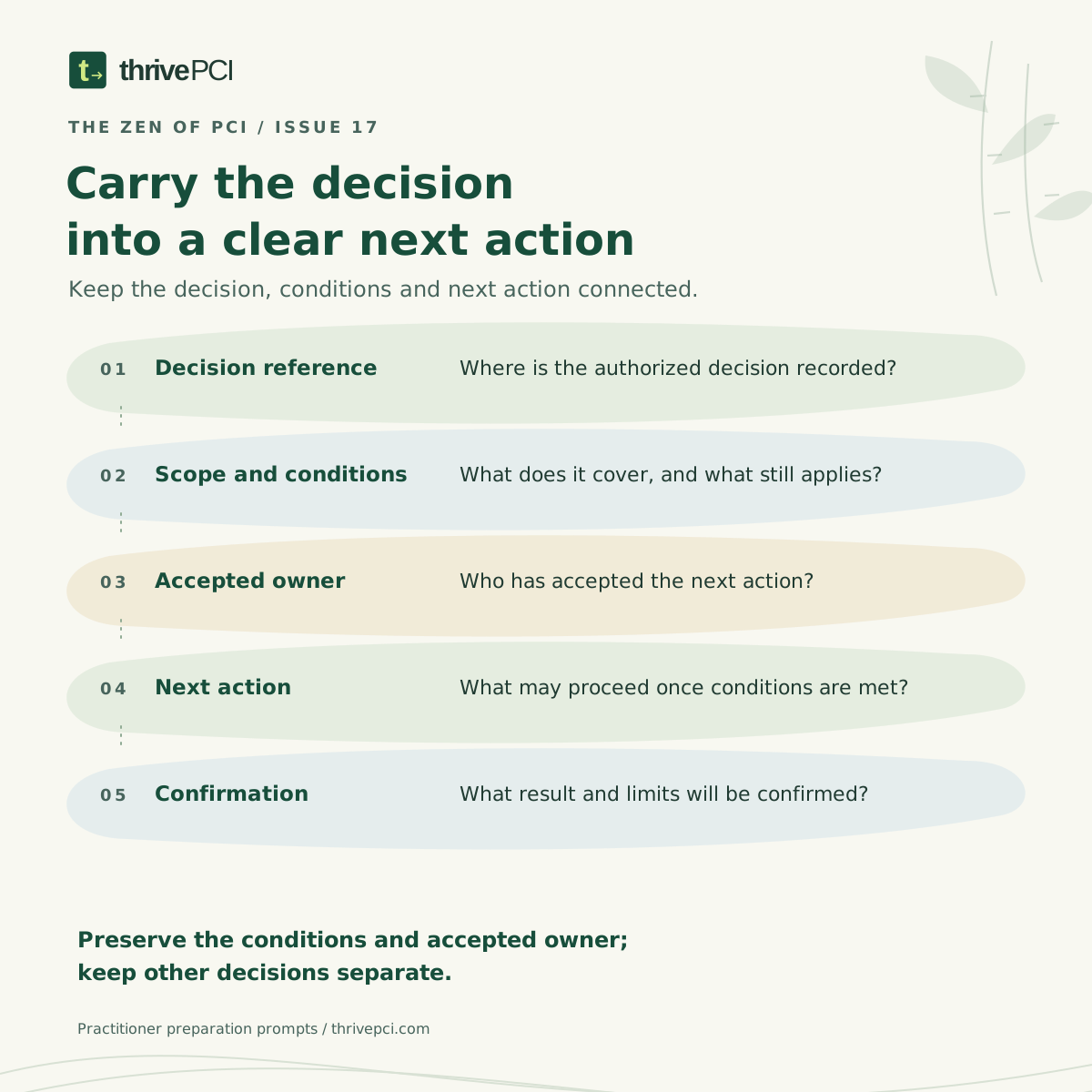
Carry the authorized decision into an accepted next action while preserving conditions and the limits of confirmation. Download PNG · Download SVG

Newsletter: The Zen of PCI

Practical PCI preparation for the people who own the work: responsibilities, evidence, timing, and habits that last.

Suggested sequence: Supporting posts form a suggested editorial sequence; publication dates are set by Scott.

Suggested T+ release plan

T+0 = actual publication day for issue seventeen. Offsets below use calendar days. Set T+0 only when the issue is ready for publication.

OffsetContentSuggested purpose
T+0Newsletter: Carry the decision into the right next action
Post: Carry the decision into the right next action
Publish issue seventeen and introduce five prompts for carrying decisions into bounded action.
T+2Post: Keep the conditions attached to the decisionPreserve the decision scope, conditions, and unresolved questions.
T+5Post: Confirm the person who accepts the next actionConfirm accepted ownership of the next action through the normal process.
T+8Post: Confirm what the next step actually establishesDistinguish task completion from a supported result and its limits.
T+12Post: Try a fictional decision-to-action handoverInvite a fictional paired decision-to-action handover exercise.
T+16Post: Make the decision easier to carry into everyday workConnect the practice to the free guide and request-details route.

Scott may adjust offsets for editorial readiness and audience conversation. These are publication suggestions, not PCI control intervals, engagement deadlines or claims about platform algorithm performance.

Download T+ plan · Download CSV

NEWSLETTER · ISSUE 17

Carry the decision into the right next action

A decision can clarify the way forward while leaving important work to do. Someone still needs to understand its scope, confirm its conditions, accept the next action, and record what happens. The useful transition is from an authorized decision to an action that stays within what the decision actually permits.

This is a handover into work. It needs enough context for the receiving person to continue accurately. A summary that drops a condition can make a limited decision sound broader than it is. A name added to an action list can imply acceptance that has never been confirmed.

In the next part of our fictional supplier-integration example, suppose the authorized owner records a decision permitting a limited placeholder wording trial only if its stated conditions are met. This is an invented decision for the exercise. It does not describe a real approval or authorize a live integration.

The trial concerns the specified participants and placeholder handoff within the decision's recorded scope. The contributor-capacity question still needs its own appropriate decision. The live integration decision remains pending. Keep those positions separate when arranging the next step.

Read the decision before restating it

Start with the approved reference through the normal access route. What activity does the decision address? Which version, participants, environment, or represented period does it cover? Which conditions must be established before action, and which responsibilities remain elsewhere?

If the wording is unclear, return to the appropriate authority for clarification. Do not fill a gap with the answer that would make scheduling easiest. A coordinator can connect the participants and preserve the question without widening permission or taking another role's decision.

Check the position before work starts. Acknowledgement of the decision is distinct from acceptance of an action. Acceptance of an action is distinct from satisfying its prerequisites. Record each supported position through the normal approval, change, and operating processes that apply.

Leave a decision-to-action note people can use
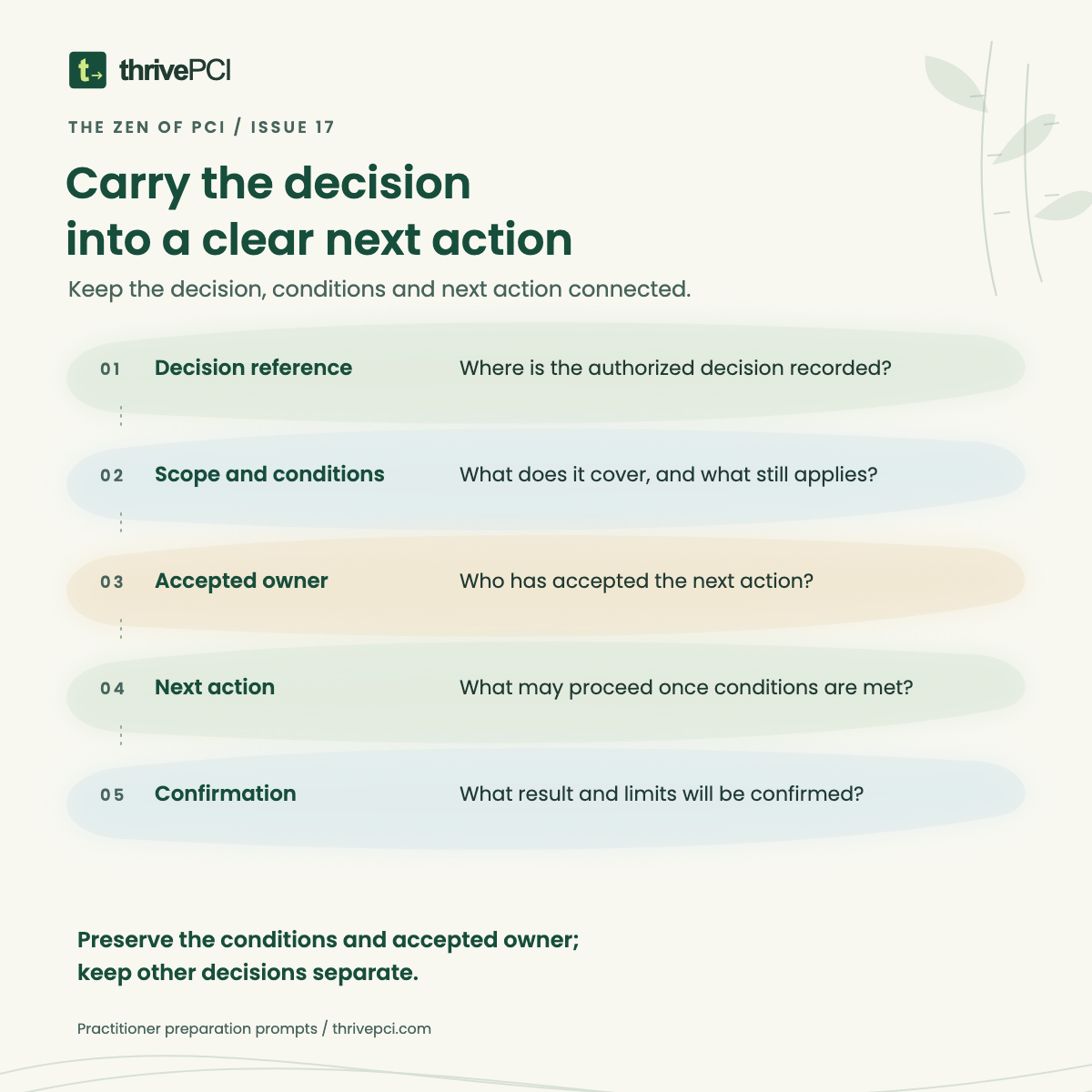
Five decision-to-action prompts: Decision reference, Scope and conditions, Accepted owner, Next action, and Confirmation. Receipt does not establish acceptance, and a conditional decision does not establish satisfied prerequisites.
Practitioner handover prompts; confirm acceptance and conditions before proceeding beyond the supported position. Download PNG · Download SVG

Use five prompts to carry the decision into a clear, bounded next step:

Decision reference: Identify the approved decision and its relevant version or other reference. Keep the underlying record in its authorized location. Share the reference and necessary context only with people permitted to receive them.

Scope and conditions: State what the decision permits, the boundaries of that permission, and the conditions that apply. Preserve any prerequisite, dependency, or unresolved question. A decision permitting the fictional trial under stated conditions does not establish that those conditions have been met.

Accepted owner: Confirm who has accepted the next action and has the appropriate responsibility and authority to carry it out. Identify contributions or decisions still assigned elsewhere. A copied recipient, acknowledgement, or name in a note does not establish acceptance.

Next action: Describe the specific work the owner has agreed to take forward, using the normal work record. Make any step that must happen first explicit. Where a condition is unconfirmed, preserve that position and use the appropriate clarification or escalation route before proceeding beyond what is authorized.

Confirmation: Agree what will establish the supported next position and where that confirmation belongs. Distinguish assignment, action taken, and the result of a check. Keep the scope and limitations of the confirmation visible so another participant can understand what remains open.

The note helps people coordinate. It does not replace a decision record, approval, change procedure, evidence-handling rule, or required operational record. It changes no obligation, deadline, or prescribed activity interval. Applicable urgent response processes still take precedence; do not delay required action to complete a coordination note.

Keep the action within the decision

In the fictional trial, the receiving owner can compare the proposed next action with the decision's scope and conditions. If a participant or condition differs, the earlier decision may not answer the new question. Use the established route to confirm the supported position instead of silently treating the difference as covered.

When work proceeds through the proper process, record what actually happened and what the confirmation supports. A completed scheduling task does not demonstrate a successful trial. A successful placeholder example does not establish permission for live integration or a wider rollout.

Try a small decision-to-action handover

Use the invented conditional trial decision and role placeholders. Write one note with the five prompts. Leave one prerequisite visibly unconfirmed. Ask a partner to identify the accepted next action, what must be confirmed first, and which decision remains outside the note's scope.

Revise phrases that imply assumed acceptance, satisfied conditions, or broader authorization. Use no real evidence. This optional practice creates no PCI interval and promises no assessment outcome.

A useful decision-to-action handover leaves someone able to continue the right work, within the right boundaries, with an honest way to confirm what follows.

Explore the free Program Maintenance guide (opens in a new tab)

LINKEDIN POST

Carry the decision into the right next action

Suggested companion: download the matching PNG.

A useful decision can leave important conditions to confirm before work moves.

Issue seventeen of The Zen of PCI connects five prompts: Decision reference, Scope and conditions, Accepted owner, Next action, and Confirmation.

In our fictional example, suppose an authorized owner records permission for a limited placeholder wording trial only if its stated conditions are met. That invented decision does not settle contributor capacity, establish that prerequisites are satisfied, or authorize a live integration.

Read the approved reference, confirm the accepted next action, and preserve what remains unresolved through the normal process.

Which condition would another person need to see before carrying your next decision into work? Keep receipt, acceptance, permission, action, and the result of a check distinct.

Explore the free Program Maintenance guide (opens in a new tab)

LINKEDIN POST

Keep the conditions attached to the decision

A short decision summary can accidentally lose the part that matters most.

What activity is permitted? Which version, participants, environment, or period does it cover? What must be confirmed before the next step may proceed?

In our fictional placeholder trial, a conditional decision does not establish that the conditions are satisfied. It also leaves the live integration decision pending and contributor commitments with their appropriate owner.

Use the approved reference through the normal access route. If its wording does not resolve the question, seek clarification from the authorized role. Do not extend permission to make scheduling easier.

Which boundary or prerequisite would make your next action handover more accurate for the receiving person?

Explore the free Program Maintenance guide (opens in a new tab)

LINKEDIN POST

Confirm the person who accepts the next action

A decision has arrived. Who has accepted the work that follows?

Being copied on the decision, acknowledging it, and accepting a specific action are different positions. A name on an action list does not establish capacity, agreement, responsibility, or authority.

Confirm the receiving person's accepted next action through the normal process. Keep other contributions and decisions assigned to their appropriate roles. Preserve a proposed owner as proposed until acceptance is established.

Then connect the action to the decision's scope and applicable conditions. Acceptance does not by itself satisfy a prerequisite or authorize work beyond the decision.

What would help your next handover show both an accepted action and the boundary within which it can proceed?

Explore the free Program Maintenance guide (opens in a new tab)

LINKEDIN POST

Confirm what the next step actually establishes

A completed task can change the position without answering every question.

In our fictional example, arranging a placeholder session does not establish that the trial succeeded. A successful example would still have a limited scope. It would not authorize a live integration or wider rollout.

Agree what confirmation is needed, where its record belongs, and which limits remain. Distinguish an assigned action, work performed, and the result of an appropriate check.

If the actual work differs from the decision's conditions, use the established clarification or escalation route. Avoid silently expanding the earlier permission.

Which part of your next completion update would help a reader understand what happened and what remains unconfirmed?

Explore the free Program Maintenance guide (opens in a new tab)

LINKEDIN POST

Try a fictional decision-to-action handover

Suggested companion: download the matching PNG.

Use an invented conditional decision about a limited placeholder wording trial. Keep real evidence out.

Write five prompts: Decision reference, Scope and conditions, Accepted owner, Next action, and Confirmation. Leave one prerequisite visibly unconfirmed and keep the live integration decision pending.

Ask a partner to identify the accepted action, its authorized scope, and what must be established before proceeding. Add an acknowledgement that confirms receipt without accepting the action. Does the note preserve that difference?

Revise unsupported implications of ownership, satisfied conditions, or wider permission. Keep the proper approval and operating routes visible.

This optional practice creates no PCI interval or assessment outcome. It never replaces required records or delays prescribed urgent action.

Explore the free Program Maintenance guide (opens in a new tab)

LINKEDIN POST

Make the decision easier to carry into everyday work

An authorized decision becomes easier to continue when its reference, scope, conditions, accepted owner, next action, and confirmation remain understandable.

The free Program Maintenance guide offers a starting point for considering the continuing work behind preparation. The thrivePCI pilot page includes a free sample and a request-details route for people exploring further training.

Practice with invented decisions and placeholder records. Keep evidence in its authorized location, preserve applicable approvals and obligations, and confirm what each next action actually establishes. A receipt or completed task does not automatically demonstrate a wider result.

Requesting details records interest without placing an order or enrolling you. Training promises no compliance or assessment outcome.

What would make your next decision handover easier to continue accurately?

Try the free sample or request pilot details (opens in a new tab)

Scott’s publication review

The campaign links include UTM labels for later reporting; this release adds no visitor tracking. Source copy and editorial notes are versioned in GitHub.

Download the complete newsletter and post copy

Download copy and visual review pack (ZIP)