
NEWSLETTER · ISSUE 08
When two records tell different stories
Two records can look inconsistent while describing different moments, different parts of the work, or different meanings of a status label. They can also reveal a real error or unresolved question. Preparation improves when someone makes that distinction visible and connects it to an appropriate owner.
Start with the records as they are. Identify the apparent difference, check the context, and ask what would support an explanation another person can follow.
Continue the fictional supplier-access example
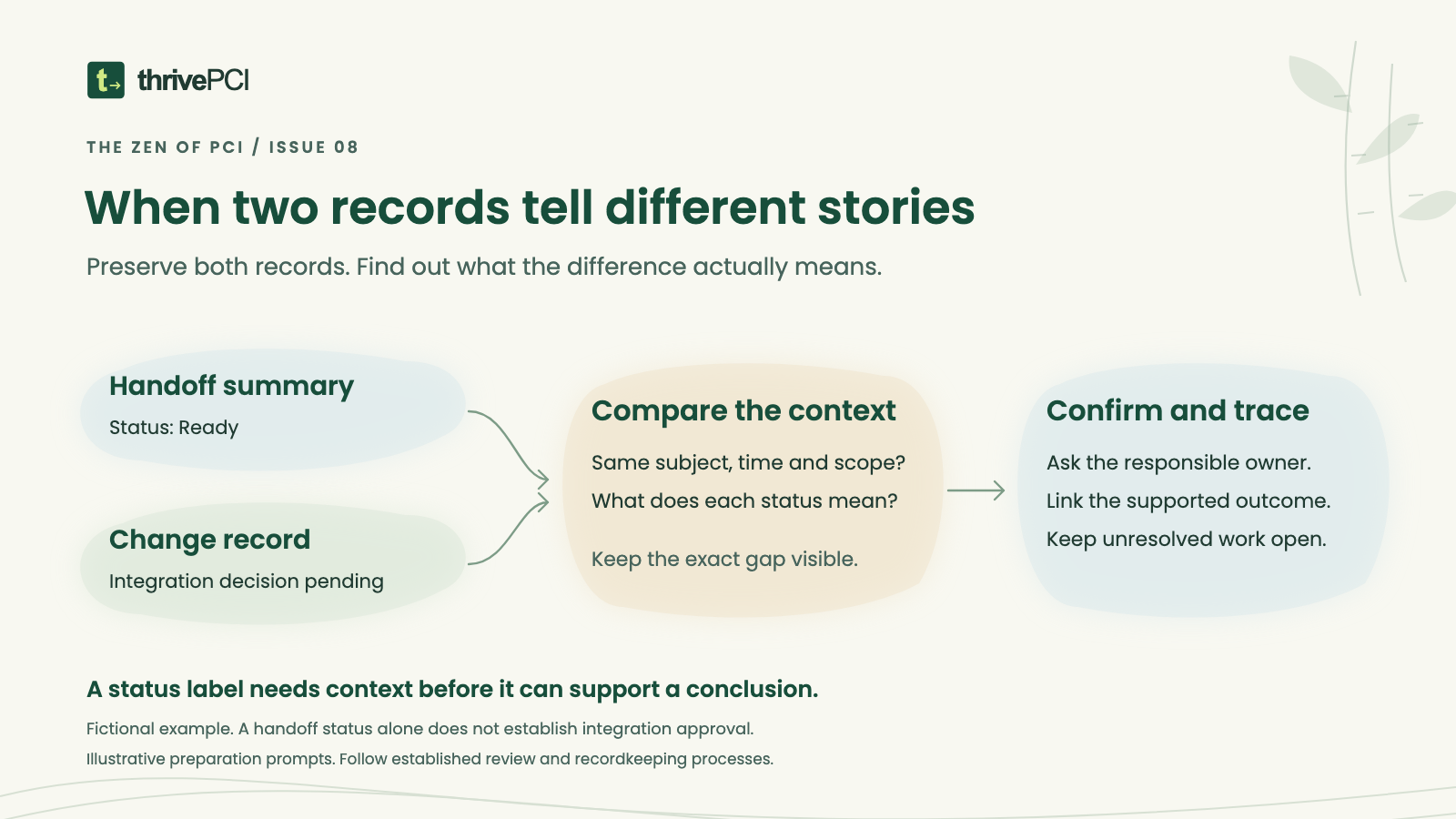
The covering colleague from issue seven opens a preparation handoff marked “ready.” The approved change record for the proposed supplier integration still shows a pending decision. A recipient asks whether the integration has been approved.
The colleague has two references and an important uncertainty. “Ready” might mean the preparation update is complete, while the integration decision remains open. It might also be an inaccurate summary. The word alone cannot settle the question.
The colleague retains both references and asks the responsible owners what each status describes. Coordination completion and technical approval need separate explanations, even when they appear in the same handoff.
Check whether the records describe the same thing
Compare the subject, the time represented, the coverage, and the meaning of each status. Are both records about the same integration, environment, and action? Does one describe a proposal while the other describes a completed preparation task? Were they created before and after a relevant event?
A newer timestamp is useful context, but it does not establish that every statement in a record is correct. A dashboard label or a senior author’s name does not resolve the difference by itself either.
Write the comparison in terms a source owner can confirm. Keep sensitive details in approved systems and use references appropriate to the people involved. Preserve earlier versions through the organization’s normal recordkeeping process.
Name the exact difference
Replace “the records disagree” with a question that can be answered. In the fictional case: “Does ‘ready’ refer to completion of the preparation handoff, and what record confirms whether the integration decision has been made?”
Ask the source owners for the relevant context and supporting records. Where a decision requires authorization, seek confirmation from the role responsible for that decision. A preparation coordinator can organize the comparison without acquiring authority to approve the integration.
If the information is unavailable, keep the question open with an owner, a next step, and a return point. Follow established escalation and risk processes when the circumstances require them. Avoid treating the easiest record to find as the answer.
Leave a reconciliation note people can use
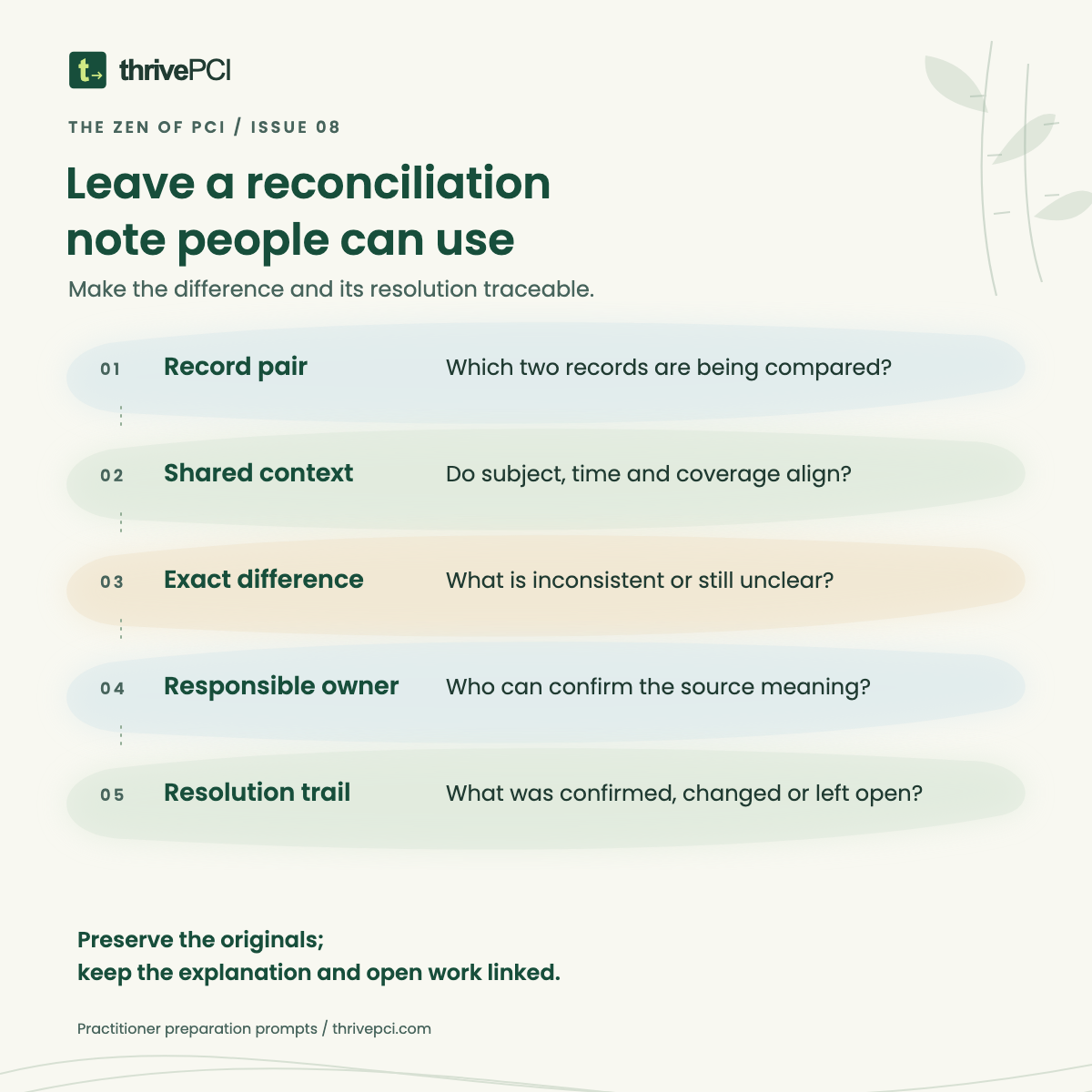
Try five prompts: Record pair, Shared context, Exact difference, Responsible owner, and Resolution trail.
For the fictional integration, a note could say: “The handoff summary says ‘ready’; the change record shows the integration decision pending. Confirm whether the summary describes coordination completion only. The service owner will confirm the decision status through the established process. Retain both references and link the resulting explanation or correction.”
The note records the question and its route. It does not declare either record definitive before the relevant facts and authority have been checked.
Keep the resolution traceable
The source owners may confirm that both records are accurate within different coverage. Record that explanation and its supporting references so the next reader can understand the labels.
If a correction is needed, use the authorized recordkeeping process. Retain the reason, supporting information, responsible role, and connection to the earlier version as appropriate. Do not silently rewrite the original or backdate a status to make the sequence look simpler.
An unresolved difference should remain visible. Explain what is supported, what is still uncertain, and who owns the next check. A tidy summary is useful only when a reader can trace the explanation behind it.
Try a five-minute record comparison
Create two fictional records with placeholder identifiers. In one version, let them describe the same action at the same time with different statuses. In another, let one describe a preparation update and the other an integration decision.
Use the five prompts with a colleague. Ask which context distinguishes the cases, what confirmation is needed, and where the resolution trail would live. Keep missing facts visible rather than inventing agreement.
These are practitioner preparation prompts. Applicable PCI requirements, prescribed activities and intervals, authorized processes, and assessment context still govern the underlying work. A reconciliation note does not establish compliance or determine an assessment outcome.
The free thrivePCI Assessment Handover guide offers a place to practice an explanation that another person can check.
Practice with the free Assessment Handover guide (opens in a new tab)