
NEWSLETTER · ISSUE 32
What can your MIDs and TIDs reveal about your payment channels?
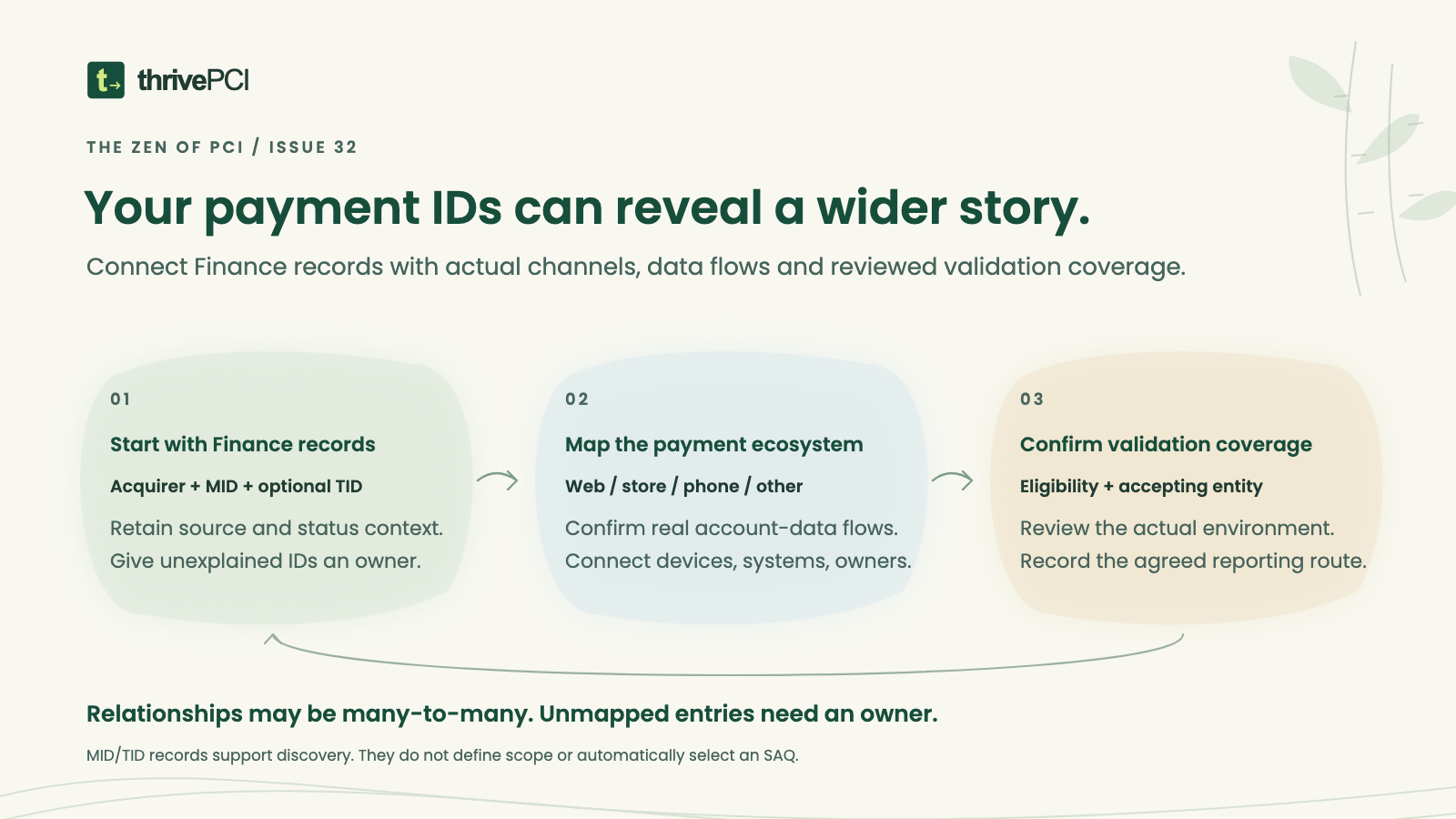
Your Finance team may already hold a useful starting point for your PCI DSS program: the Merchant IDs (MIDs) and Terminal IDs (TIDs) associated with your acquiring and processing arrangements. Have you brought those records into the conversation about how your business accepts payments?
An identifier can connect a financial relationship with a checkout, a location, a provider, and the people who operate it. Reconciling those connections can reveal an overlooked channel, an old arrangement still awaiting closure, or a validation question that needs an owner.
Start a conversation across teams
Ask Finance for the available inventories from each acquirer or processor, with the provider context, source date, and status information they can supply. Confirm what each field means in that arrangement. Access and completeness vary; one export should not be assumed to represent every payment activity.
Bring Operations, IT, and the PCI program owner into the review. Compare financial records with locations, websites, applications, provider agreements, device inventories, and existing data-flow diagrams. Build a Payment Channel Ecosystem that connects the business view with the actual operating environment.
Leave a payment channel map people can use
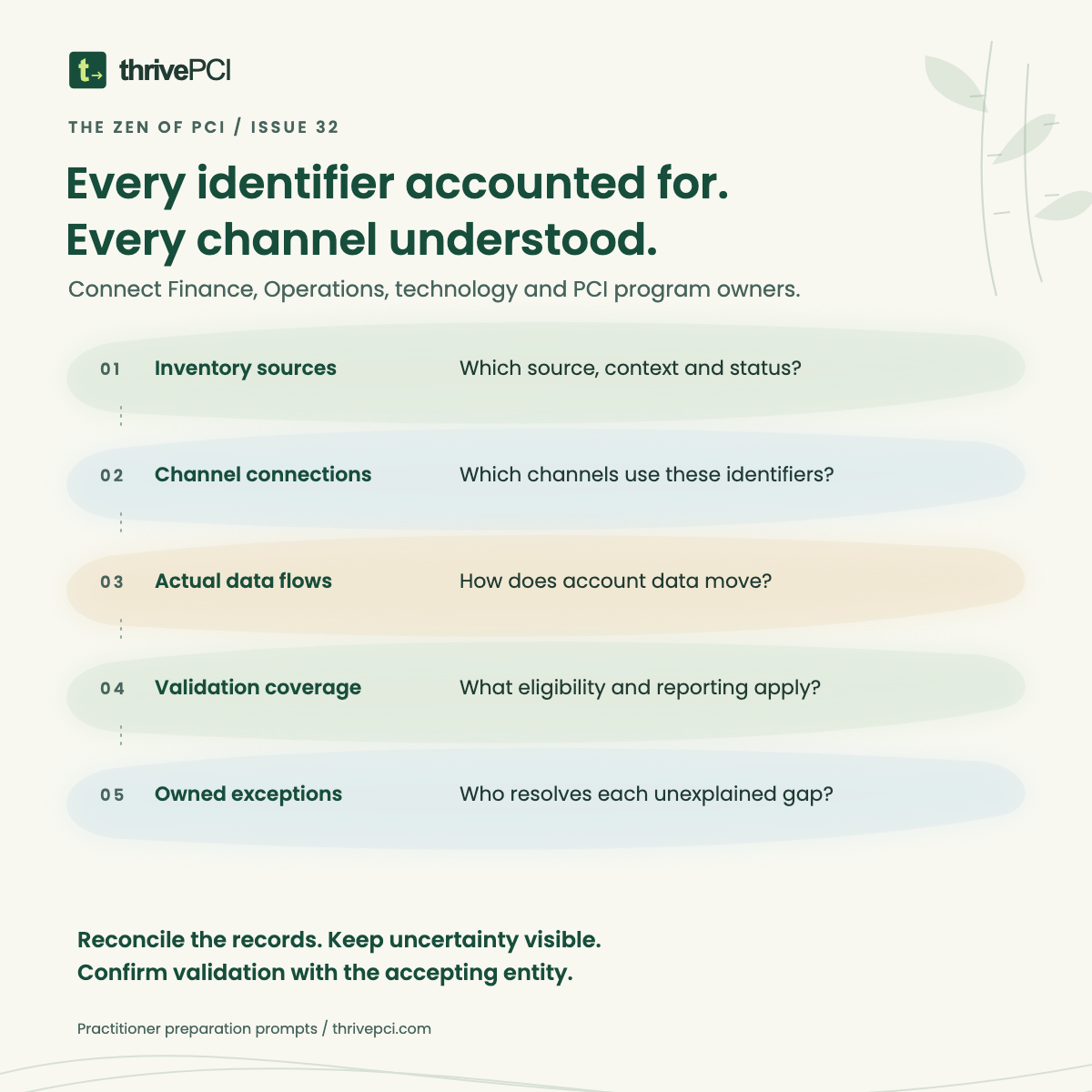
Use five prompts to turn a list of identifiers into useful questions and accountable coverage:
Inventory sources: Preserve where each record came from, when it was obtained, and who can explain it. Keep the acquiring or processing context alongside an ID, rather than assuming the number is globally unique. Distinguish active, retired, and unresolved records. A retirement label needs enough supporting context to explain what happened to the associated service or device.
Channel connections: Link MIDs and TIDs to the relevant payment arrangements, locations or digital services, and accepted business owners. Allow the relationships you actually find: several identifiers may support one channel, and one identifier may appear across more than one arrangement. An online channel may have no TID. A TID is not automatically the physical device's serial number.
Actual data flows: Confirm how customers enter account data, which systems and providers receive it, where it is retained, and what can affect its security. Include the surrounding operating processes, such as telephone orders and refunds. Reconcile the map with technical diagrams and inventories. Financial identifiers offer discovery clues; they do not establish the cardholder data environment boundary or replace the full inventory of in-scope components.
Validation coverage: Connect each understood environment with its proposed validation route, the evidence supporting eligibility, and the party confirming the reporting method. Avoid selecting an SAQ from a MID or terminal label alone. Record what the eventual submission covers, and keep unconfirmed choices visibly provisional. Some merchants may need a Report on Compliance rather than an SAQ.
Owned exceptions: Give every unexplained identifier, unmapped channel, disputed relationship, and missing eligibility answer an accepted owner and next action. Include a review point suited to the work. Confidence grows when every record has a supported explanation or a visible unresolved question, rather than an optimistic allocation.
Follow the unexpected record
Imagine a fictional retailer with a shop, a website, and occasional telephone orders. Finance's export contains an unfamiliar MID associated with an earlier pop-up. Operations believes the pop-up closed, while the program map shows only the shop and website.
The team preserves the record as unresolved. Finance checks the acquiring arrangement; Operations confirms how the pop-up accepted payments; IT compares the associated devices and connections with existing records. They establish whether the service remains available, has been retired, or needs further investigation. They also examine how telephone orders are actually handled. Neither item disappears because it does not fit the first diagram.
For a practice exercise, use invented identifiers and a fictional provider. Leave one MID unexplained and one digital channel without a TID. Ask a partner to trace each record to an environment or an owned exception, then explain what evidence would support the next decision. Keep real merchant records and account data out of public examples.
Confirm the reporting arrangement
PCI SSC guidance allows for combined or separate SAQ reporting in suitable circumstances. Separate channel SAQs depend on the applicable eligibility criteria and adequate network segmentation; each covered environment must be described in the Attestation of Compliance. The acquirer or other compliance-accepting entity confirms the validation and reporting method.
The benefit is a clearer conversation: Finance can explain the commercial records, Operations can identify the payment activity, and technical owners can confirm the environment. Together, they can challenge gaps before reporting season and revisit the map when arrangements change. A completed map supports preparation; it does not itself demonstrate compliance.
Explore the free Provider Responsibilities guide (opens in a new tab)