
NEWSLETTER · ISSUE 29
Testing the payment integration before going live
A payment integration can show a reassuring success page while leaving an important handoff untested. What happens when the customer cancels, a payment is unsuccessful, or a notification arrives later than expected? Testing gives those questions a controlled place to produce useful answers before release.
Begin with a bounded purpose: establish how the proposed arrangement behaves under the scenarios your business needs to handle. A working demonstration is valuable, but the team also needs observable results, owned defects, and a separate decision about going live.
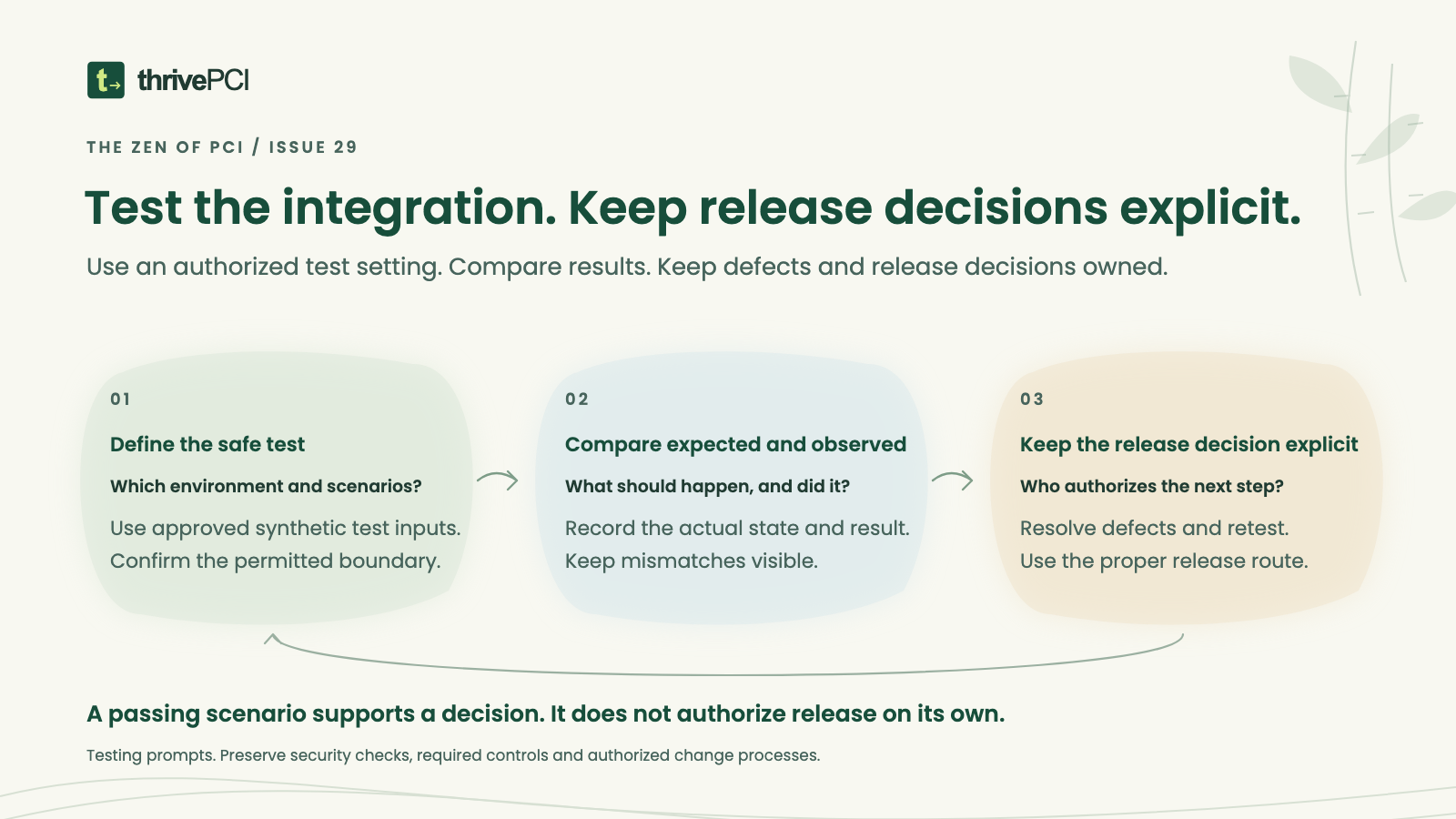
Define the safe test
Our fictional subscription startup has configured its provider and developer handoff in a test setting. The team now wants to check the intended payment journey and notification route. It follows the provider's documented testing instructions and confirms the environment, permissions, tools, and synthetic data before anyone begins.
Keep test activity within that authorized boundary. Use provider-approved test facilities and synthetic details for the exercise, with notifications directed to designated test recipients. Do not introduce real customer records, card details, live charges, or messages to real customers simply to make the practice feel realistic.
Leave an integration test note people can use
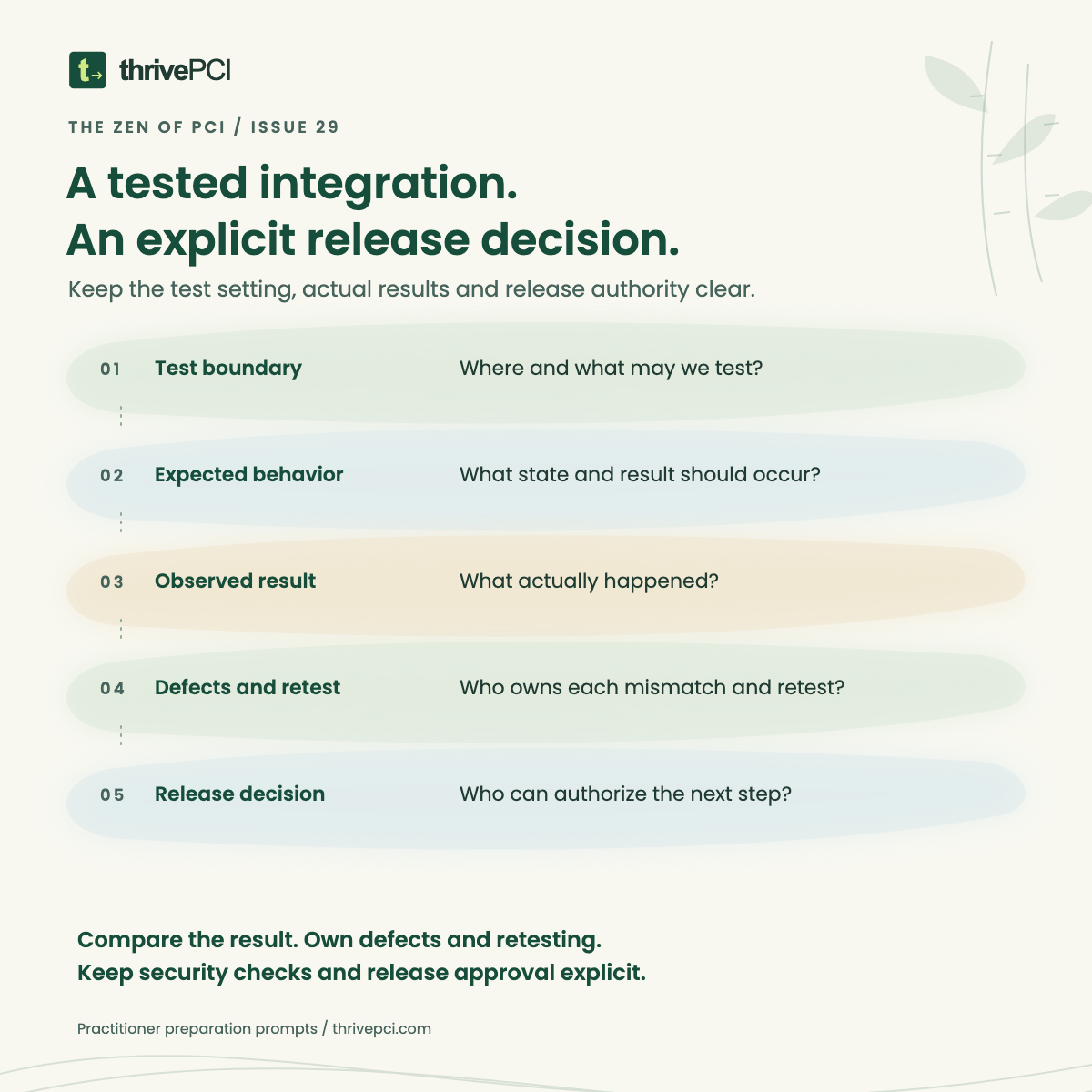
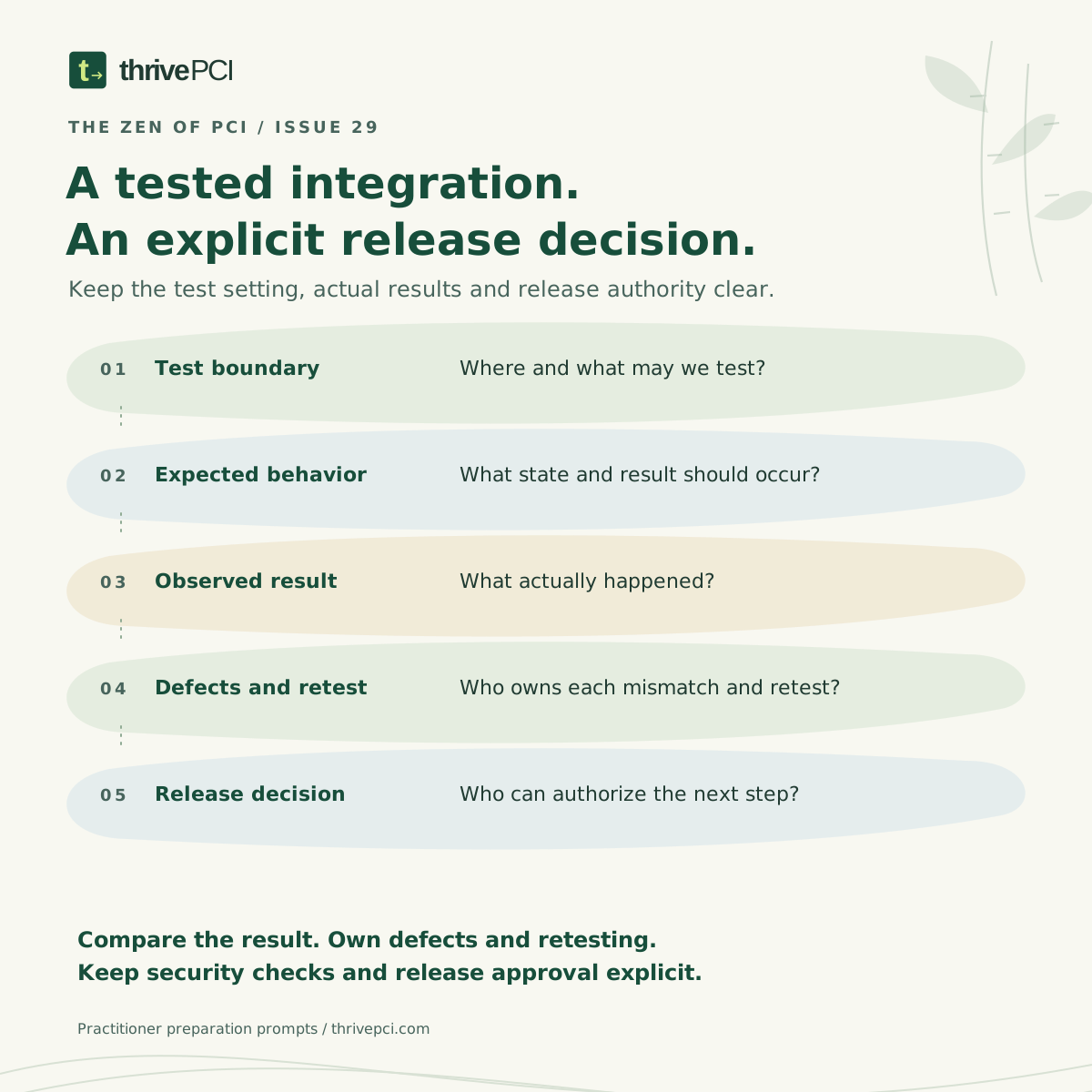
Use five prompts to connect a scenario with its result and the decision that follows:
Test boundary: Name the service, integration version, authorized environment, people, and test tools involved. Record what is included and what remains outside the exercise. Confirm the provider and business responsibilities for each part. A test plan gives people context; it does not grant access or permission to test a live service.
Expected behavior: Describe the starting condition, the action, and what should happen afterward. Include the payment state, order or subscription state, customer-facing response, and relevant notification or record. Follow the provider's documented integration and trusted confirmation route. A browser returning to a success page should not by itself be treated as confirmation that the business can act on a completed payment.
Observed result: Record what actually happened and compare it with the expectation. Identify the scenario, relevant version, observation, and appropriate reviewer without putting secrets or sensitive payment information into the note. If one part was not observed, say so. A checked box should not stand in for the behavior the team intended to establish.
Defects and retest: Give each mismatch an accepted owner, explain its impact, and identify which decision depends on resolving it. After an authorized correction, repeat the affected scenario and relevant related paths. Retain enough context to distinguish the original result from the retest. An unexplained discrepancy should remain visible rather than disappearing beneath an overall passed label.
Release decision: Keep the test result separate from authority to release. Identify who can make the decision, the evidence they need, unresolved issues, and the conditions that must be met. Record which conditions are met, which need correction, and which need further authorized review. Keep applicable controls and approvals in force. Passing a functional scenario does not authorize production use or establish PCI DSS compliance.
Compare expected and observed
Start with the intended successful journey and the unsuccessful or cancelled paths relevant to the arrangement. Where supported, use the provider's test facilities to examine delayed, repeated, or failed notifications and applicable refund or subscription behavior. These are practitioner scenario suggestions, not a universal PCI test list.
In the fictional exercise, a repeated synthetic notification produces an unexpected order update. The team records the mismatch, identifies who accepted its investigation, and leaves the affected release question open. The developer and provider contact use the documented route to clarify the behavior, then arrange the appropriate correction and retest.
Include the security work that applies to the change. PCI DSS v4.0.1 addresses production change procedures, authorized approval, testing for adverse security impact, and handling failures while returning to a secure state. A functional payment check does not replace applicable security testing, assessment activities, or provider oversight.
Keep the release decision explicit
Review the results with the people responsible for implementation and operation. Confirm the production configuration through the approved process, monitoring and response ownership, and what happens if the change fails. Apply the required removal of test data and test accounts from system components before those components go into production.
Practice with an invented checkout and synthetic messages. Leave one scenario unresolved, then ask a partner to explain the observed result, who owns the retest, and which release decision remains open. No real payment activity is needed.
PCI SSC identifies compliance-accepting entities as determining validation and reporting methods. Confirm that route separately. A useful pre-launch test leaves the team with clearer evidence of behavior and an honest, owned decision about what happens next.
Explore the free Provider Responsibilities guide (opens in a new tab)