
NEWSLETTER · ISSUE 26
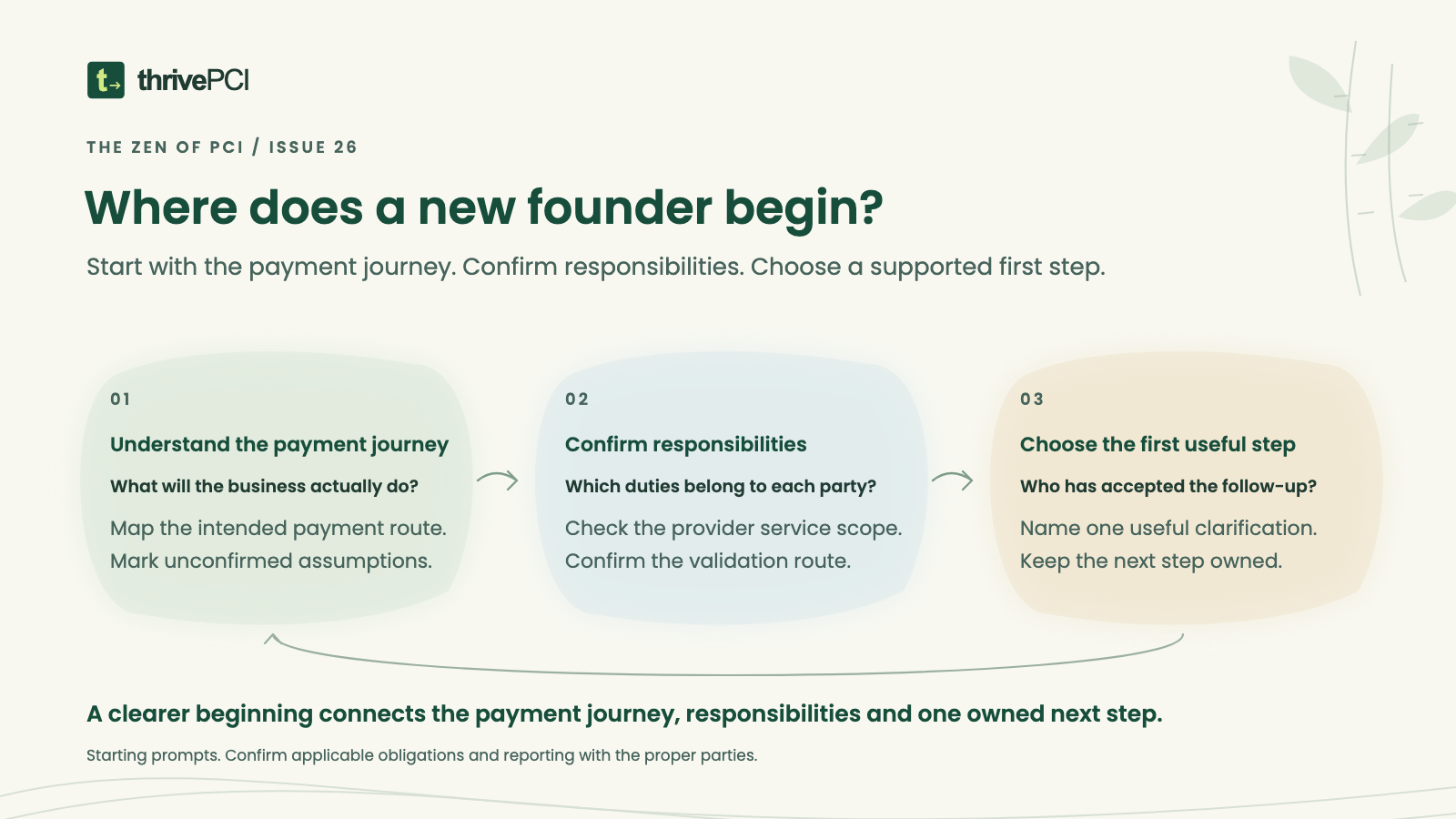
Where does a new founder or startup begin?
A founder can have a promising product, a payment provider selected, and very little clarity about where PCI preparation begins. The first useful move is to make the intended payment arrangement understandable enough to ask good questions and assign the work.
You do not need to reconstruct a large company's compliance program before having that first conversation. You do need an honest picture of the business you are building, the people involved, and the assumptions still waiting for confirmation.
Start with the business you intend to run
Our fictional startup plans to sell subscriptions using a provider-hosted checkout. Its founder expects the provider to handle payment entry. A developer will build the website, and a small support team will answer customer questions. The checkout choice is a starting assumption to examine alongside the actual integration and everyday workflows.
Sketch what a customer will do: reach the website, enter checkout, receive confirmation, and request help or a refund. Identify the systems and people touching those steps. Ask what information could appear in support messages, receipts, logs, and administration tools. Use invented examples while learning; keep payment details and real customer records out of the exercise.
Clarify the business's role, too. A company accepting payments for its own products and a company providing payment-related services to others can raise different questions. Confirm the relevant merchant, service-provider, or other roles with appropriate help rather than inferring them from the word startup.
Leave a founder starting note people can use
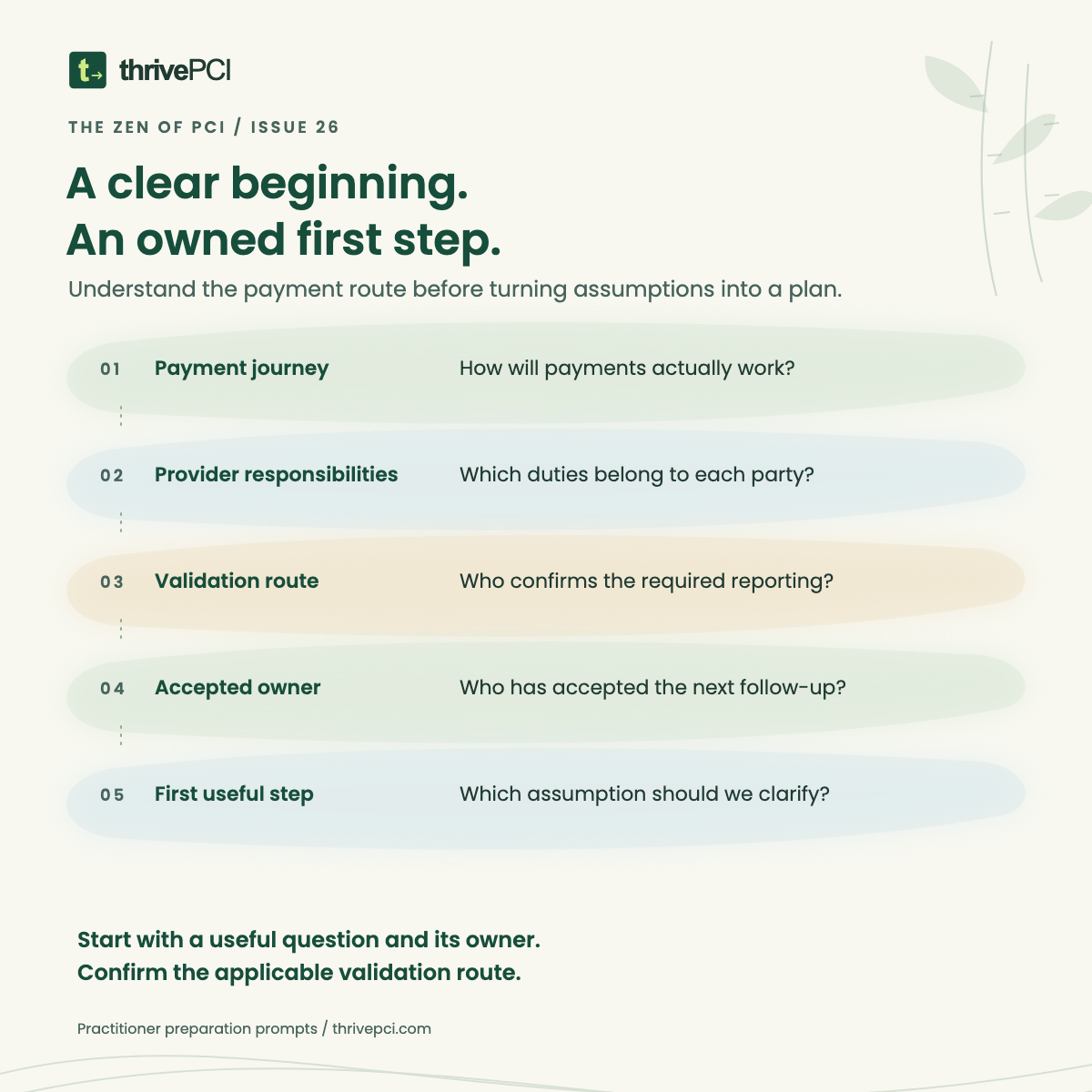
Use five prompts to turn an overwhelming subject into a useful first conversation:
Payment journey: Describe how the business intends to accept payments, the channels involved, and where the customer, provider, website, and support team interact. Mark what is planned, what has been implemented, and what remains unknown. This first sketch helps identify questions; it is not a completed scope determination or a substitute for the diagrams and documentation that may be required.
Provider responsibilities: Identify the services the provider will actually supply and the responsibilities your business will retain or share. Ask for the relevant compliance information and responsibilities for those services. PCI SSC explains that outsourcing payment processing does not remove a merchant's responsibility for protecting account data through its providers. A provider's badge alone cannot answer every question about your implementation.
Validation route: Ask the organization that accepts your compliance reporting what validation and reporting it requires for the actual arrangement. For merchants, that contact is commonly the acquirer, or merchant bank, or the relevant payment brand. PCI SSC identifies these compliance-accepting entities as determining validation and reporting methods. Do not select a particular self-assessment questionnaire merely because a provider's marketing page mentions it.
Accepted owner: Name someone who has accepted responsibility for coordinating the questions, obtaining answers, and keeping decisions visible. In a small business, the founder may initially take that role. Coordination does not make that person qualified to decide every technical question. Identify who can provide the expertise and authority needed for each unresolved matter.
First useful step: Choose a bounded action that resolves an important uncertainty. Our fictional founder could ask the provider to explain the proposed checkout integration and retained responsibilities, then confirm the reporting contact. Record the accepted action, expected answer, and appropriate follow-up. Keep unknowns visible instead of labeling the whole program complete.
Build understanding before collecting everything
A folder full of templates can feel productive while leaving basic questions unanswered. Begin with the questions that affect the design and operation of your payment arrangement. Gather the records needed to support those decisions through authorized routes. Avoid collecting sensitive information simply because a generic checklist has a box for it.
Small size is not an exemption from PCI DSS. PCI SSC states that the standard is intended for entities involved in payment processing regardless of size or transaction volume. What your business needs to validate and report must be confirmed for its circumstances.
Ask for qualified support when the arrangement or responsibilities are unclear. Describe the proposed business model and integration accurately so that advice addresses the business you intend to operate. Keep material design changes visible and return to affected questions when the plan changes.
Practice the first conversation
Use an invented subscription business and a blank page. Write the five prompts, sketch the intended journey, and leave one provider question unanswered. Ask a partner to explain what is known, who accepted the follow-up, and which answer would help the next decision.
These are preparation prompts, not the full set of applicable requirements or a compliance conclusion. Required controls, approvals, and deadlines still apply. A calm beginning is a clearer picture of the work and an owned route to the next reliable answer.
Explore the free Assessment Preparation path (opens in a new tab)