thrivePCISite v0.43.62+20261122T201000Z · Published November 22, 2026

SCOTT REVIEW · NEWSLETTER ISSUE 18

Share the lesson and keep its limits

One newsletter issue and 6 supporting posts. Two downloadable visuals illustrate the practice. These drafts promote the current free preparation resources and the request-details contact route. The copy buttons copy ready-to-edit text to your clipboard. Nothing here posts to LinkedIn.

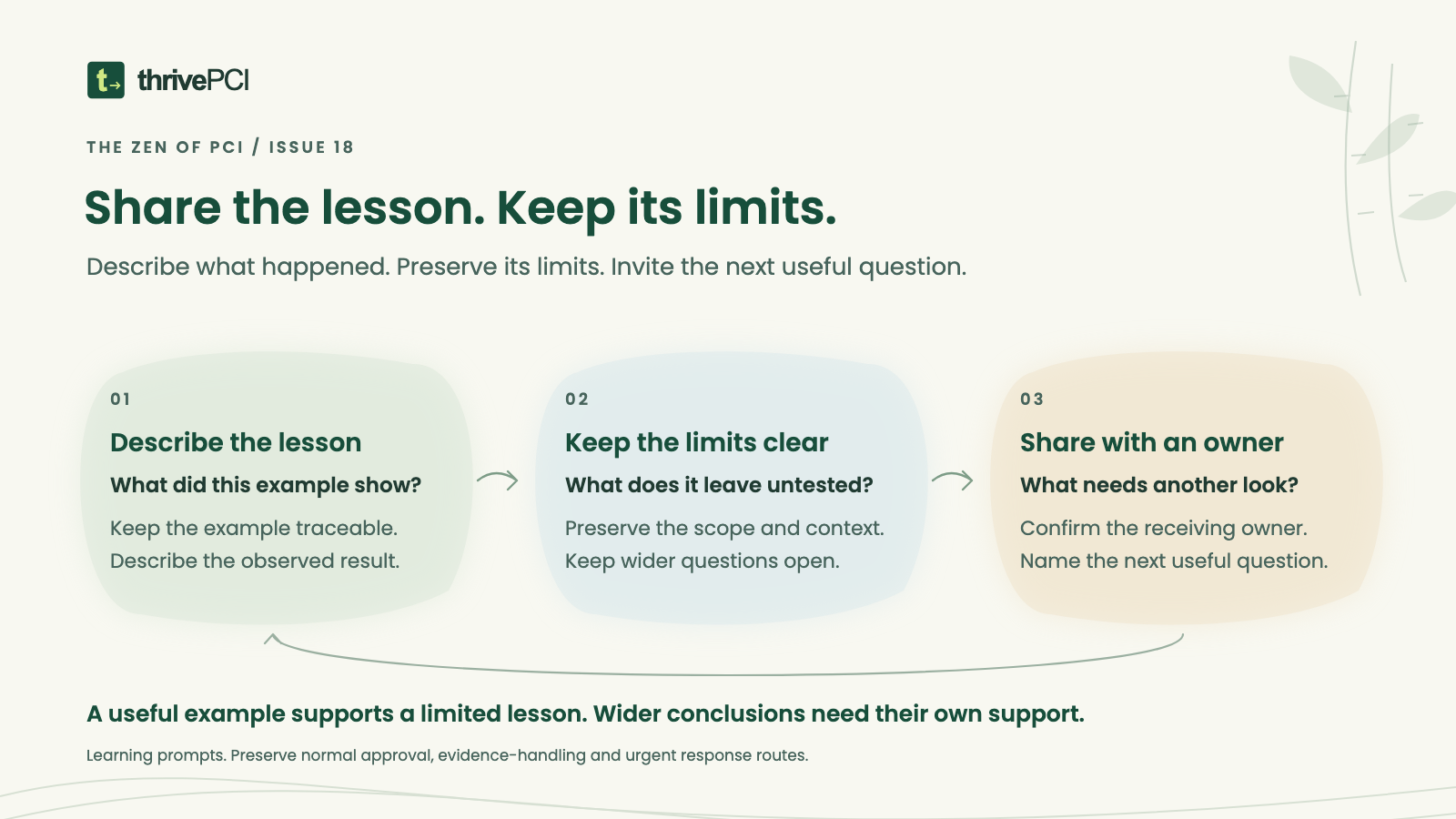
Three soft Forest Zen fields connect Describe the lesson, Keep the limits clear, and Share with an owner. A useful example supports a limited lesson; wider conclusions need their own support.
Share the useful observation with its example and limits so the next owner can judge relevance. Download PNG · Download SVG

Newsletter: The Zen of PCI

Practical PCI preparation for the people who own the work: responsibilities, evidence, timing, and habits that last.

Suggested sequence: Supporting posts form a suggested editorial sequence; publication dates are set by Scott.

Suggested T+ release plan

T+0 = actual publication day for issue eighteen. Offsets below use calendar days. Set T+0 only when the issue is ready for publication.

OffsetContentSuggested purpose
T+0Newsletter: Share the lesson and keep its limits
Post: Share the lesson and keep its limits
Publish issue eighteen and introduce the five prompts for sharing useful lessons with their limits.
T+2Post: Begin with the observationDistinguish a concrete observation from its proposed explanation.
T+5Post: Keep the example attached to the lessonKeep the supporting example and relevant limits attached to the lesson.
T+8Post: Give the lesson an accepted receiving ownerConfirm accepted consideration and an appropriate next question.
T+12Post: Practice a learning note with a fictional exampleInvite a fictional paired learning-note exercise without using real evidence.
T+16Post: Make useful preparation lessons easier to shareConnect the practice to the free guide and request-details route.

Scott may adjust offsets for editorial readiness and audience conversation. These are publication suggestions, not PCI control intervals, engagement deadlines or claims about platform algorithm performance.

Download T+ plan · Download CSV

NEWSLETTER · ISSUE 18

Share the lesson and keep its limits

A useful lesson becomes more valuable when another person can understand where it came from and where it stops. The aim is to make a specific observation available for better work without turning it into a promise that every similar situation will behave the same way.

Preparation produces these moments constantly. A revised explanation helps someone find the right record. A clearer handoff reveals a question earlier. A small trial suggests wording that another team might find useful. Sharing the lesson can save effort, provided its example and limits travel with it.

In our fictional supplier-integration exercise, suppose the limited placeholder wording trial proceeds only after its own recorded conditions are confirmed through the proper process. For this invented example, one receiving participant can identify the next question from the revised wording. That narrow observation gives the team something useful to discuss.

It does not settle the separate contributor-capacity question or the pending live integration decision. The example uses placeholders, a particular participant, and a defined situation. Those details are part of the lesson, because they help the next person judge how it relates to their own work.

Start with what happened

Write the observation before writing the recommendation. In the fictional trial, the participant identified a next question from the revised wording. That is a clearer account than saying the handoff is now reliable or the integration is ready. A reader can understand the specific result and ask an appropriate follow-up.

Then separate the observation from your interpretation. Perhaps the explicit question label helped. Perhaps the participant already understood the context. The example alone may not establish which factor made the difference. Preserve a useful possibility as a possibility, then identify what could help the receiving owner consider it.

A lesson can be small and still be worth sharing. Its value comes from helping someone take an informed next step, with the original context available through the right route.

Leave a learning note people can use
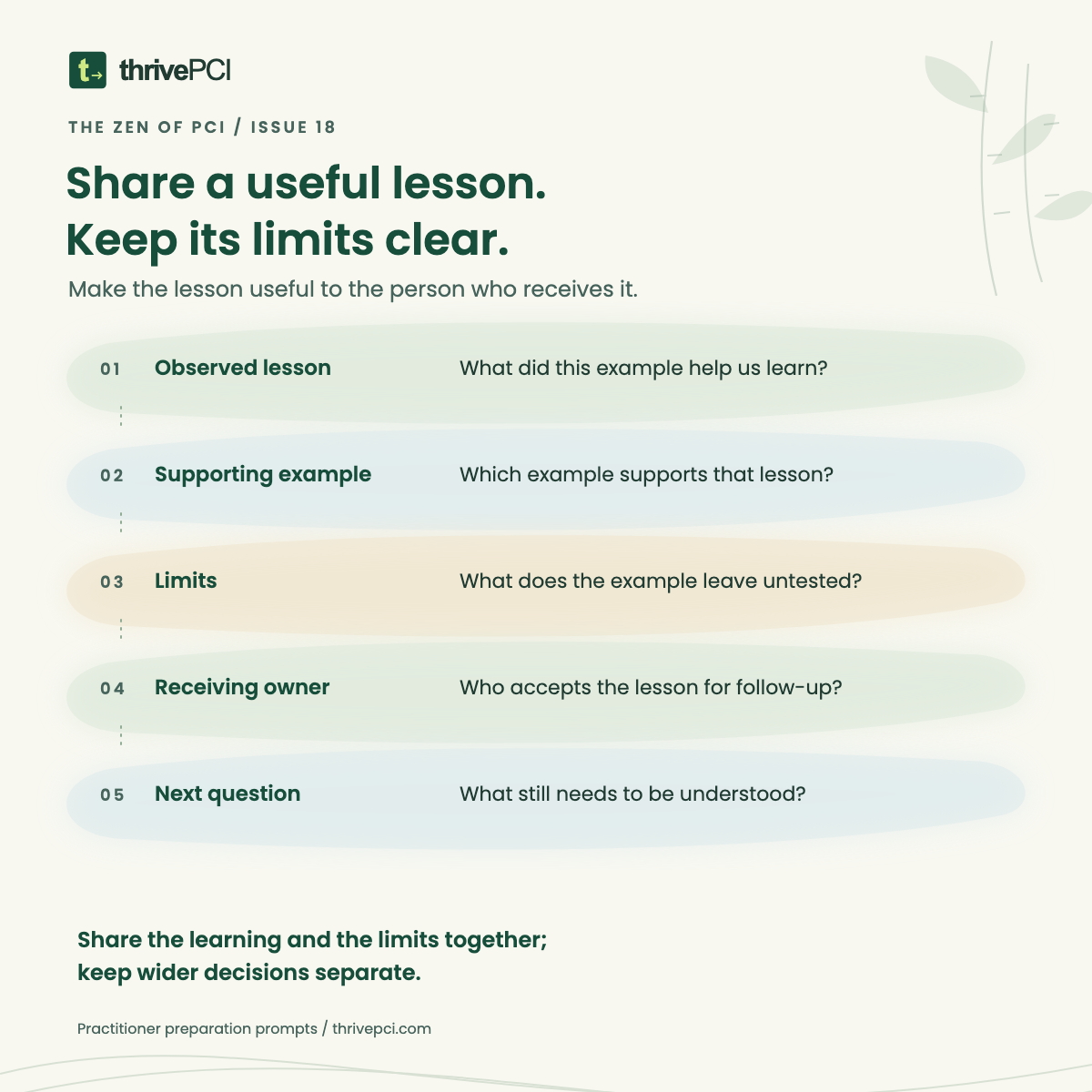
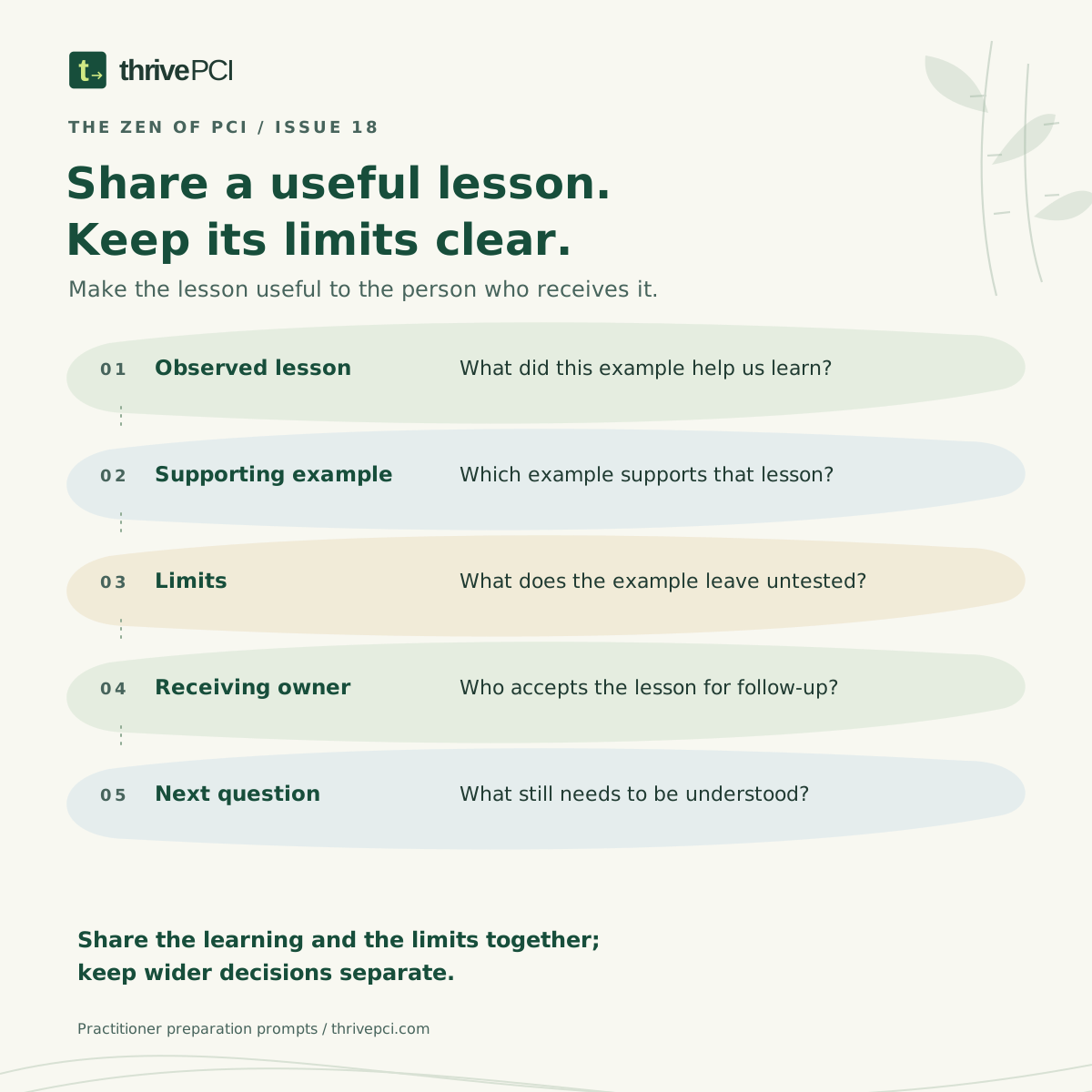
Five learning-note prompts: Observed lesson, Supporting example, Limits, Receiving owner, and Next question. Keep the observation distinct from interpretation and confirm accepted consideration through the normal route.
Practitioner learning prompts; preserve the scope of the observation and confirm the receiving owner and next question. Download PNG · Download SVG

Use five prompts to carry the useful part of the experience forward:

Observed lesson: Describe what was noticed in the specific situation. Keep the account concrete enough that another person can distinguish an observed result from a proposed explanation. Avoid broad words such as reliable, complete, or proven when the example supports a narrower statement.

Supporting example: Identify the relevant example and its authorized reference. Include the version, participants, environment, or represented period needed to understand it. Keep underlying evidence in its approved location, and share only the context the receiving person is permitted to use.

Limits: State what the example did not address and which conditions mattered. In the fictional trial, placeholder wording and one participant do not represent all users, production conditions, or continuing operation. A good description lets the reader see both the useful observation and the questions it leaves open.

Receiving owner: Confirm who has accepted consideration of the lesson within their responsibility. Receiving an idea does not automatically accept an implementation task or grant approval for a change. Keep those separate positions visible so a helpful suggestion does not quietly become someone else's commitment.

Next question: Agree what the owner needs to understand next and where that discussion belongs. They might compare existing guidance, ask the original participant for context, or propose a further check through the normal process. The next question should follow from the lesson's actual limits.

These prompts support coordination alongside the records and procedures that already govern the work. Keep approval, change, evidence handling, assessment, and urgent response routes intact. A learning note creates no PCI activity interval, changes no obligation or deadline, and should never delay required action.

Let the next person judge its relevance

The receiving owner may find the lesson useful while choosing a different response. Their setting could involve different participants, information, or constraints. Ask what carries across and what needs to be understood locally before proposing a change.

In the fictional example, another team could consider whether an explicit next-question label would help its own handoff. That consideration does not authorize a live integration or wider rollout. If a change is proposed, its owner uses the applicable approval route and preserves the supporting record.

Try sharing one bounded lesson

Use the invented placeholder trial and role names. Write a short learning note with the five prompts. Ask a partner to restate the observation, identify a limit, and name the receiving owner's next question. Use no real evidence or sensitive details.

Revise any phrase that makes the example sound broader than it is. A useful lesson leaves another person better informed, able to find the right context, and ready to consider the next question with care.

Explore the free Program Maintenance guide (opens in a new tab)

LINKEDIN POST

Share the lesson and keep its limits

Suggested companion: download the matching PNG.

A small preparation lesson can help another person when its example and limits remain easy to understand.

Issue eighteen of The Zen of PCI follows five prompts: Observed lesson, Supporting example, Limits, Receiving owner, and Next question.

In our fictional placeholder wording trial, suppose one participant identifies the next question from the revised wording. That invented observation can inform a conversation without establishing that every handoff will work the same way.

Keep the separate contributor-capacity question and pending live integration decision visible. Confirm who has accepted consideration of the lesson, then agree what they need to understand next.

What would help someone receiving your next lesson see both its useful part and the boundary of its example?

Explore the free Program Maintenance guide (opens in a new tab)

LINKEDIN POST

Begin with the observation

Before recommending a change, write what someone actually observed.

In a fictional placeholder trial, one participant identifies a next question from revised wording. That account gives the next reader a specific result to consider. Calling the whole handoff reliable would reach beyond this example.

The reason for the result may still be uncertain. An explicit label might help; the participant's existing knowledge could also matter. Keep a proposed explanation distinct from the observation.

Then give the receiving owner a useful question: what would help them understand the result in their own setting?

Which word in your next lesson could become more accurate if you replaced it with a concrete description of what happened?

Explore the free Program Maintenance guide (opens in a new tab)

LINKEDIN POST

Keep the example attached to the lesson

A lesson travels better when its example travels with it.

Identify the relevant version, participants, environment, or period through an authorized reference. Include the context the receiving person needs and is permitted to use. Keep underlying evidence in its approved location.

Then preserve the limits. A placeholder trial with one participant does not represent all users, live conditions, or continuing operation. Those boundaries help another owner judge relevance and frame a sensible next question.

In our fictional example, contributor capacity and the live integration decision remain separate pending matters.

What detail would stop someone from reading your next lesson as a broader result than its supporting example establishes?

Explore the free Program Maintenance guide (opens in a new tab)

LINKEDIN POST

Give the lesson an accepted receiving owner

A useful idea needs somewhere appropriate to go.

Confirm who has accepted consideration of the lesson within their responsibility. A person copied on a note may have received it without accepting a review, an implementation task, or a decision.

Keep those positions distinct. Ask what the owner needs to understand next, and record any agreed follow-up through the normal route. If they propose a change, the applicable approval and change processes still govern it.

The owner may find the observation useful while choosing a different response for their setting. Sharing a lesson gives them context for that judgment.

What would make your next learning handover clear about both accepted consideration and the next question?

Explore the free Program Maintenance guide (opens in a new tab)

LINKEDIN POST

Practice a learning note with a fictional example

Suggested companion: download the matching PNG.

Try sharing a small lesson with its limits intact.

Use the invented placeholder wording trial: under its own confirmed conditions, one participant identifies a next question from revised wording. Keep real evidence and sensitive details out.

Write five prompts: Observed lesson, Supporting example, Limits, Receiving owner, and Next question. Ask a partner to restate the observation, find a limit, and explain what the receiving owner has accepted.

Revise phrases that imply wider success, automatic ownership, or permission for a live integration. Leave the separate contributor-capacity and live integration decisions pending.

This optional practice creates no PCI interval or assessment outcome. Preserve normal approvals and required records, and never delay prescribed urgent action to complete it.

Explore the free Program Maintenance guide (opens in a new tab)

LINKEDIN POST

Make useful preparation lessons easier to share

A clear lesson connects an observation with its example, limits, receiving owner, and next question.

The free Program Maintenance guide offers a starting point for thinking about the continuing work behind preparation. The thrivePCI pilot page includes a free sample and a request-details route for people exploring further training.

Practice with invented situations and role placeholders. Share authorized references and necessary context while keeping evidence in its proper location. Let the receiving owner judge relevance before proposing a change through the appropriate process.

Requesting details records interest without placing an order or enrolling you. Training promises no compliance or assessment outcome.

Which preparation lesson would become easier to use if its limits and next question were clearer?

Try the free sample or request pilot details (opens in a new tab)

Scott’s publication review

The campaign links include UTM labels for later reporting; this release adds no visitor tracking. Source copy and editorial notes are versioned in GitHub.

Download the complete newsletter and post copy

Download copy and visual review pack (ZIP)