
NEWSLETTER · ISSUE 31
Monitoring the first days after launch
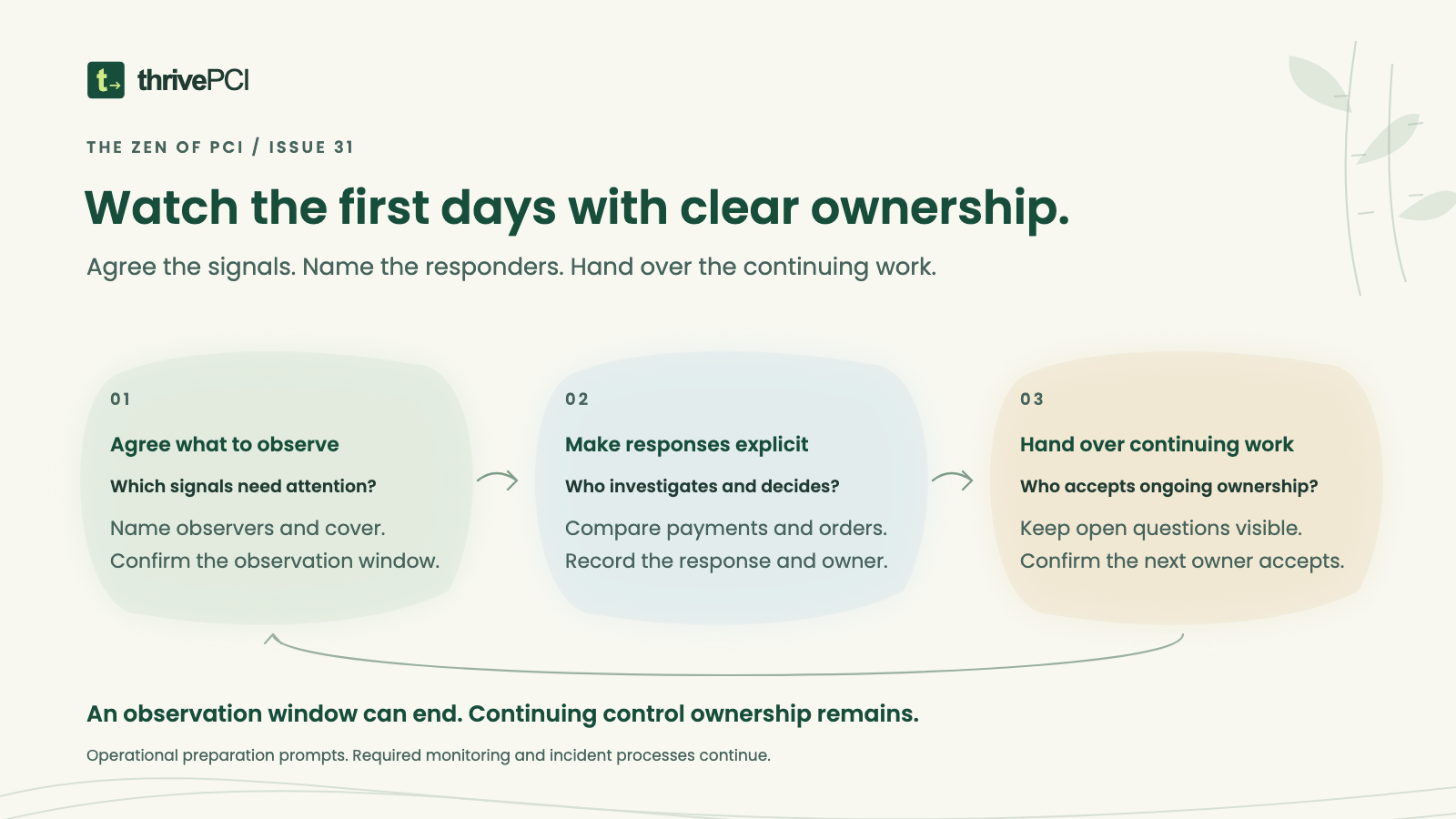
The first days after launch give a team something testing cannot supply: a view of how the actual service behaves in its operating setting. Useful monitoring connects those observations with people who can interpret them and make the next decision.
A quiet dashboard deserves context. Were the expected events observed? Did the payment and order records agree? Could a concern reach someone who had accepted responsibility for responding? A clear note helps the team answer those questions without keeping the launch meeting open indefinitely.
Begin with the launch agreement
Our fictional subscription startup has completed its authorized launch. The business operator, developer, and provider contact return to the observation and recovery arrangements agreed before release. They confirm the service version, known conditions, accepted contacts, and the secure response routes available to them.
They choose an additional observation window suited to this launch and its risks. Its duration and decision points belong to their actual arrangement. There is no universal number of first days that demonstrates stability, and this extra attention does not replace required security monitoring or incident response.
Leave a monitoring note people can use
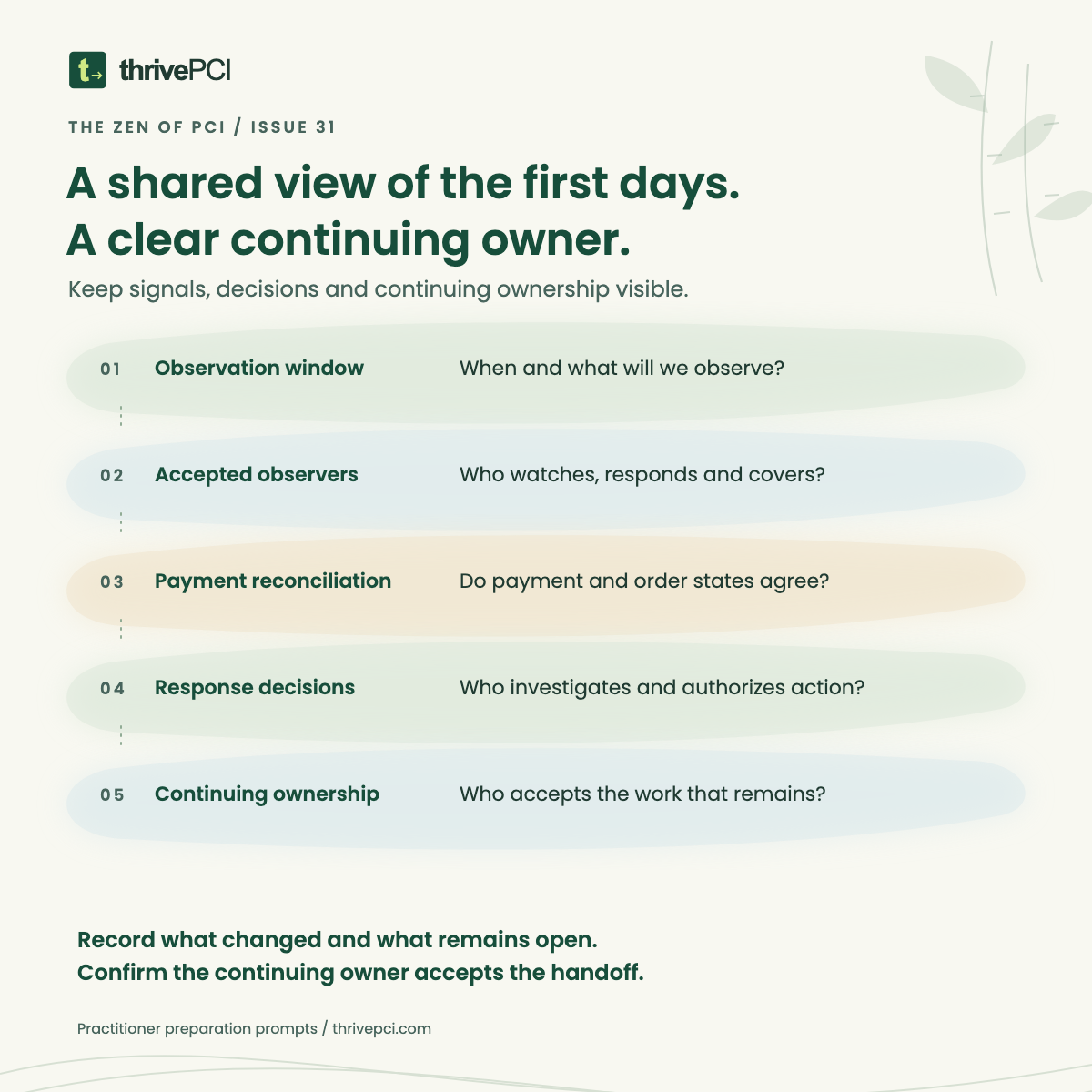
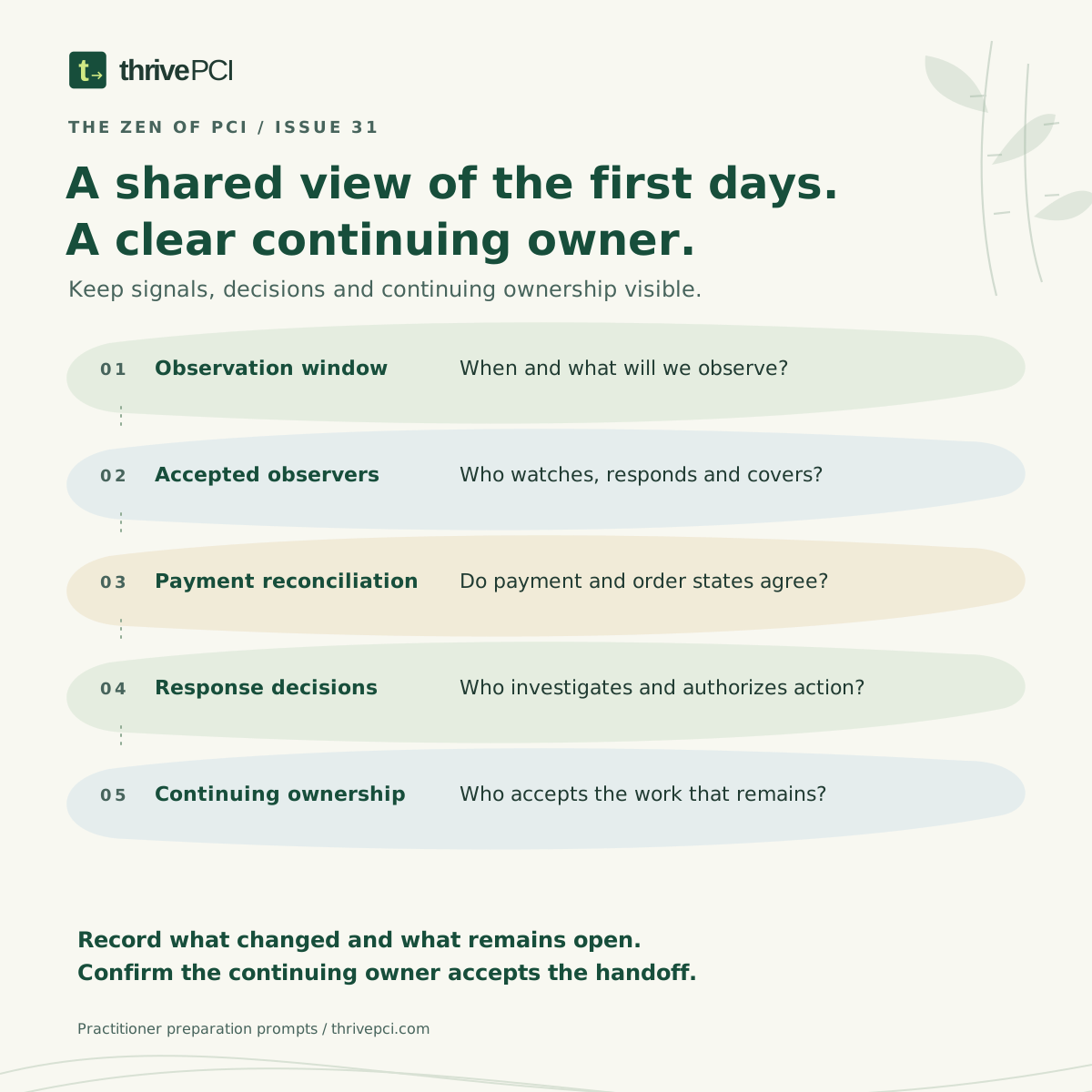
Use five prompts to connect an observation with a responsible next step:
Observation window: Describe what changed, which behavior needs attention, what evidence is available, and when the team will reconsider its position. Include expected payment and order transitions, relevant security signals, and known limitations in what can be observed. An absence of alerts is harder to interpret when a signal has not been confirmed as working.
Accepted observers: Identify who will examine each signal, who receives concerns, and who accepted the backup role. Confirm access through the approved process and availability for the agreed work. Explain who coordinates with the provider and which decisions need business or security authority. A name on the launch note is useful when the person understands and accepts the responsibility.
Payment reconciliation: Compare the appropriate payment, provider, and order records through the documented process. Account for pending activity, delayed notifications, repeated messages, and the provider's defined states. Preserve relevant records and restrict their use to authorized people and purposes. A visible disagreement is a question to investigate; it does not by itself authorize a retry, refund, or manual state change.
Response decisions: Record what calls for investigation, an authorized pause, provider support, recovery, or the incident-response route. Choose and approve decision conditions for the actual service and its risks. Distinguish an observer raising a concern from someone authorized to execute a change. Keep the secure recovery plan usable while required controls continue operating.
Continuing ownership: Explain what supports ending the extra launch observation, what remains unresolved, and who accepts the ongoing work. Transfer relevant findings, limitations, provider contacts, and open actions. Confirm that the receiving owner can locate and use them. Finishing this window changes the operating arrangement; it does not end monitoring or prove PCI DSS compliance.
Follow one disagreement through
During the fictional observation, the provider record shows a payment outcome that the order view has not yet reflected. The operator records the mismatch and the available timing context. The accepted technical owner checks whether the notification is delayed, repeated, or not being applied as expected, using the provider's documented behavior and the authorized records.
The team keeps the uncertainty visible. They do not charge again merely because the order view is incomplete, or mark the order resolved without establishing the relevant outcome. If the issue crosses an agreed decision condition, the authorized person follows the appropriate pause, escalation, or recovery route. A suspected security incident goes through the incident-response process.
For a rehearsal, use invented records and synthetic messages in an authorized test setting. Ask a partner to find the observer, decision-maker, provider contact, and next review point. Leave one signal unavailable. Can they explain what is known, what remains uncertain, and who owns obtaining the missing information?
Keep the useful work going
PCI DSS v4.0.1 includes audit-log review requirements and an incident-response plan ready for suspected or confirmed security incidents. The additional launch note supports coordination around those obligations; it does not set their frequencies or replace their required activities. Provider involvement also leaves the customer's oversight responsibilities in place.
Before ending the extra observation, walk the remaining work with the receiving owner and confirm acceptance. Record the reason for the transition and any outstanding decision. The business's validation and reporting method remains a separate matter for its compliance-accepting entity. A calmer first week leaves a service that people can continue to understand and care for.
Explore the free Program Maintenance guide (opens in a new tab)