
NEWSLETTER · ISSUE 02
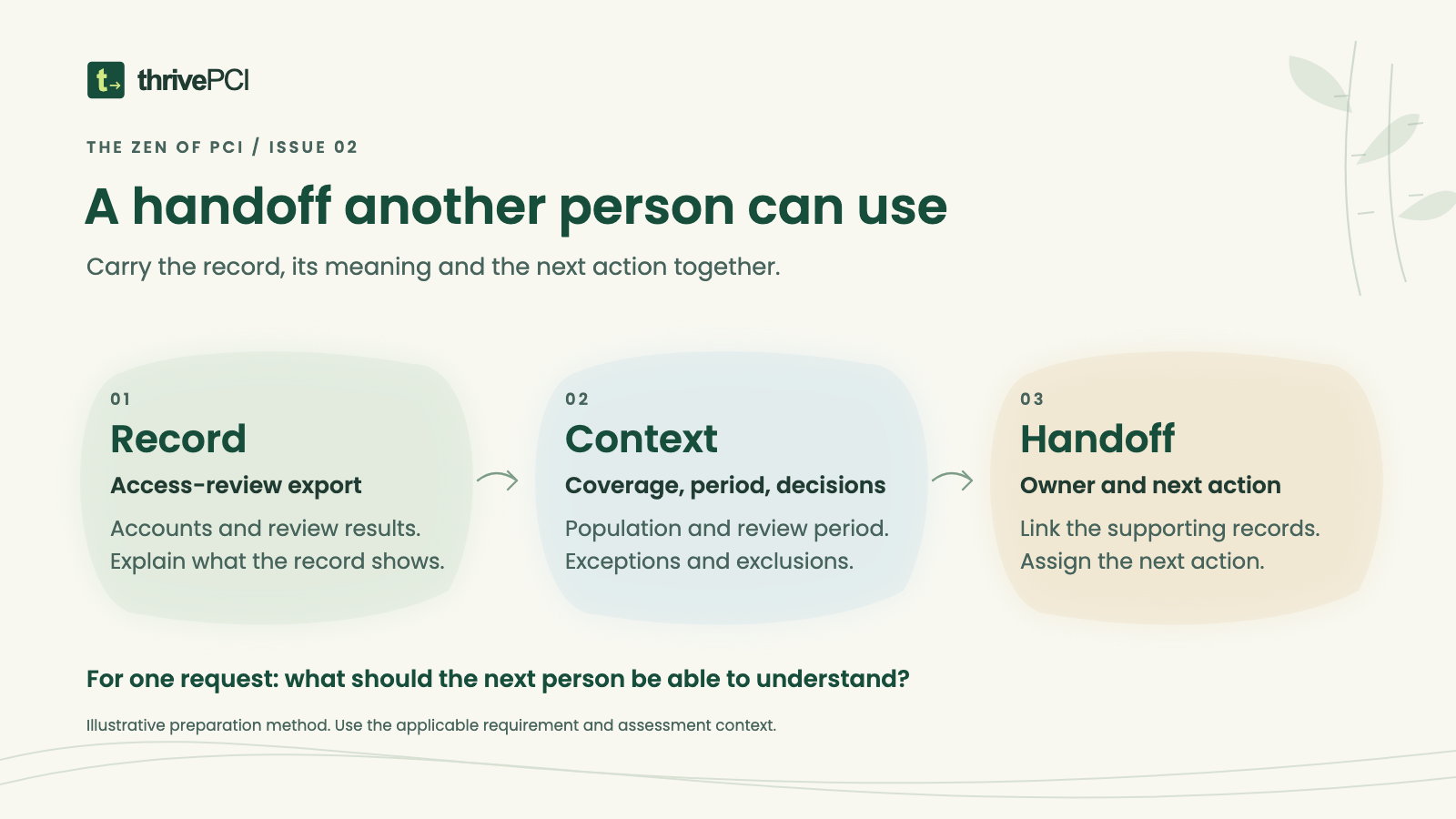
A handoff another person can use
The next person to review your evidence may have missed the meeting, joined the team recently, or inherited the request after its original owner moved on. What would help that person understand the work and continue it responsibly?
A useful handoff carries enough context for someone else to follow the record, understand the decisions, and identify the next action. That context can be short. It needs to be specific.
Follow one fictional access review
Consider a fictional access review for a payment-support application. The application owner sends a spreadsheet to the preparation lead. Its filename includes “complete,” and most rows have a tick beside them.
The preparation lead opens the file and finds three different kinds of entries. Some accounts were reviewed and retained. Two accounts were referred for removal. One account has an unresolved question about the role assigned to it.
The spreadsheet records useful work. Several facts still need an explanation: where the account list came from, which environment it covers, when it was captured, who made the review decisions, and whether the removal requests were completed.
The application owner can help assemble that explanation. The access administrator can confirm the resulting changes. The preparation lead can keep the response and its open items connected.
Make the record traceable
Start with coverage. Identify the application and environment, the population reviewed, and the source used to establish that population. Explain any exclusions and who can substantiate them. If the review covered only one business unit, keep that limit visible.
Then state the relevant period. A list captured on a particular day, a review performed over several days, and a change completed later may each have their own date. Preserve those distinctions so the reader can understand the sequence.
For this fictional example, the response might say: “The application owner reviewed the accounts in the production export identified in the attachment index. The review record shows the decision for each listed account. The access administrator is confirming completion of the two removal requests.”
That short paragraph helps the reader locate the population, follow the decisions, and see the remaining work. The supporting records still need to demonstrate those statements.
Keep decisions and open items visible
A decision deserves more than a mark in a column. Record what was decided, the responsible role, and where the basis for the decision can be found. Where an exception needs attention, explain its status and the next step.
In our example, the account with the unresolved role question stays open. The application owner identifies the business-role owner who can answer it and records a return point. The preparation lead can now distinguish the completed review decisions from a question that still needs resolution.
The same care applies to removal requests. A ticket requesting a change and a record confirming that the change occurred support different parts of the story. Keep them connected in the response index.
Build a handoff another person can use
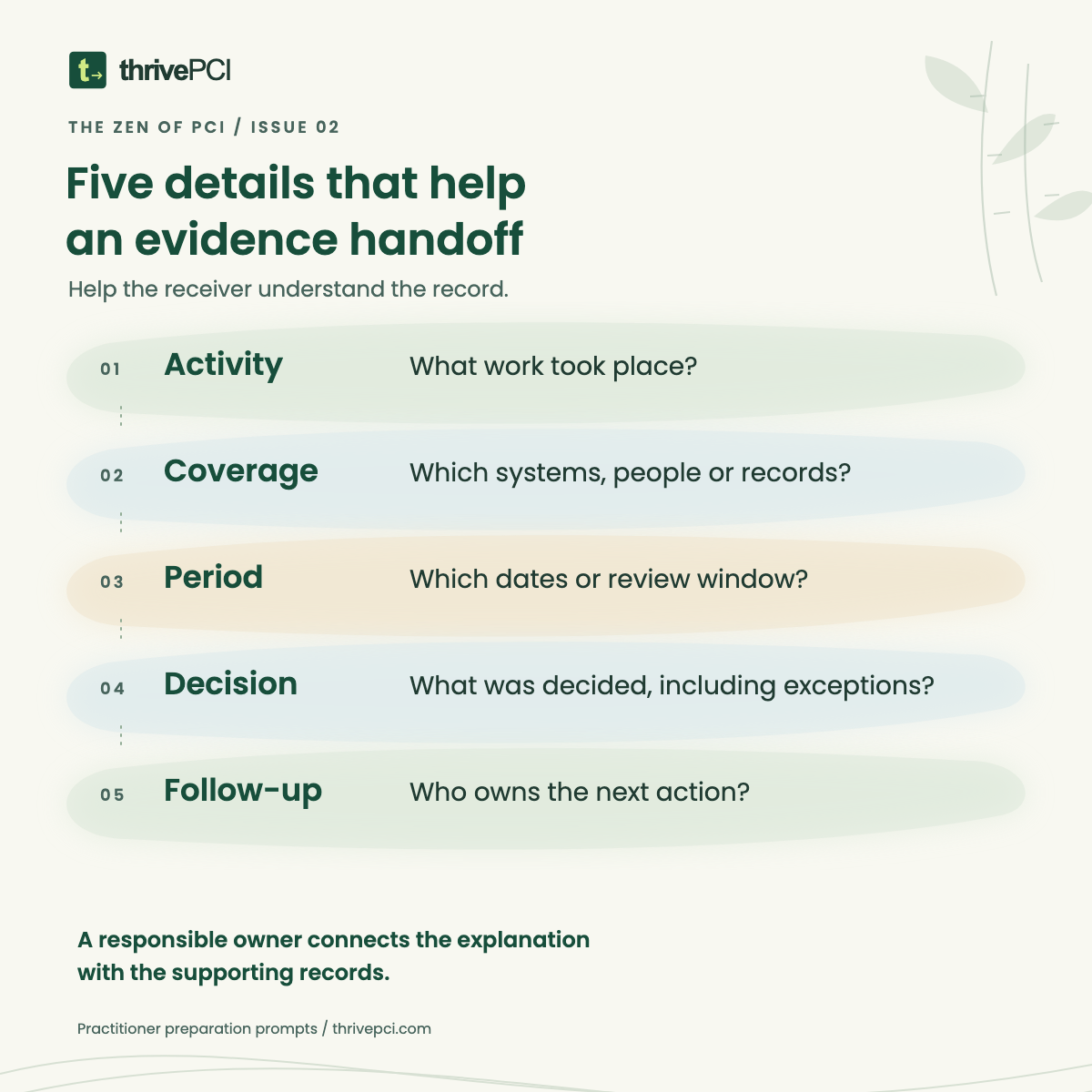
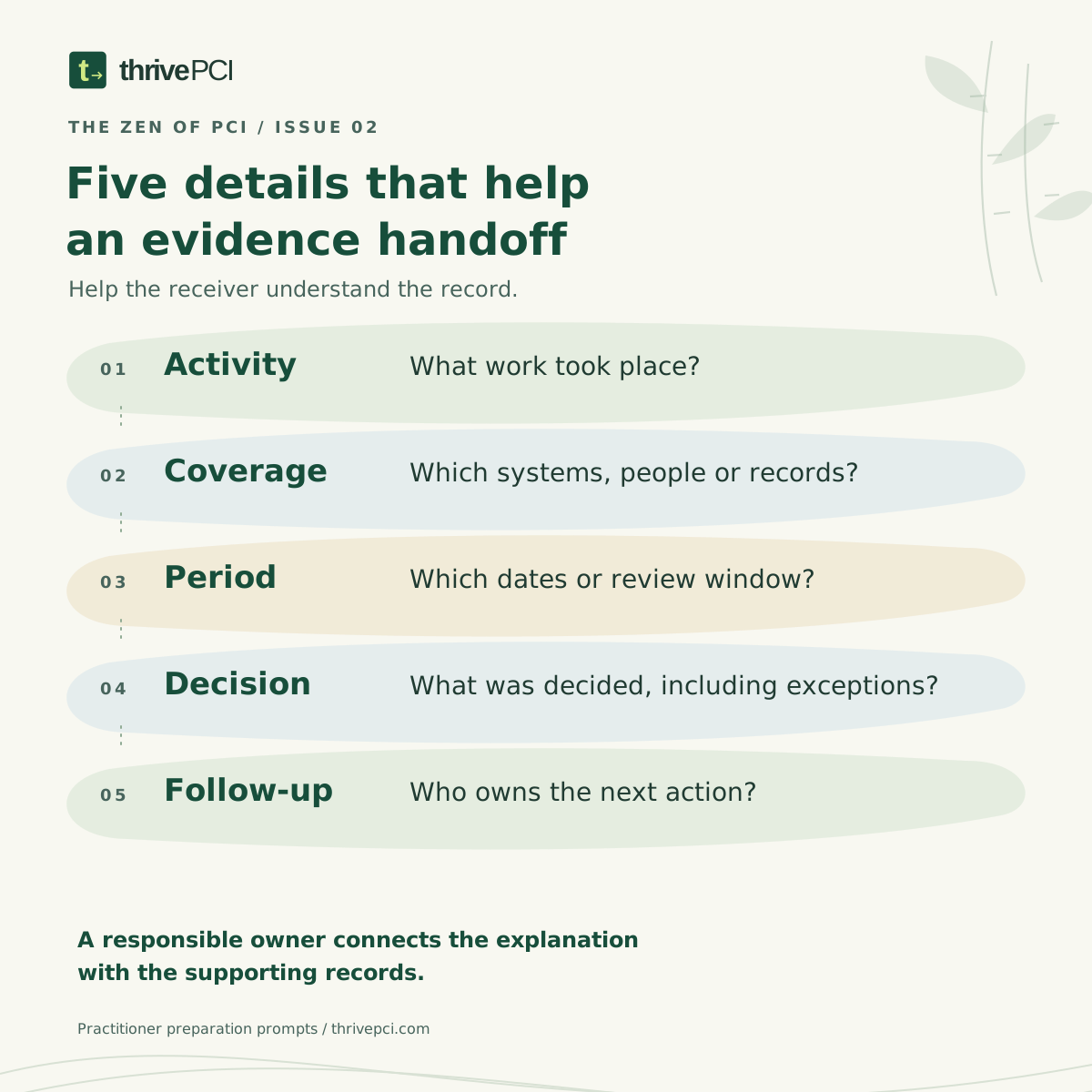
Before sending the response, write a small handoff note around five prompts: activity, coverage, period, decision, and follow-up. Identify the accountable owner alongside them and link each material statement to its supporting record.
The receiving person should be able to find the records without guessing which folder, export, or ticket you meant. Use the approved evidence location and its access controls. A generic training exercise can use fictional identifiers and placeholder links.
The applicable PCI DSS requirement, testing procedures, and assessment context govern the evidence that must be evaluated. This preparation practice helps people explain and examine the work. It gives an assessor or another responsible reviewer a clearer starting point for their own evaluation.
Try a five-minute handoff check
Choose one response your team is preparing. Ask a colleague who did not perform the activity to read it. Give them the handoff note and the approved links, then let them identify the coverage, period, decision, and next action.
Where do they need an explanation from the original author? Add that context to the response. If a fact is still unknown, record the question and its owner rather than filling the gap with an assumption.
A calm handoff leaves the next person with something usable: a traceable record, an honest explanation, and a clear place to continue.
The free thrivePCI Assessment Handover guide includes a fictional case and prompts you can use to practice this with your team. Start with one response and notice which detail makes the work easier to understand.
Practice with the free Assessment Handover guide (opens in a new tab)