A practical course on responsibility, handoffs, escalation, and review routines in a PCI program.
Scott’s review pass complete. The narration below is a script for the owner to record. It is not recorded audio. This remains an unlisted draft and is not a released course.
Learn to distinguish coordination from execution, shape a useful handoff, and make unresolved work visible.
Estimated narration: approximately 6 minutes at 140 words per minute. Planning estimate only; no recording exists.
THE RECORDING SCRIPT
Fourteen slides. One clear story.
Spoken copy follows each slide. Requirement references and recording notes stay separate from narration.
SLIDE 01 · TRAINER NARRATION
Program Ownership
Welcome to Program Ownership. A PCI program depends on people who understand what they are responsible for, what authority they have, and how to raise a problem when work cannot move forward. We will use practical examples to make those connections visible. The examples are illustrative. Your organization’s approved documents, applicable requirements, and accountable decision makers govern your actual responsibilities.
SLIDE 02 · TRAINER NARRATION
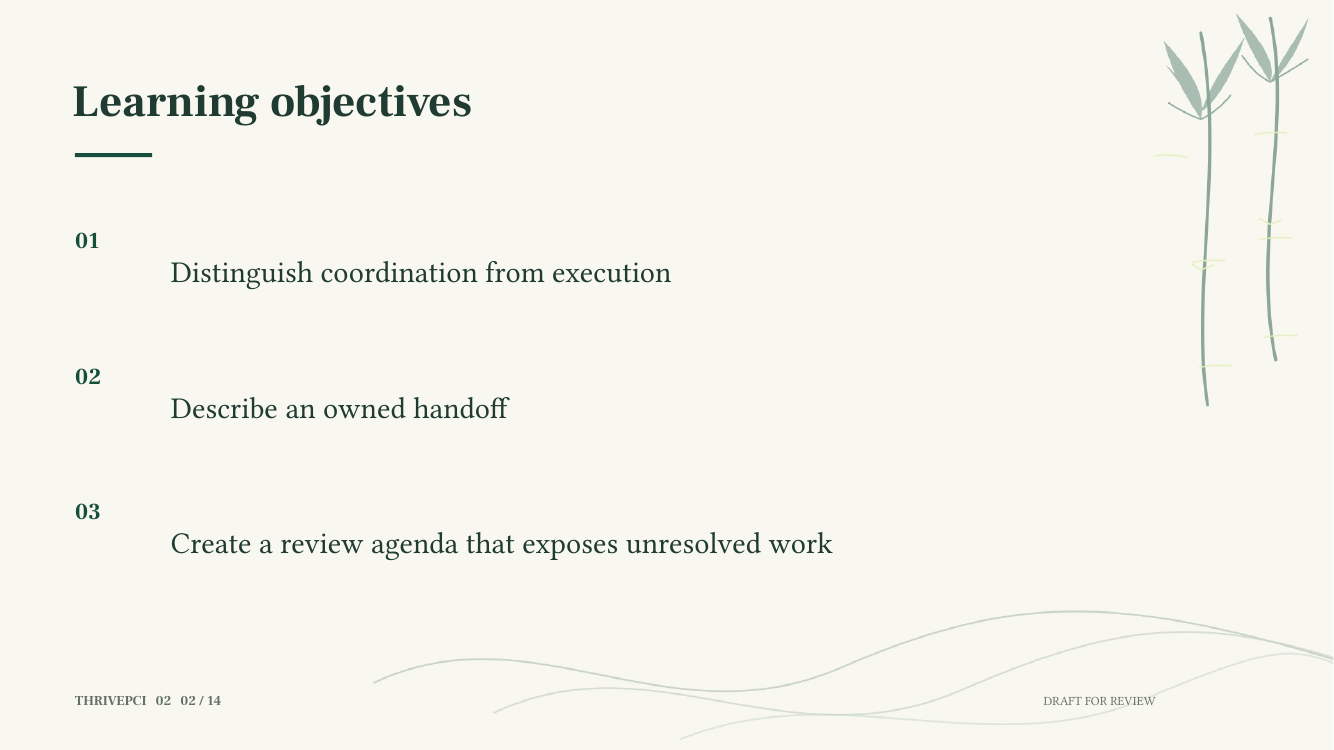
Learning objectives
By the end of this course, you should be able to distinguish program coordination from performing a specific activity, describe the parts of a useful handoff, and create a review agenda that makes unresolved work visible. As you listen, think of a generic workstream that crosses team boundaries. Avoid using customer data, payment data, or confidential evidence in your notes.
SLIDE 03 · TRAINER NARRATION
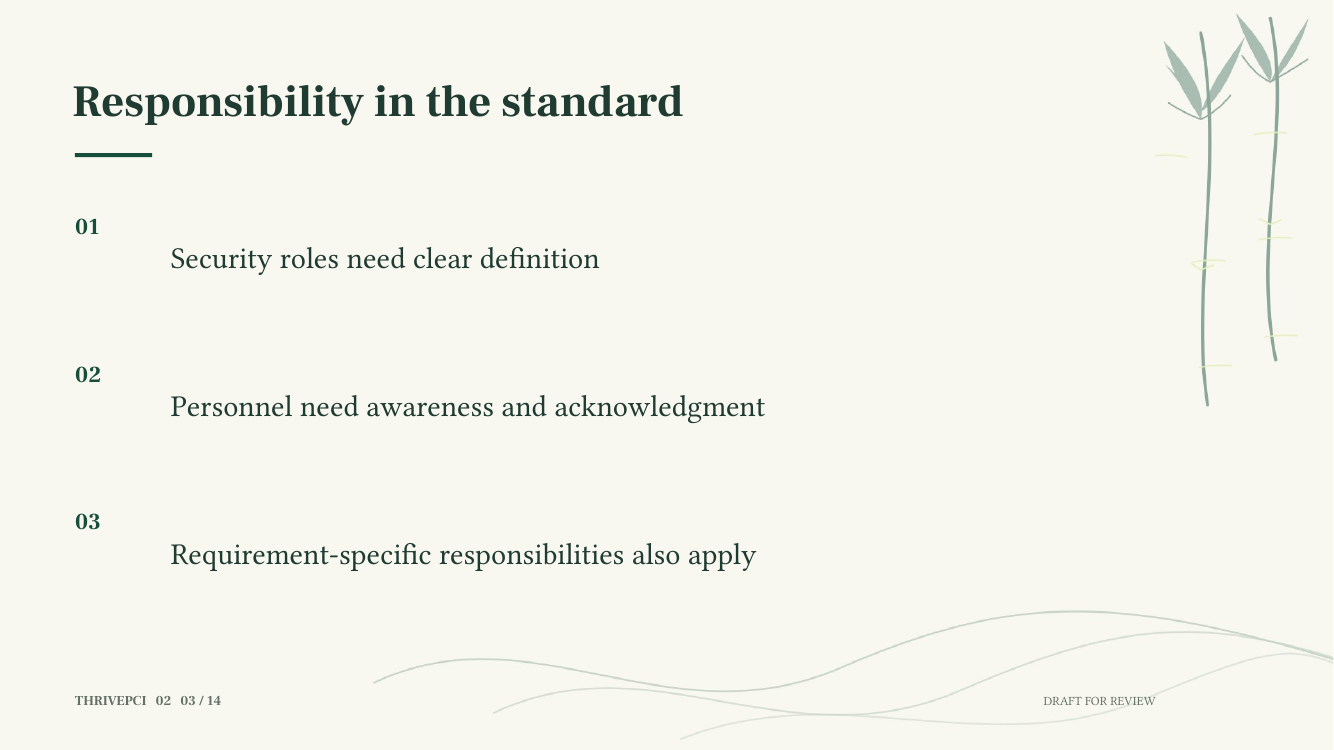
Responsibility in the standard
PCI DSS calls for responsibilities to be defined and understood. The standard includes organization-level expectations and requirements that assign particular activities or roles. A title on an organization chart does not, by itself, tell us who performs each task, what evidence is expected, or who can resolve a dependency. Use the applicable text and your approved responsibility records to answer those questions. This course helps structure the discussion; it does not determine whether a requirement applies to a particular entity.
SLIDE 04 · TRAINER NARRATION
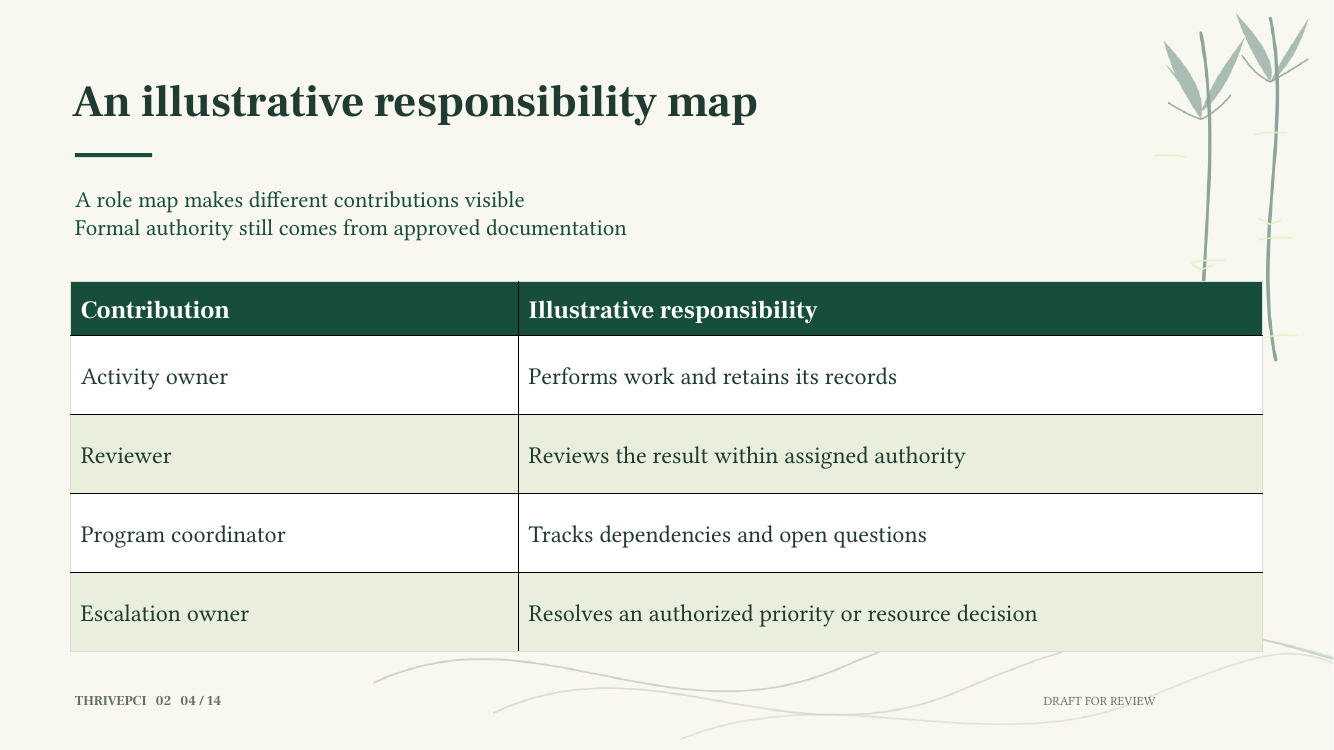
An illustrative responsibility map
A responsibility map can show how oversight, performance, evidence custody, review, and escalation differ. This example is a discussion aid, not a prescribed PCI DSS role model. A program coordinator may track progress while engineering performs a technical activity and retains a source record. An authorized leader may resolve a resource or policy question. Confirm formal authority from approved organizational documents, and record exceptions when the usual arrangement does not fit.
SLIDE 05 · TRAINER NARRATION
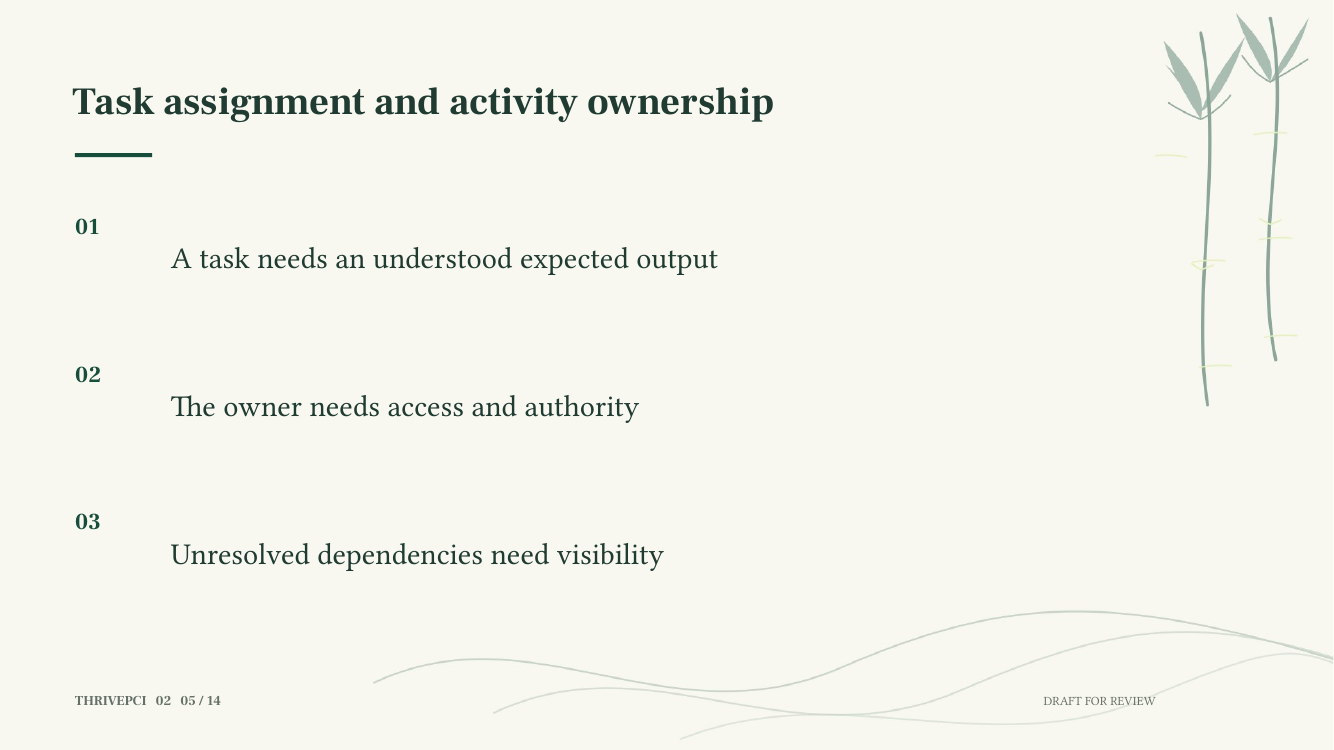
Task assignment and activity ownership
A useful assignment begins with a clear expected output. The person doing the work needs access to the right inputs and enough authority to complete it. The assignment should also reveal dependencies: for example, an approval, a system owner, or a defined population. If one person is named for everything, coordination can look like ownership while the actual work remains unassigned. Name the performer and the oversight owner where they differ.
SLIDE 06 · TRAINER NARRATION
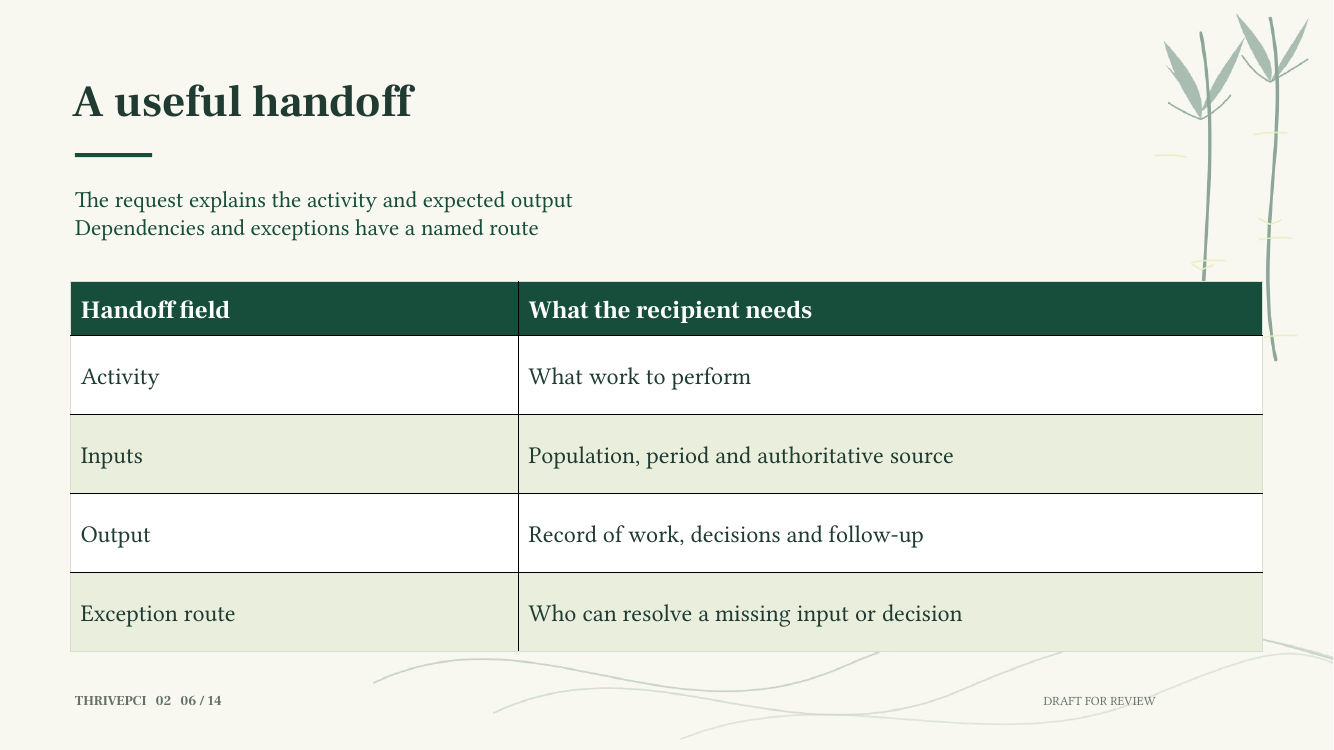
A useful handoff
A handoff should tell the recipient what activity to perform, which population and period are in scope for that activity, where authoritative inputs come from, and what record or decision to return. It should explain how to raise a missing input, exception, or decision. The specific details depend on the requirement and the organization’s process. “Complete the green task” or “send last year’s file” leaves too much interpretation for the next person.
SLIDE 07 · TRAINER NARRATION
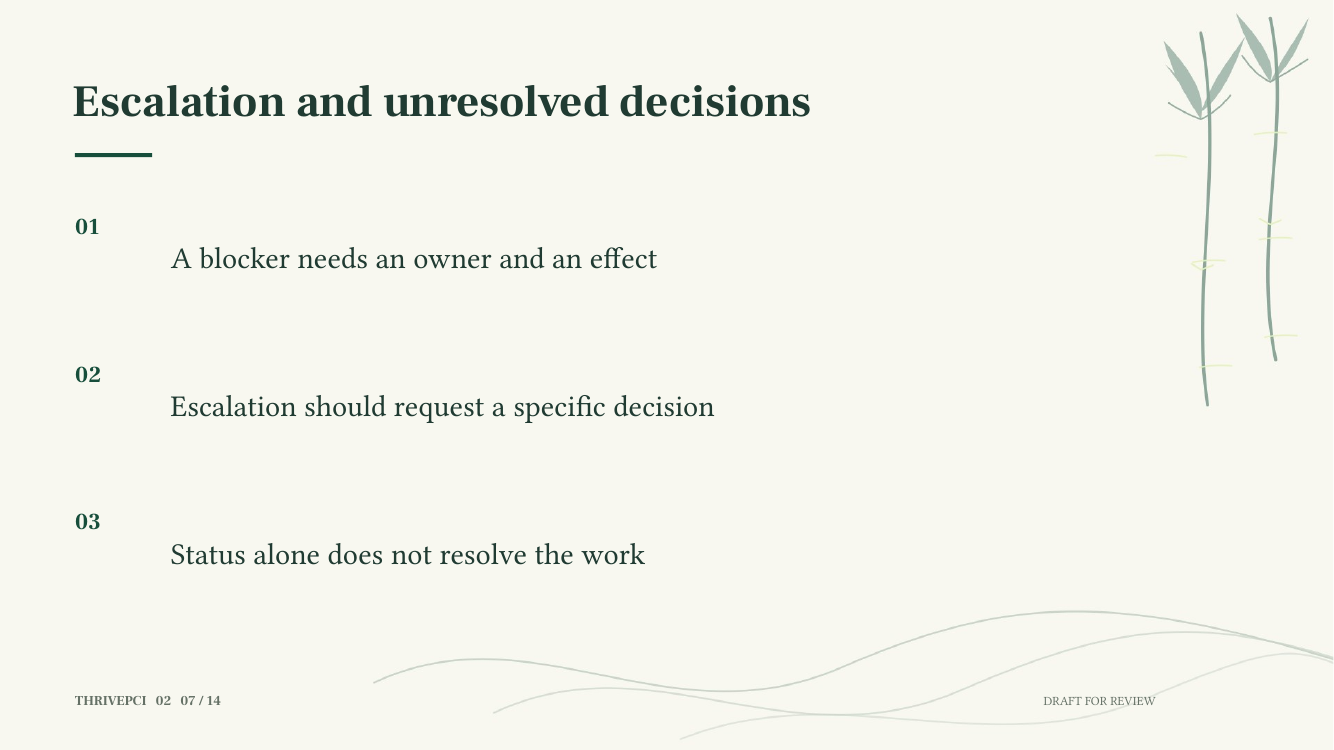
Escalation and unresolved decisions
When work is blocked, describe the blocker, its effect, the person who can help resolve it, and the decision or action requested. A status label such as “at risk” can signal attention, but it does not clear the dependency. Set a review point so that an unresolved decision does not disappear between meetings. Follow the organization’s established escalation and incident processes when they apply.
SLIDE 08 · TRAINER NARRATION
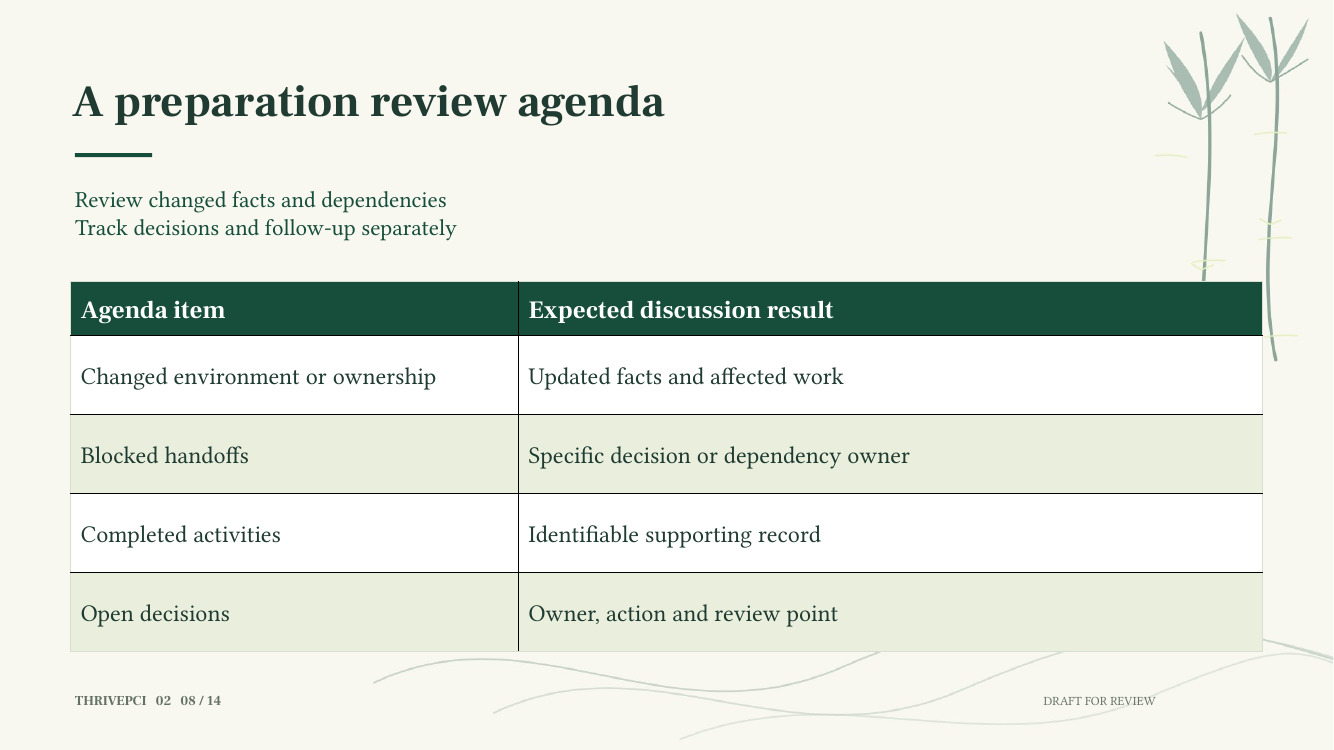
A preparation review agenda
A short review meeting can focus on changed facts, blocked handoffs, completed activities and their supporting records, and open decisions. Keep the decision, its owner, the action, and the follow-up date visible. This structure helps a team distinguish discussion from resolution. It is a practical meeting format, not a PCI DSS mandated agenda.
SLIDE 09 · TRAINER NARRATION
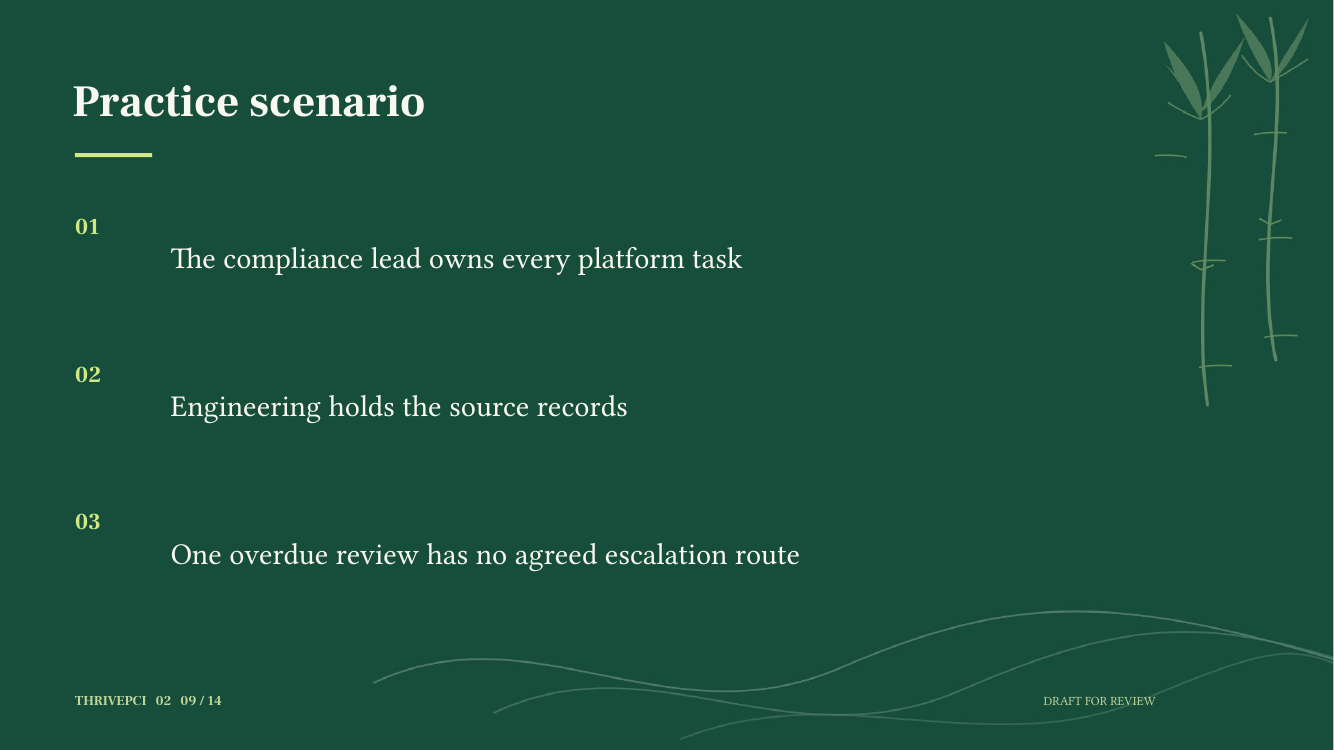
Practice scenario
Consider this fictional scenario. A compliance lead is listed as the owner for every platform task. Engineering holds the source records. One review is overdue, and no one has agreed who can resolve the delay. Pause here and identify what is missing. Who performs each task? What information is needed? Who can decide how the overdue review should proceed? What effect does the delay have on the work?
SLIDE 10 · TRAINER NARRATION
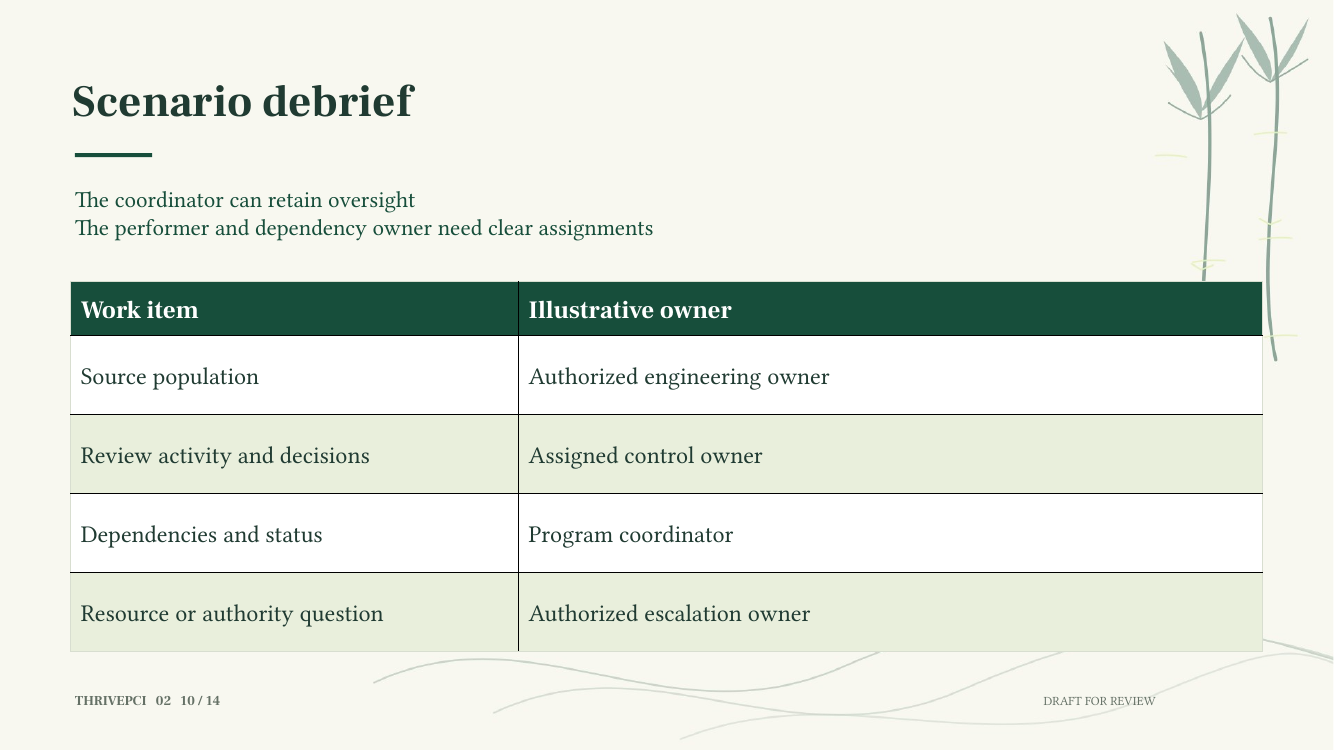
Scenario debrief
The coordinator can retain oversight of the workstream without personally performing every platform task. Assign the actual performer and confirm access to the source records. Identify who owns the dependency and who has authority to resolve the overdue review. Record the expected output and route for exceptions. If authority is unclear, surface that as an open decision rather than treating the task as complete.
SLIDE 11 · TRAINER NARRATION
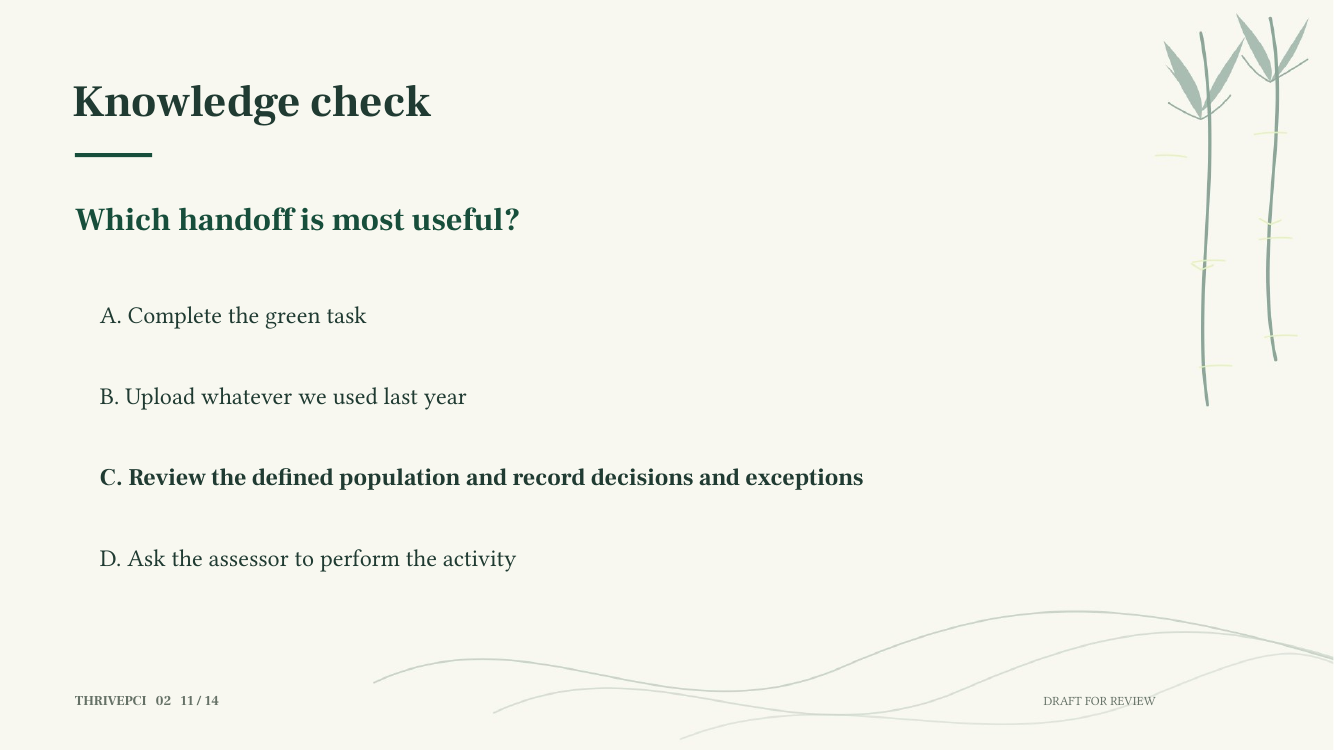
Knowledge check
Which handoff is most useful? Option A says, “Complete the green task.” Option B says, “Upload whatever we used last year.” Option C asks the recipient to review a defined population and record decisions and exceptions. Option D asks the assessor to perform the activity. Choose the option that gives the recipient actionable work while keeping the organization’s own responsibilities clear.
SLIDE 12 · TRAINER NARRATION
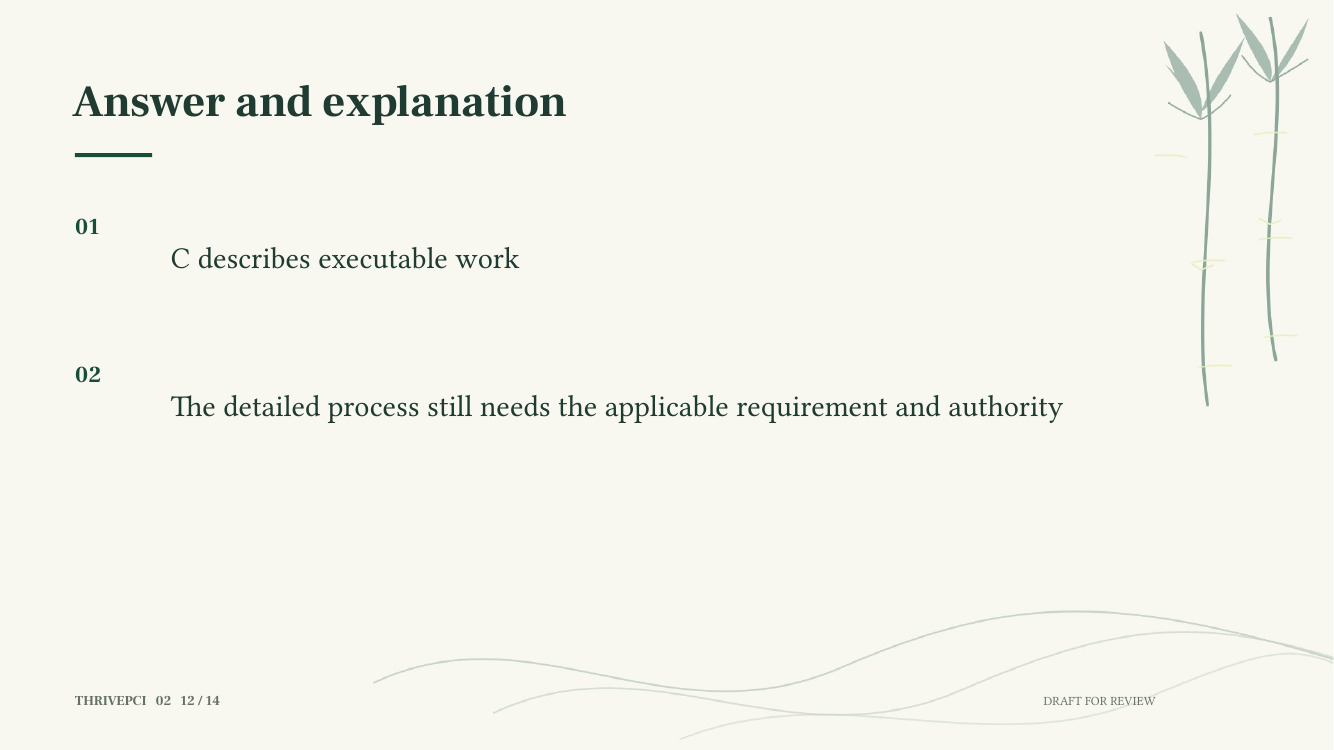
Answer and explanation
Option C is the strongest of these choices because it describes work that can be performed and a result that can be returned. It still needs enough detail to be useful: the applicable population, period, source, expected record, and decision authority. The organization must confirm the actual requirement and process. An assessor’s role does not automatically transfer an entity’s responsibilities to the assessor.
SLIDE 13 · TRAINER NARRATION
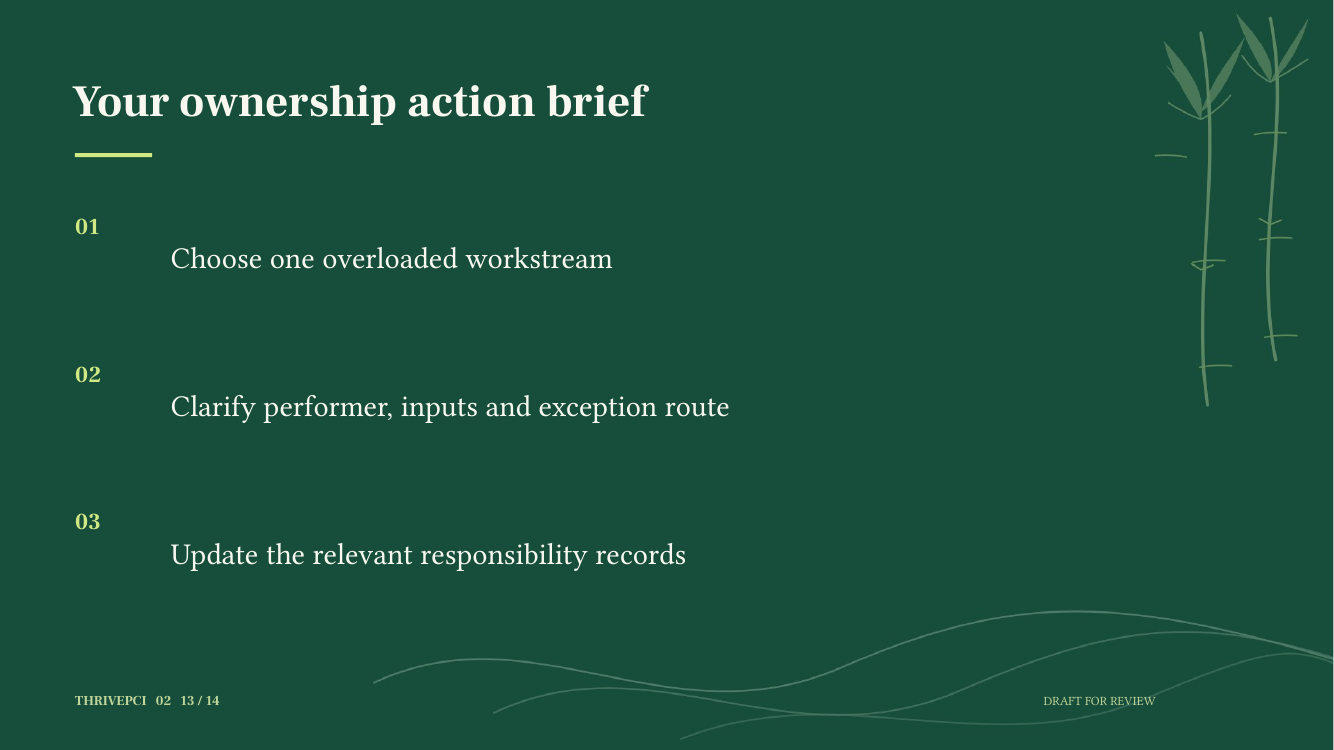
Your ownership action brief
Choose one generic workstream where a role seems overloaded or a handoff often stalls. Identify the performer, oversight owner, inputs, expected output, authority, dependency owner, and exception route. Then update the responsibility record through your organization’s approved process. Keep the action brief factual and avoid adding sensitive evidence or cardholder data.
SLIDE 14 · TRAINER NARRATION
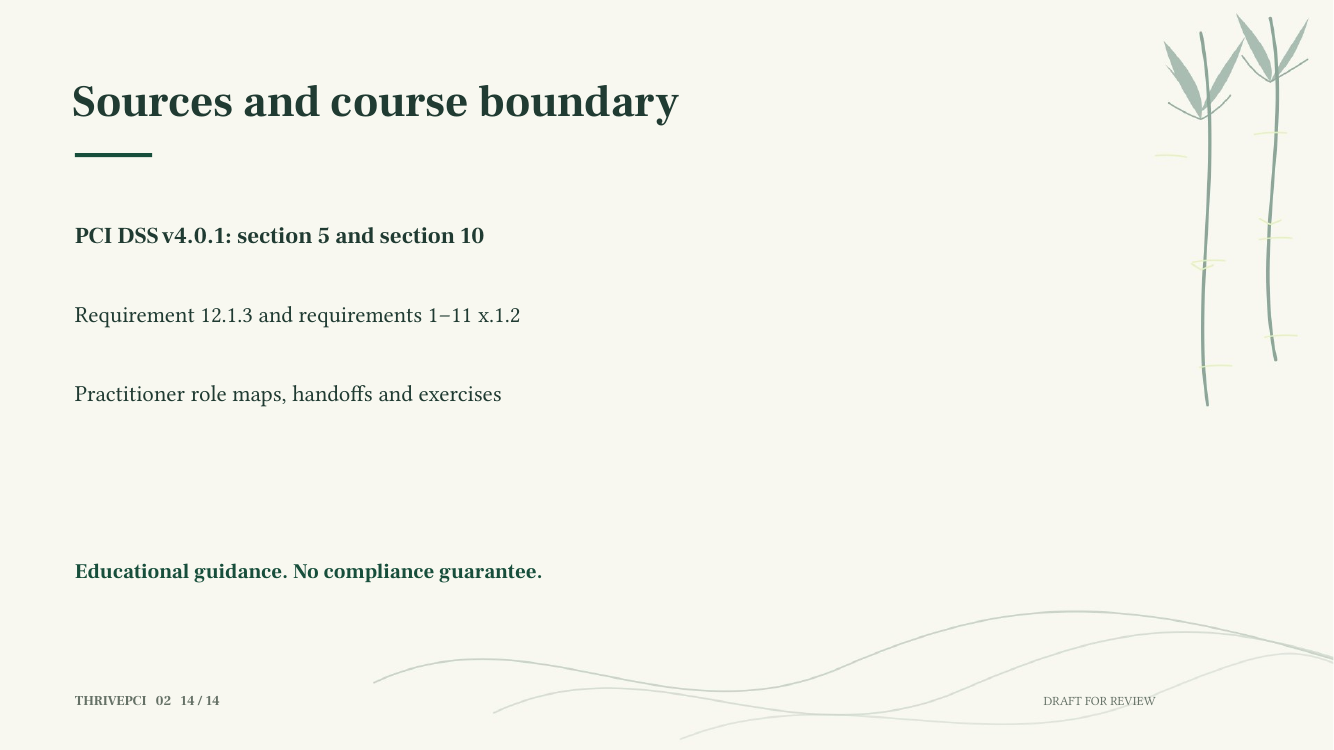
Sources and course boundary
This course references PCI DSS version 4.0.1, including sections 5 and 10, requirement 12.1.3, and the requirement-specific role language cited on this slide. Read those statements in the supplied authoritative document and in context; this script is not a substitute for the standard or its testing procedures. The role maps, handoffs, and meeting prompts are practitioner teaching aids. This course is educational guidance. It does not establish scope, determine compliance, or guarantee an assessment result.
---
COURSE BOUNDARY
Practical guidance, with its limits visible.
This course does not assign responsibilities for a specific entity, determine scope or applicability, establish compliance, or guarantee an assessment result. Verify technical references against the supplied PCI DSS v4.0.1 document before recording.