This unlisted review copy brings the reviewed 14-slide deck, its recording script, an accessible text companion, and supporting materials together for owner-recording preparation and versioned follow-up.
Scott’s review pass complete. The script is text for the owner to record. No audio, video, or timed captions have been produced. This remains an unlisted draft outside the public training catalog and is not approved for release.
Estimated narration: 10.4 minutes at 140 words per minute. This is an estimate, not recorded runtime.
THE RECORDING SCRIPT
Fourteen slides. One clear story.
Read the narration beside each slide’s teaching points. Source notes are separated from spoken text.
SLIDE 01 · cover
PCI Foundations
A confident first step into PCI
Trainer edition 0.1.2+20261118T001907Z · Draft for review
RECORDING SCRIPT · NOT RECORDED AUDIO
Welcome to ThrivePCI. This course introduces the people and preparation questions behind a PCI DSS program. We will follow a fictional business called Harbor Learning as its team prepares for a discussion about payment security. The examples contain no real customer information. You do not need a technical background to begin. Our goal is to help you ask clearer questions and recognize the work your organization owns. This course provides education. It does not determine your scope, select your reporting path or establish compliance. Keep those decisions with the appropriate responsible parties and use the current standard alongside this material.
Describe the organization’s preparation responsibilities
Create a useful first discussion agenda
RECORDING SCRIPT · NOT RECORDED AUDIO
By the end, you should be able to explain several terms without turning them into an assessment conclusion. You should also be able to separate the work of the organization from the support provided by a readiness partner or an assessor. Finally, you will prepare a short agenda for your team. Think about your current situation as we proceed, but use generic notes rather than live payment details or confidential evidence. If a term is unfamiliar, pause and write it down. The point of this introduction is to build a shared language that supports better decisions, not to memorize every requirement number.
PCI DSS describes security requirements and testing procedures
The environment and services shape the questions
Reporting instructions come from the applicable compliance program
RECORDING SCRIPT · NOT RECORDED AUDIO
PCI DSS is the Payment Card Industry Data Security Standard. Its requirements and testing procedures provide the basis for assessment work. You will also hear terms such as cardholder data environment, service provider, self-assessment questionnaire and Report on Compliance. Each term has a specific meaning in the applicable documents. Avoid choosing a reporting document simply because its name sounds familiar. PCI SSC explains that payment brands, acquirers and other organizations managing compliance programs determine reporting requirements. For Harbor Learning, the useful first task is to describe how payments work and identify who provides reporting instructions. That is a preparation task, not a scope decision made by this course.
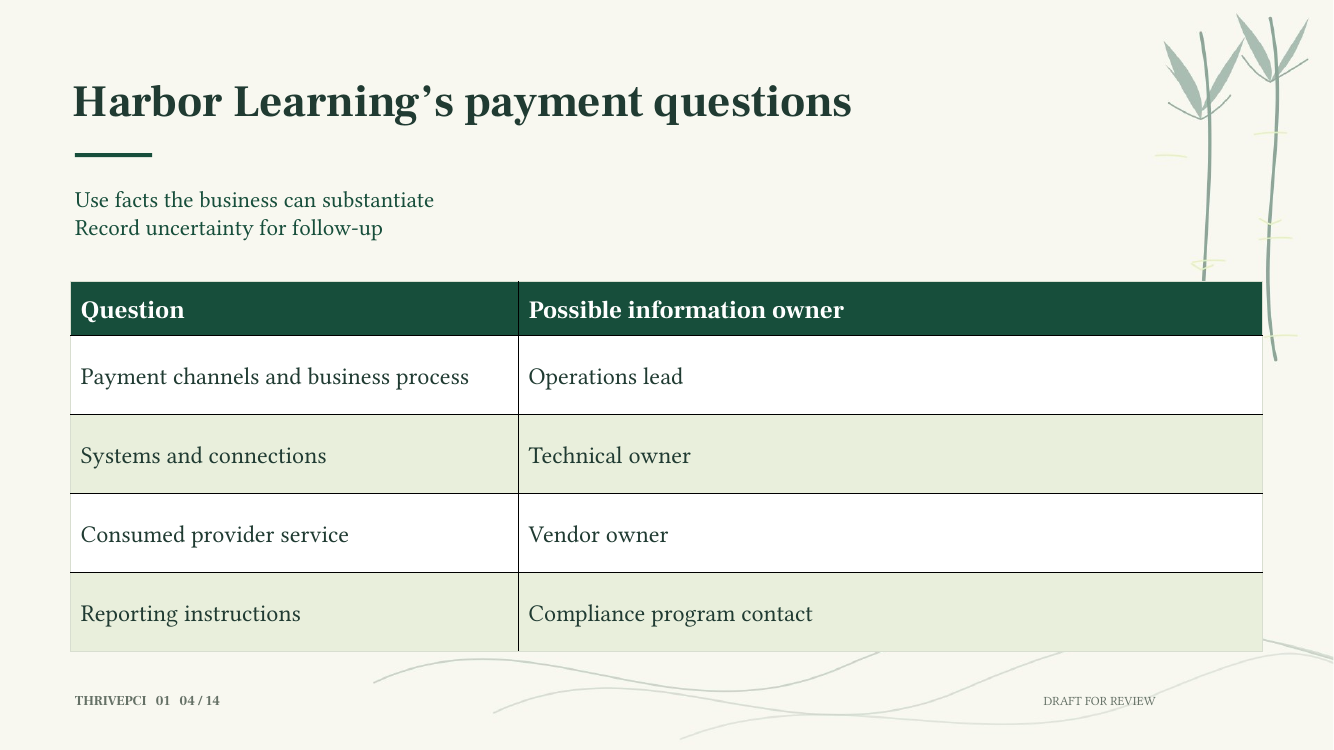
Harbor Learning sells online workshops. The operations lead says a payment provider handles checkout, but nobody has assembled a current description of the service. Rather than declaring the business out of scope, the team records questions. Which payment channels exist? Which provider service does the business consume? Where can staff see payment-related information? Which systems connect to the process? Who supplies compliance reporting instructions? The answers need support from the actual environment and service arrangements. On this slide, each question has a possible information owner. The table is a practical discussion aid. It does not replace the scoping confirmation required by the standard or any reporting eligibility criteria.
The assessed entity owns its program and submissions
A readiness partner helps prepare
The assessor performs the agreed assessment activities
RECORDING SCRIPT · NOT RECORDED AUDIO
The assessed entity is the organization whose environment and practices are being evaluated. Its team owns the program and the information it presents. A readiness partner can help the organization understand preparation needs, organize evidence and work through gaps. Readiness partner is our practitioner term for that support role, not a PCI DSS mandated job title. The assessor performs the assessment activities required by the relevant engagement and reporting instructions. Keep those responsibilities clear when asking for help. An assessor’s request for evidence is not automatically a commitment to create your policies, reconstruct your provider mapping or perform your remediation work.
Source note (not spoken): PCI DSS v4.0.1, sections 9–11; practitioner role model
SLIDE 06 · content
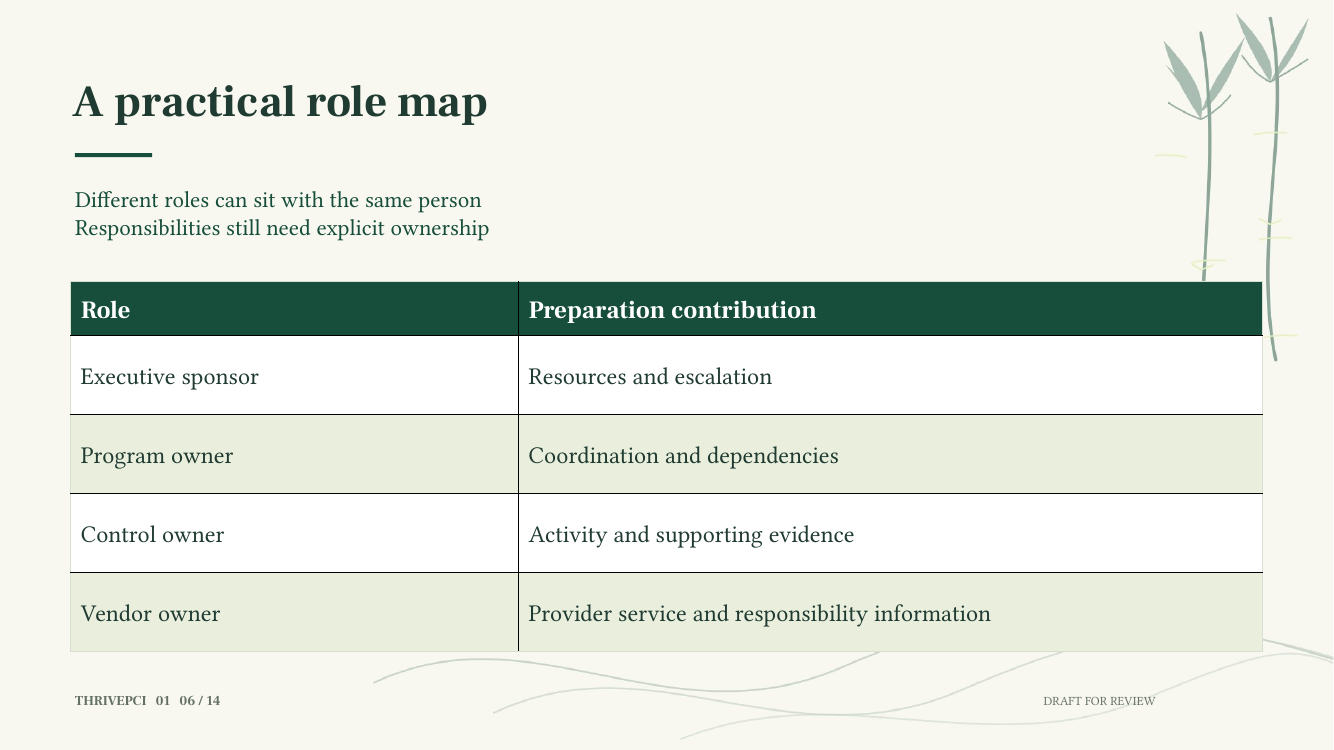
A practical role map
Different roles can sit with the same person
Responsibilities still need explicit ownership
Role
Preparation contribution
Executive sponsor
Resources and escalation
Program owner
Coordination and dependencies
Control owner
Activity and supporting evidence
Vendor owner
Provider service and responsibility information
RECORDING SCRIPT · NOT RECORDED AUDIO
In a small business, one person may hold several roles. That does not remove the need to identify the work. Harbor Learning assigns an executive sponsor to resolve priority and resource questions. A program owner coordinates the preparation plan. Technical and business control owners perform their assigned activities. The vendor owner obtains service-specific information. External readiness support helps with preparation where engaged. The assessor validates the presented information through the applicable testing. This map is intentionally simple. It supplements, rather than replaces, the organization’s formal security responsibilities and requirement-specific role documentation. Ask whether each responsibility has an owner who understands what is expected.
Source note (not spoken): PCI DSS v4.0.1, 12.1.3 and requirement-specific x.1.2 controls; practitioner role map
SLIDE 07 · content
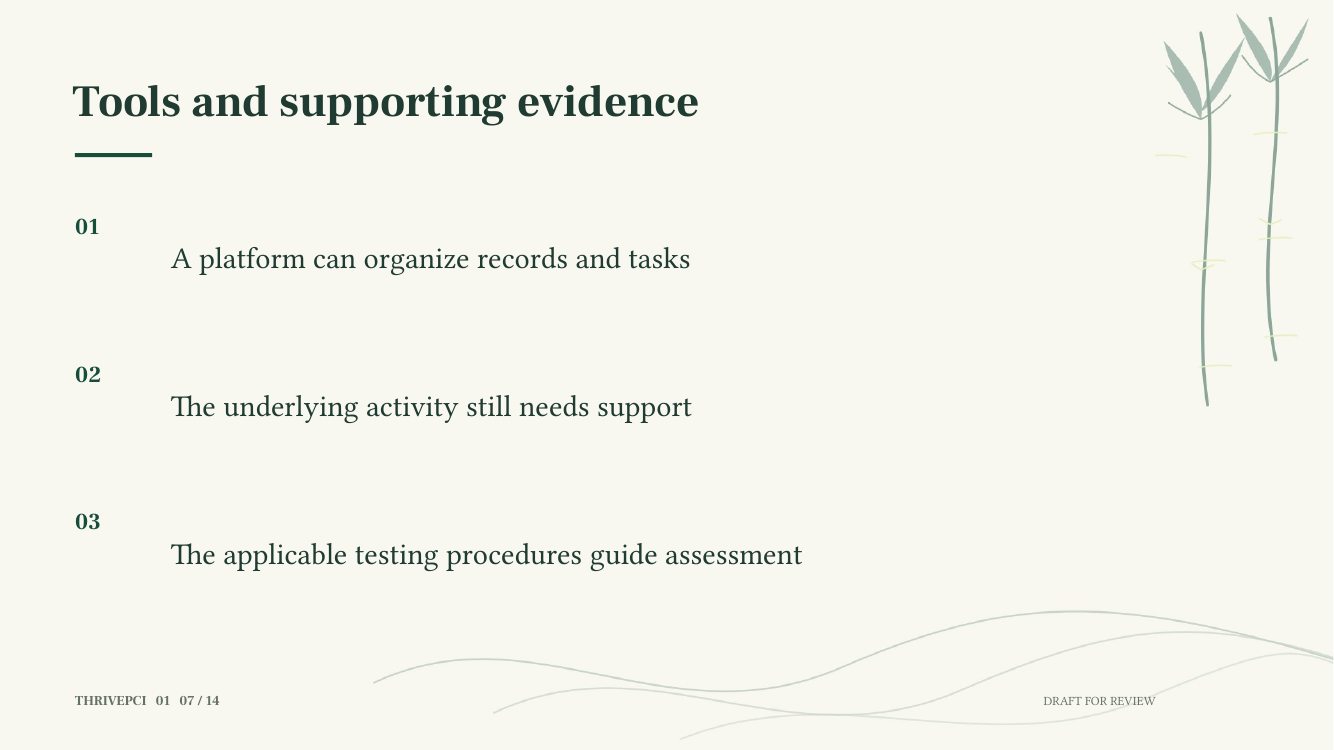
Tools and supporting evidence
A platform can organize records and tasks
The underlying activity still needs support
The applicable testing procedures guide assessment
RECORDING SCRIPT · NOT RECORDED AUDIO
A compliance automation platform can be useful. It may collect records, monitor selected conditions or organize assignments. The team must still understand what each record demonstrates. A green indicator could reflect a configured check, a submitted file or a platform-specific status. It should not be treated as a complete explanation of every PCI DSS testing objective. Harbor Learning starts by connecting the requested activity to an owner and the relevant supporting material. PCI DSS describes examination, observation and interview as assessment methods. The exact procedures determine the expected testing. Platform records can contribute, but the team should be ready to explain their relevance and limits.
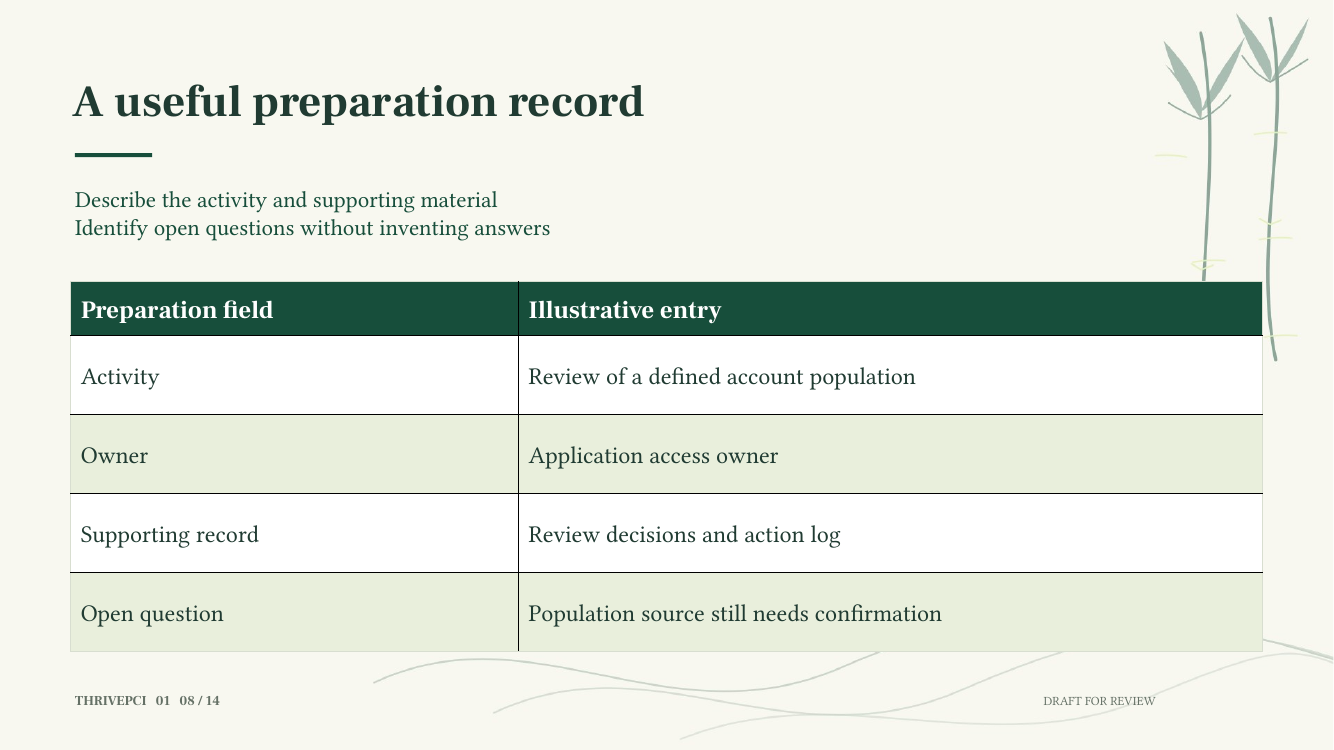
Consider a generic access review. A preparation record can state which population the review covered, who performed it, when it occurred and where the decisions and follow-up actions are recorded. That is more useful than a file called access review with no context. This example illustrates clear presentation. It does not assert that a particular review population, frequency or document satisfies a specific requirement. The organization must align those details with the applicable requirement and testing. Harbor Learning keeps an unresolved question beside the record if it cannot yet explain the population or period. Uncertainty should lead to an owned follow-up, not a guessed assertion.
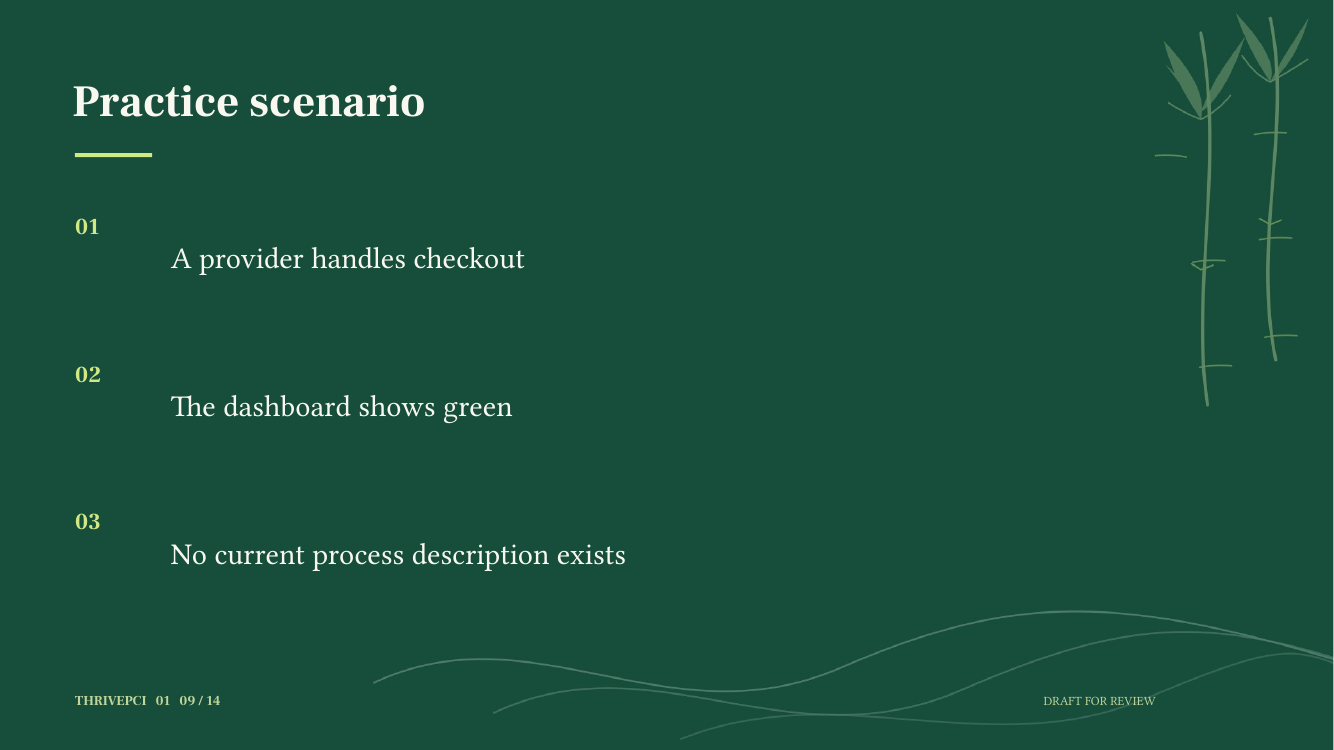
Pause here and consider Harbor Learning’s first team meeting. The founder says the provider handles checkout and the dashboard is green, so preparation should be complete. The program owner has no current payment-process description, no provider responsibility mapping and no confirmed reporting instructions. What should the team do next? Take two minutes to write three questions and assign a generic owner to each. Do not decide that the business is compliant, non-compliant or outside scope from these facts. The information is deliberately incomplete. Your task is to identify the next useful preparation work, using people who can substantiate the answers.
Source note (not spoken): Practitioner exercise based on PCI DSS v4.0.1, sections 4, 10 and 11
SLIDE 10 · content
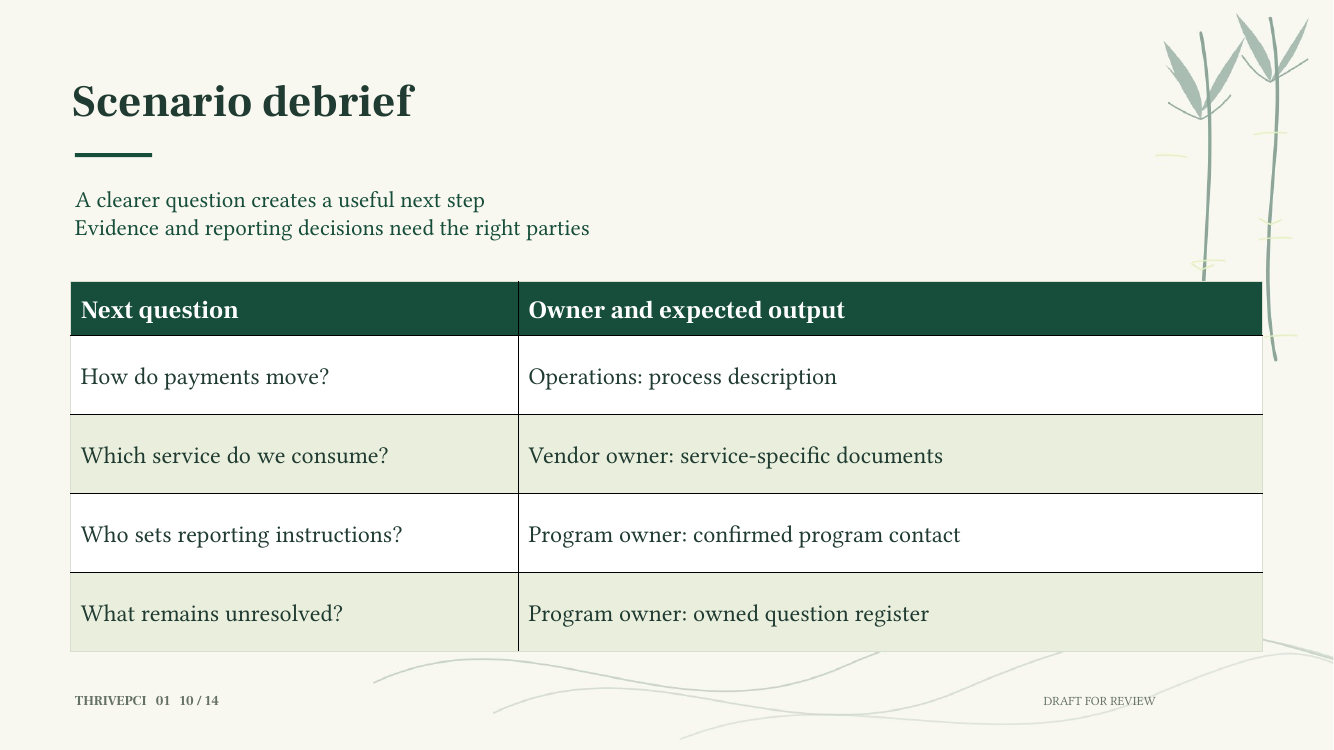
Scenario debrief
A clearer question creates a useful next step
Evidence and reporting decisions need the right parties
Next question
Owner and expected output
How do payments move?
Operations: process description
Which service do we consume?
Vendor owner: service-specific documents
Who sets reporting instructions?
Program owner: confirmed program contact
What remains unresolved?
Program owner: owned question register
RECORDING SCRIPT · NOT RECORDED AUDIO
A useful response begins with facts about the payment process. Operations can describe the channels and customer journey. The vendor owner can identify the consumed service and obtain appropriate provider documentation. The program owner can confirm which organization supplies reporting instructions and collect the unresolved questions. Technical staff can help explain systems and connections. None of these actions automatically settles scope or reporting eligibility. The team is improving the inputs for the appropriate review. Notice that every question has an owner and an expected output. This reduces the risk of a meeting ending with a general request for someone to look into PCI.
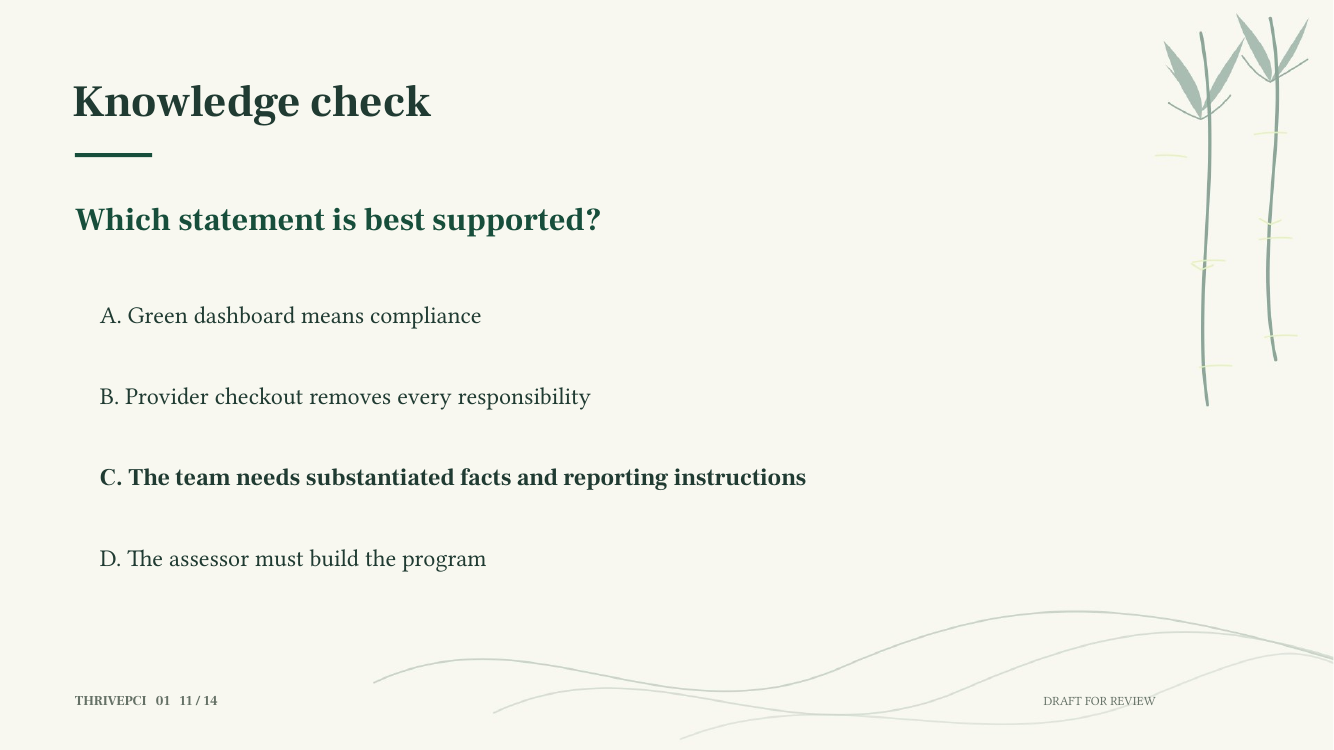
C. The team needs substantiated facts and reporting instructions
D. The assessor must build the program
RECORDING SCRIPT · NOT RECORDED AUDIO
Choose the statement that is best supported by what we know. A says the dashboard establishes compliance. B says using a provider removes every responsibility. C says the team needs substantiated facts about its environment and the relevant reporting instructions. D says the assessor must build the program. Pause before advancing and explain your choice in one sentence. This is a learning check, not a compliance score. The useful reasoning is more important than selecting a letter. Ask which statement respects the limits of the information available and assigns the organization a practical next step without inventing an outcome.
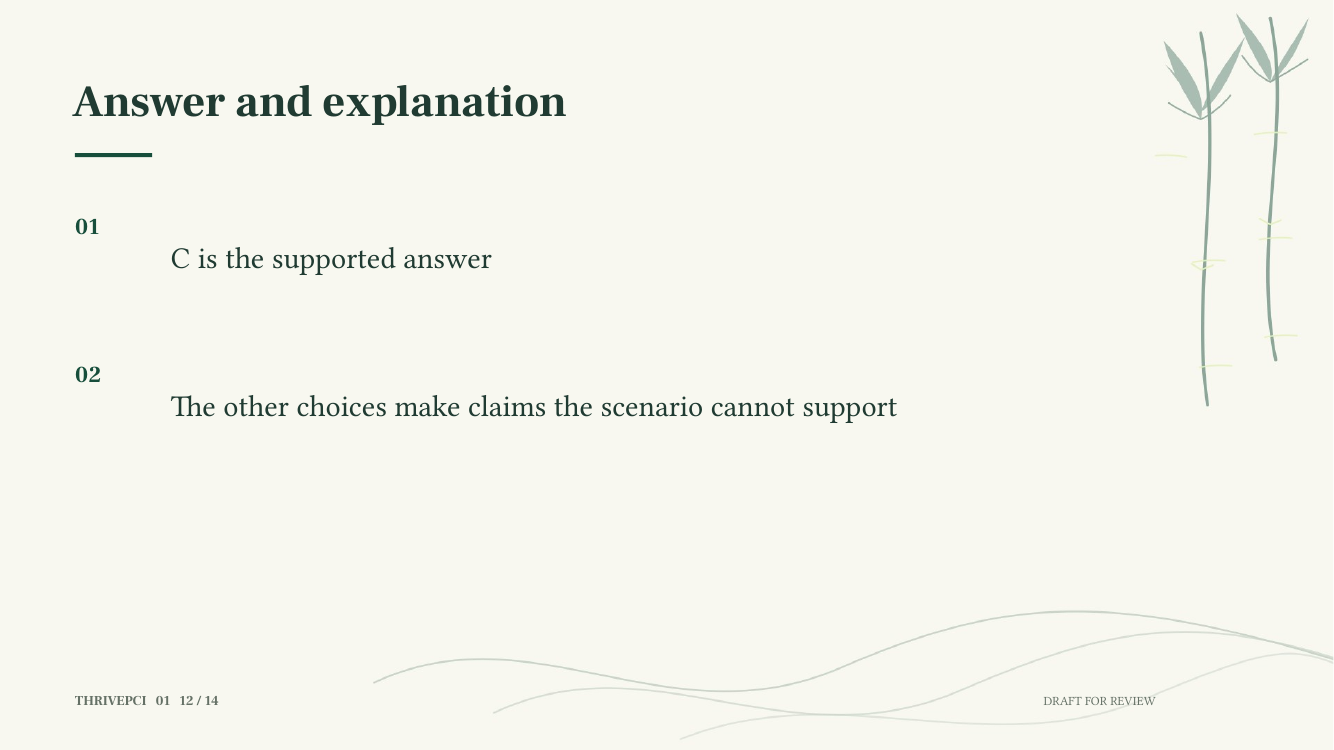
The other choices make claims the scenario cannot support
RECORDING SCRIPT · NOT RECORDED AUDIO
C is the supported answer. Harbor Learning needs reliable facts about the process and the reporting instructions that apply to its compliance program. A platform status can help direct attention, but the scenario does not show that all applicable requirements and testing have been satisfied. A provider can perform activities for the business, yet the business still needs to understand its retained and shared responsibilities. An assessment engagement also does not automatically include building the program. If you selected a different answer, identify the assumption you added. That habit is valuable in preparation work because unsupported assumptions often hide behind familiar tools, supplier names or last year’s documents.
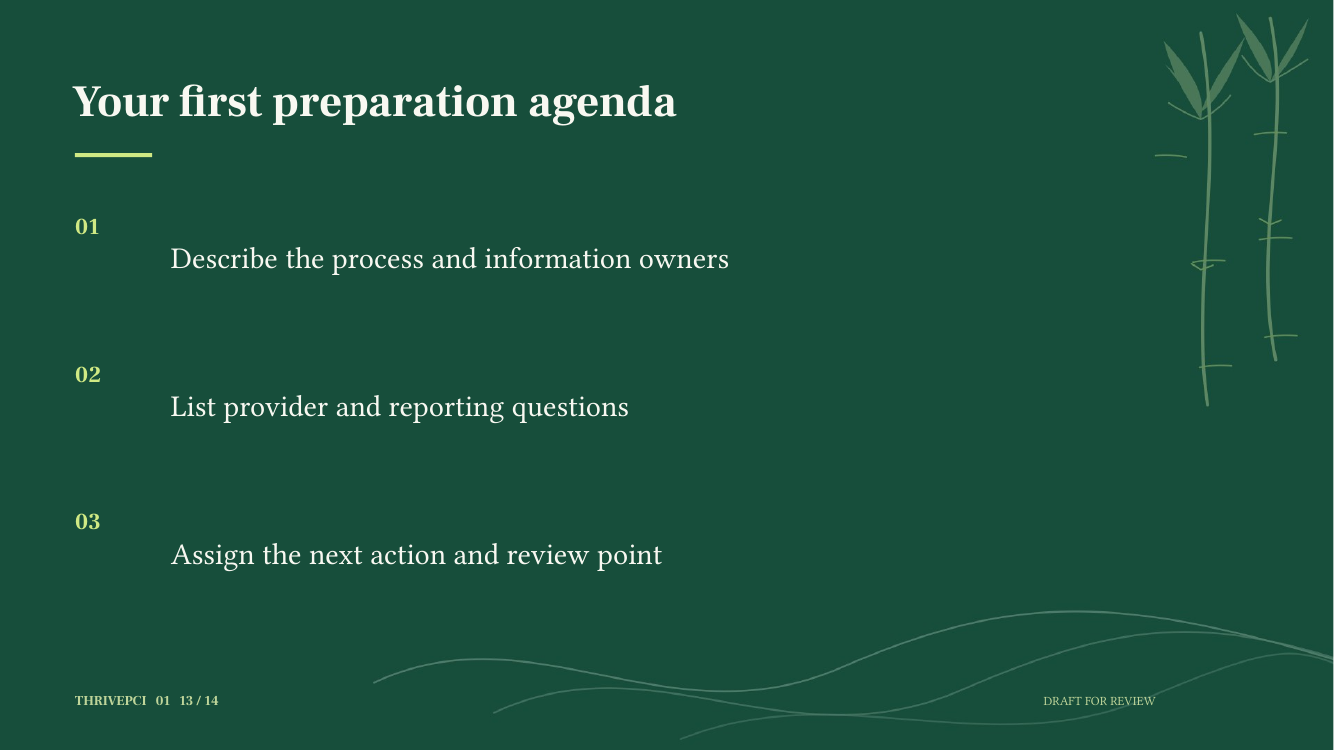
Your practical takeaway is a one-page meeting agenda. Start with the business payment process in plain language. Name the people who can explain the systems, services and reporting instructions. List what you know, what evidence supports it and what still needs confirmation. Give each open question an owner and a review point. Use generic or redacted examples in training and keep real customer records in approved channels. This agenda is a practitioner preparation tool. It does not replace formal scope documentation, security responsibilities or an assessment report. A good first meeting ends with work that someone can perform and an output the team can review.
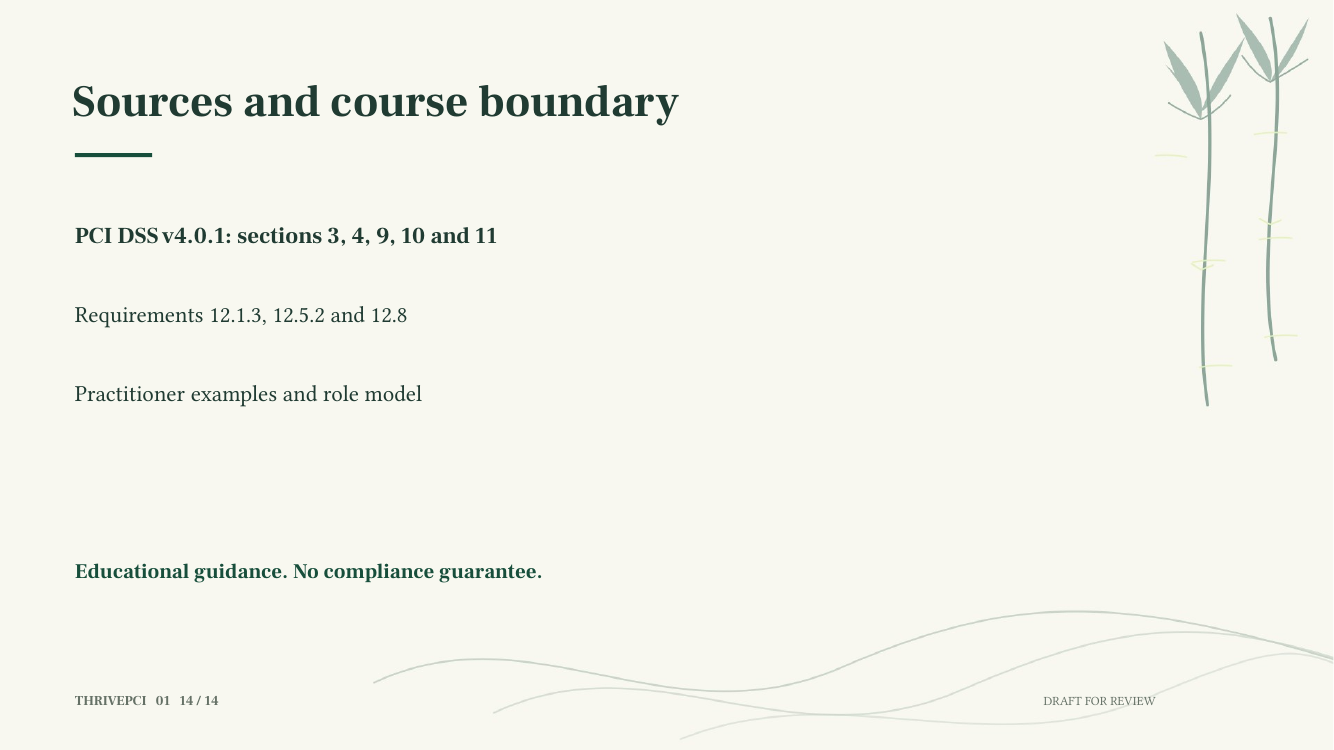
The reference baseline for this course is PCI DSS version 4.0.1, Requirements and Testing Procedures, published by PCI SSC in June 2024. The cited introductory sections explain terminology, scope, assessment practices and reporting context. The cited requirements support our discussion of responsibilities, scoping confirmation and third-party services. Our role map, agenda and fictional examples are practitioner teaching aids. They are not additional Council requirements or an endorsement by PCI SSC or another organization. Use the current authoritative documents and the instructions of the appropriate responsible parties when applying the ideas. The deck remains a review draft and does not guarantee compliance or a favorable assessment.
Education and preparation, with the limits visible.
The course does not decide scope, select a reporting path, determine whether a requirement applies, or establish compliance. It does not guarantee an assessment outcome or claim PCI SSC endorsement. The public outline remains separate from this unlisted review copy.