Sustaining the Program. The work between assessments.
Review the 14-slide course on operational routines, applicable timing, change review, current evidence, and accountable follow-up between assessment engagements.
Scott’s review pass complete. The PPTX contains the owner-recorded narration script in speaker notes. No audio or video has been produced. This page is noindex and outside the public catalog; it is not access-controlled.
Trainer edition 0.1.4+20261118T215907Z · Draft for review
RECORDING SCRIPT · NOT RECORDED AUDIO
Welcome to this ThrivePCI course on sustaining PCI program work between assessments. Our fictional organization, Beacon Learning, completed an assessment last year. Since then, it has changed a provider service, assigned a new application owner and updated part of its payment process. The program team needs to understand what those changes mean for its ongoing work. We will build a practical review rhythm, distinguish planning dates from required frequencies and prepare a continuity handover. This course provides education. It does not establish current compliance, determine scope or replace the standard’s specific requirements and testing procedures.
Source note (not spoken): PCI DSS v4.0.1, section 5 and requirements 12.1, 12.3, 12.5 and 12.8
SLIDE 02 · objectives
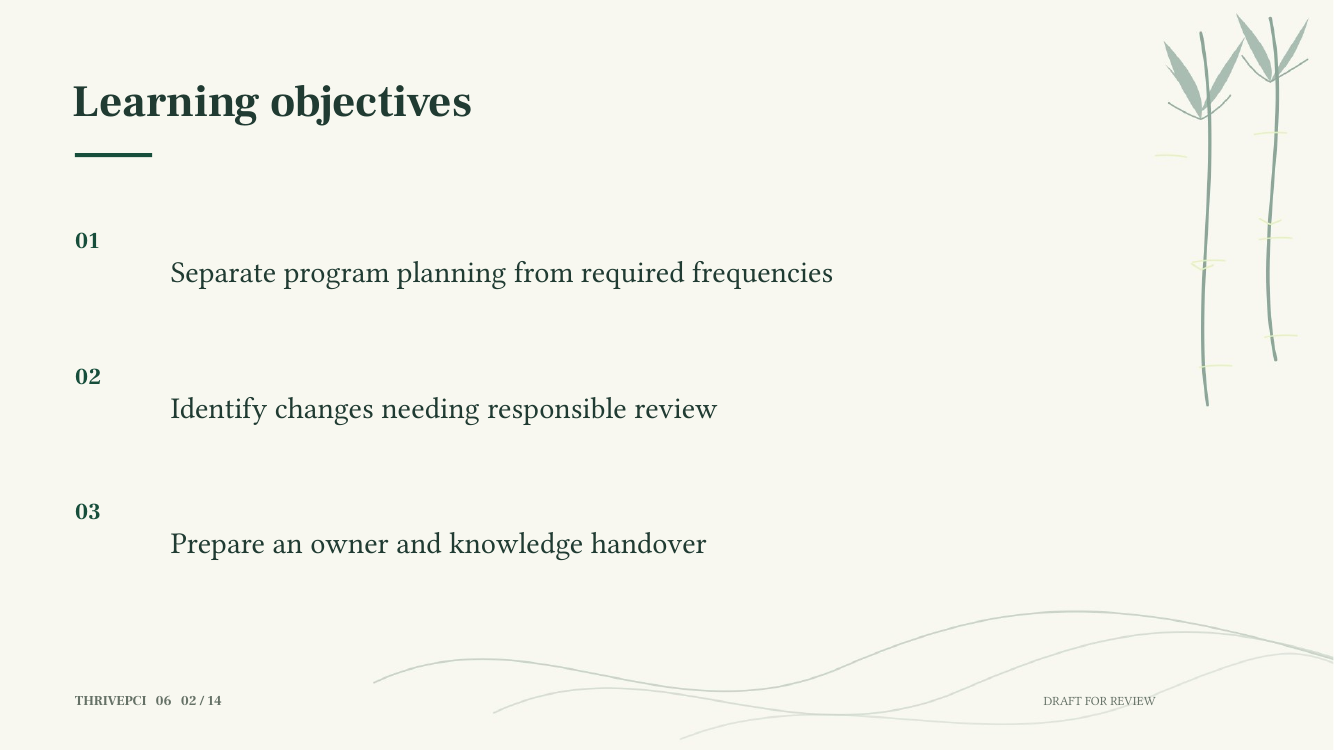
Learning objectives
Separate program planning from required frequencies
Identify changes needing responsible review
Prepare an owner and knowledge handover
RECORDING SCRIPT · NOT RECORDED AUDIO
By the end, you should be able to distinguish a convenient internal meeting schedule from a frequency required by the standard or an applicable documented analysis. You should be able to identify a change that needs review by the appropriate owner and describe the information that person needs. You will also build a small continuity record so a new owner can understand the activity, supporting records and open questions. The examples use generic roles and fictional arrangements. They help organize program work but do not replace the formal responsibilities, requirement-specific records or assessment procedures that apply to the organization.
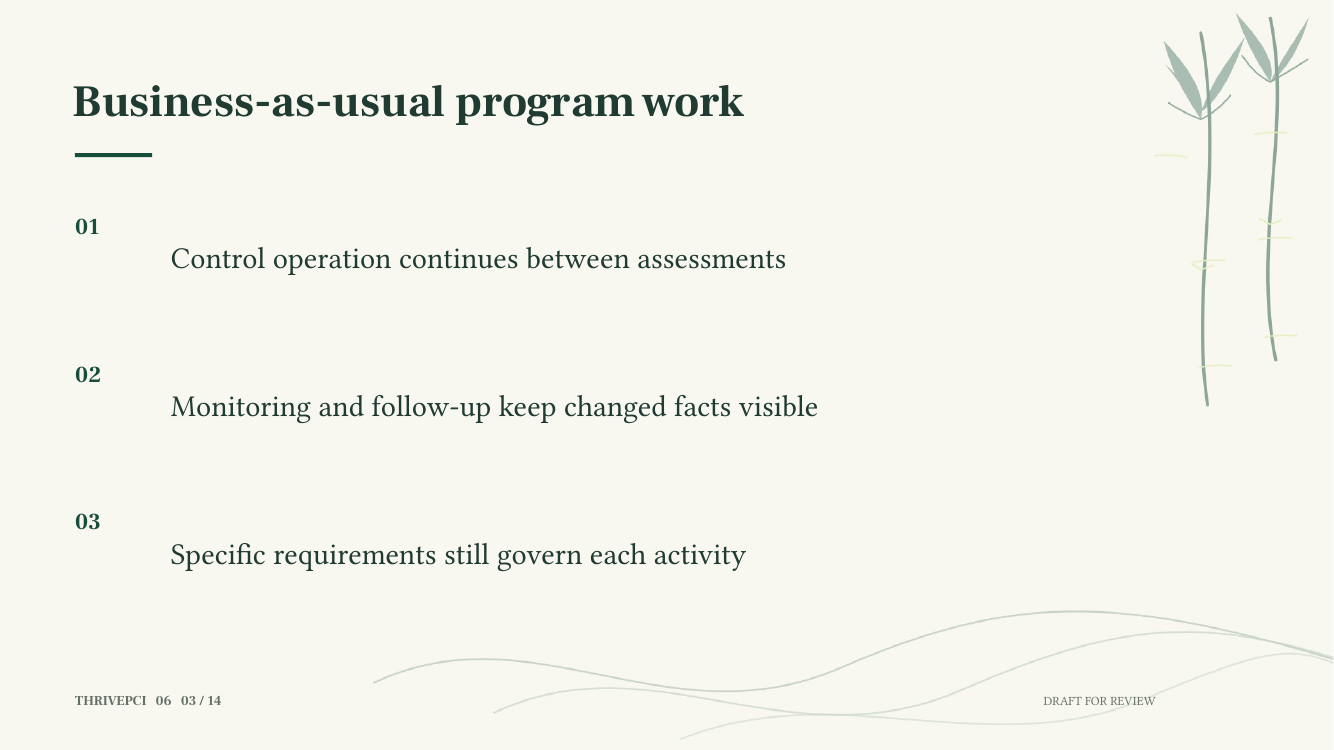
Monitoring and follow-up keep changed facts visible
Specific requirements still govern each activity
RECORDING SCRIPT · NOT RECORDED AUDIO
Section five of PCI DSS discusses business-as-usual processes as part of an overall security strategy. Its recommendations help an organization monitor controls and respond to changes between assessments. Those recommendations do not replace or extend the specific requirements. Beacon Learning uses a routine program discussion to review responsibilities, exceptions and relevant changes, but it still needs to perform each applicable activity at its required frequency. A prior assessment reflects its actual assessed period and conditions. It cannot establish that every later change or activity remains satisfactory. The useful question is what the current environment and authentic operating records demonstrate now.
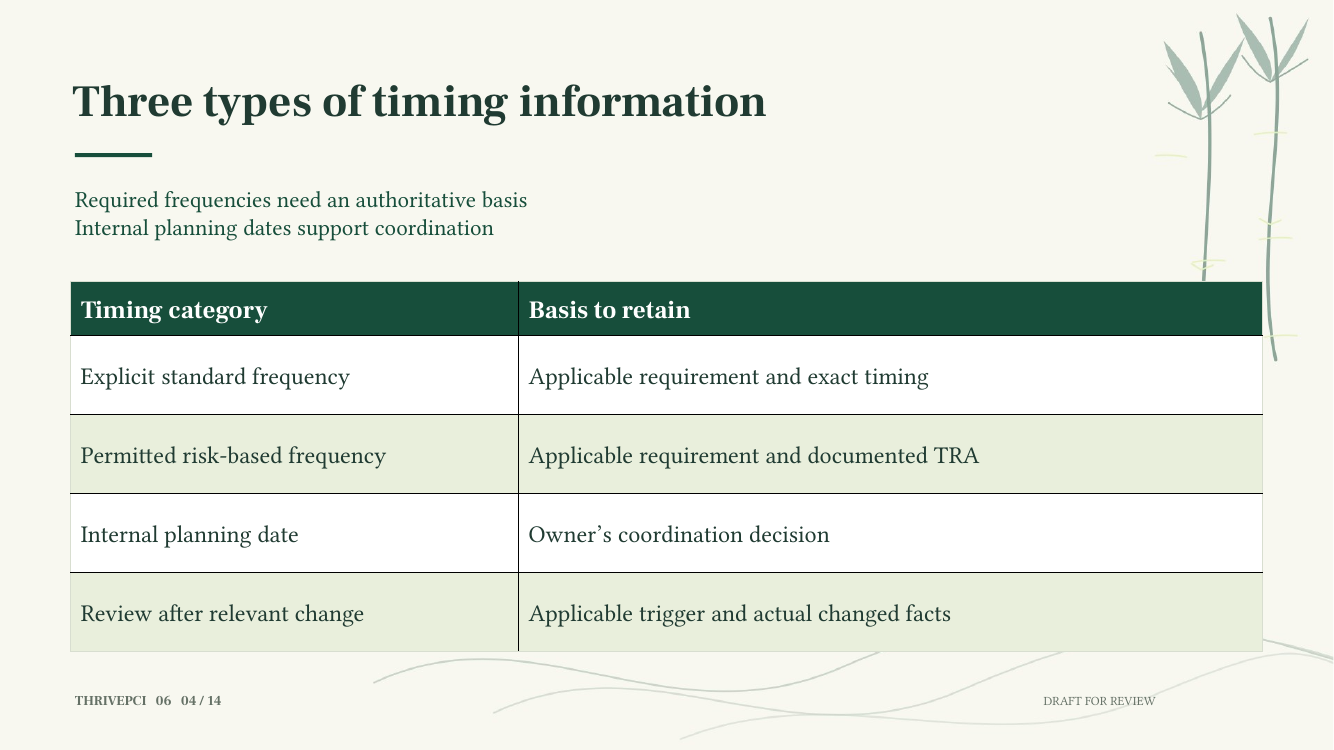
Keep timing information in separate fields. Some activities have an explicit frequency in the standard. Some requirements permit a frequency determined through a targeted risk analysis meeting the relevant conditions. Other dates are internal planning choices, such as a weekly workstream meeting or a target date for obtaining a document. Beacon should record which category applies and where the basis is documented. It should not label every calendar entry a PCI requirement or use an internal meeting as a replacement for a required activity. The table is a practitioner planning aid. The exact requirement and applicable analysis govern the actual frequency and evidence.
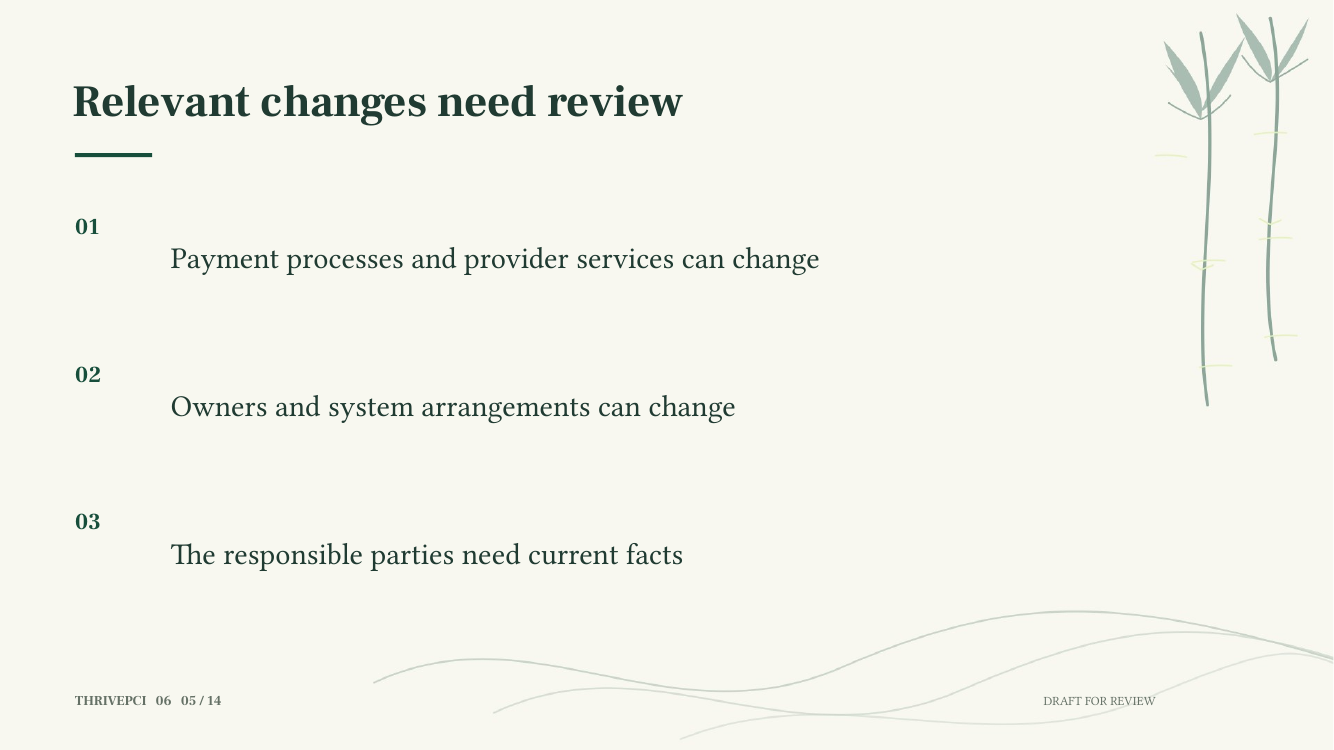
Payment processes and provider services can change
Owners and system arrangements can change
The responsible parties need current facts
RECORDING SCRIPT · NOT RECORDED AUDIO
Beacon Learning changes its managed service and introduces a new payment-related workflow. The program owner should make those facts visible to the appropriate business, technical and vendor owners. Requirement 12.5.2 includes scoping confirmation after significant changes to the in-scope environment, alongside its minimum periodic confirmation. Service providers have an additional frequency requirement under 12.5.2.1. Other requirements may also apply to changes, including 6.5.2 where applicable. This course does not decide whether a specific change is significant or determine its scope impact. The organization needs an appropriate review of the actual arrangement, documented decisions and evidence of any required follow-up.
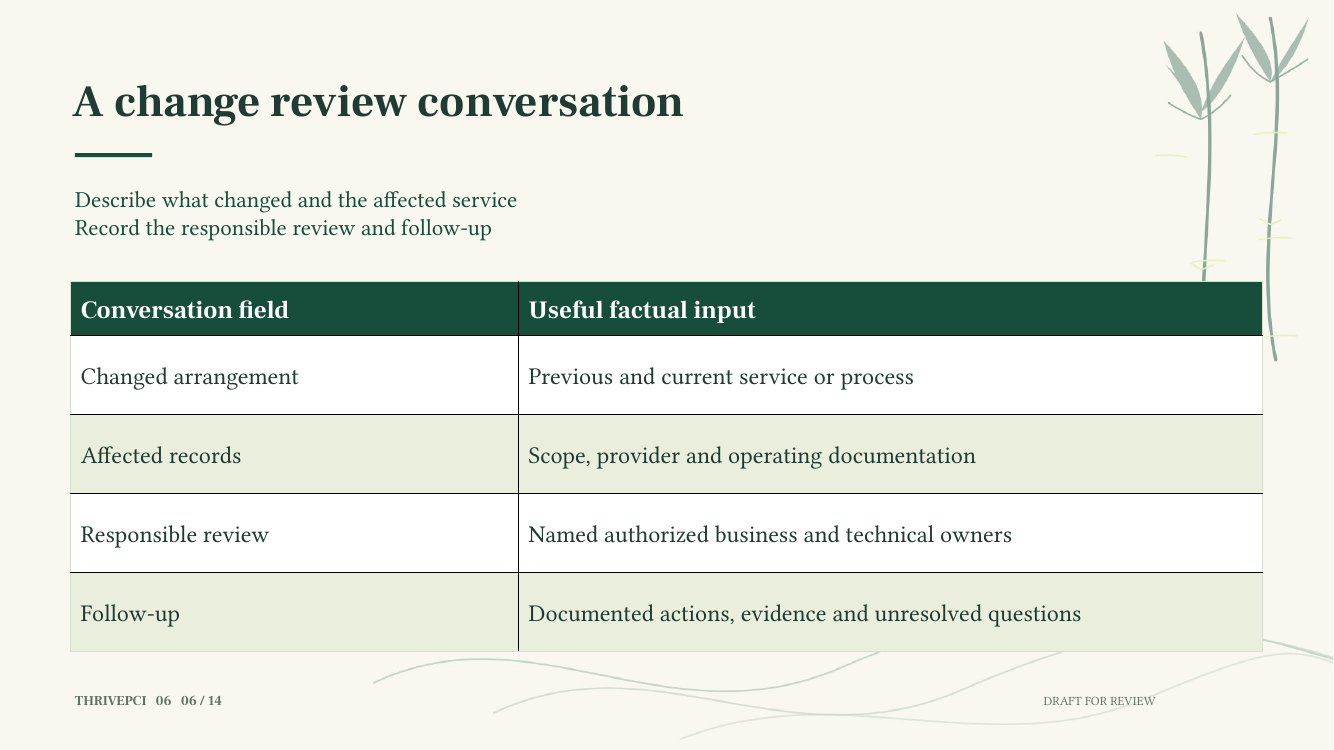
Documented actions, evidence and unresolved questions
RECORDING SCRIPT · NOT RECORDED AUDIO
A useful change conversation begins with a factual description. Beacon records the previous and new service arrangements, affected systems and responsible owners. It identifies which existing scope, provider or operational records may need review. The appropriate owners evaluate the impact under the applicable requirements and document their conclusions and follow-up. The program coordinator tracks the work without substituting a personal guess for that review. If the effect is unclear, the question remains open with an owner. This prevents a change ticket marked complete from being mistaken for confirmation that all relevant PCI work has been considered and performed.
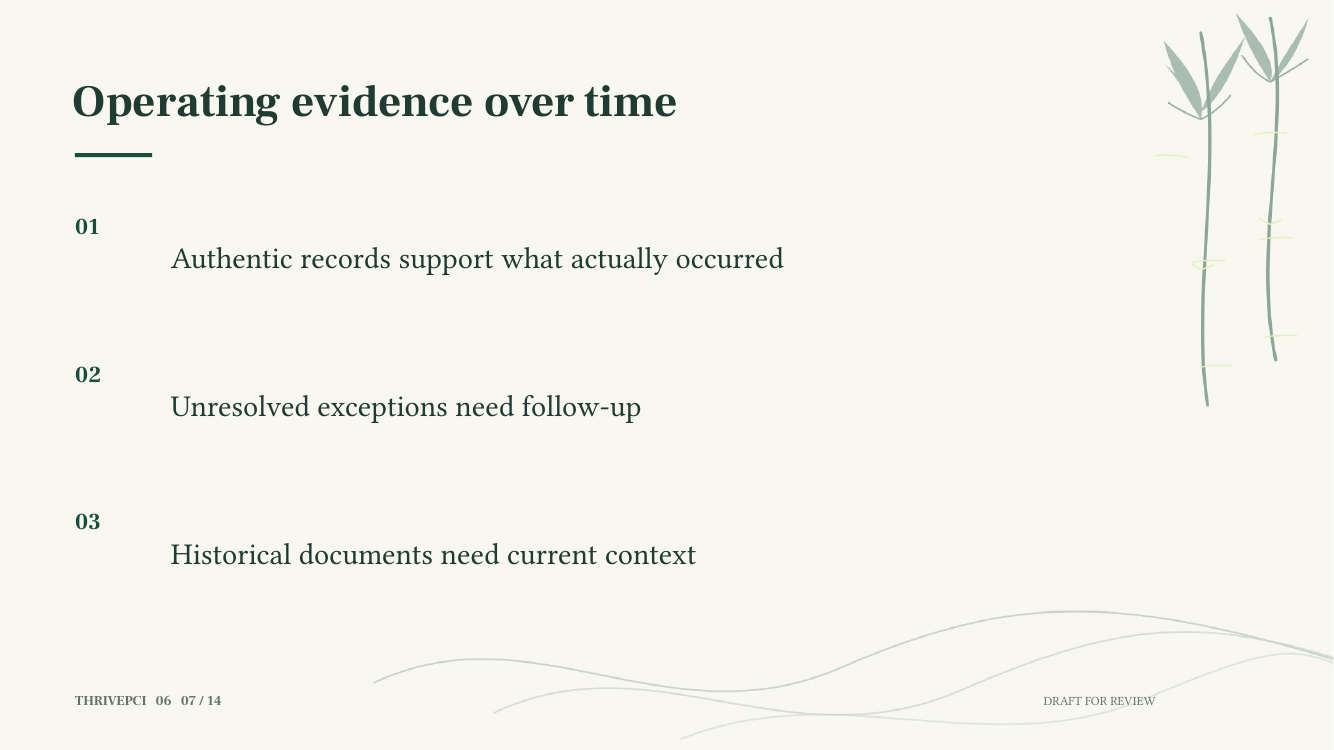
An operating record should preserve what actually occurred, including decisions and exceptions. Beacon keeps its required records through the approved process and reviews whether a record relates to the relevant population and period. If an activity was missed or support cannot be found, the team should record the fact and use its actual escalation and remediation process. It should not invent a historical record to fill a folder. Old documents can provide context or a starting template, but they need review against current facts. The precise retention and activity requirements depend on the relevant control and other applicable obligations, so this course does not set a universal retention period.
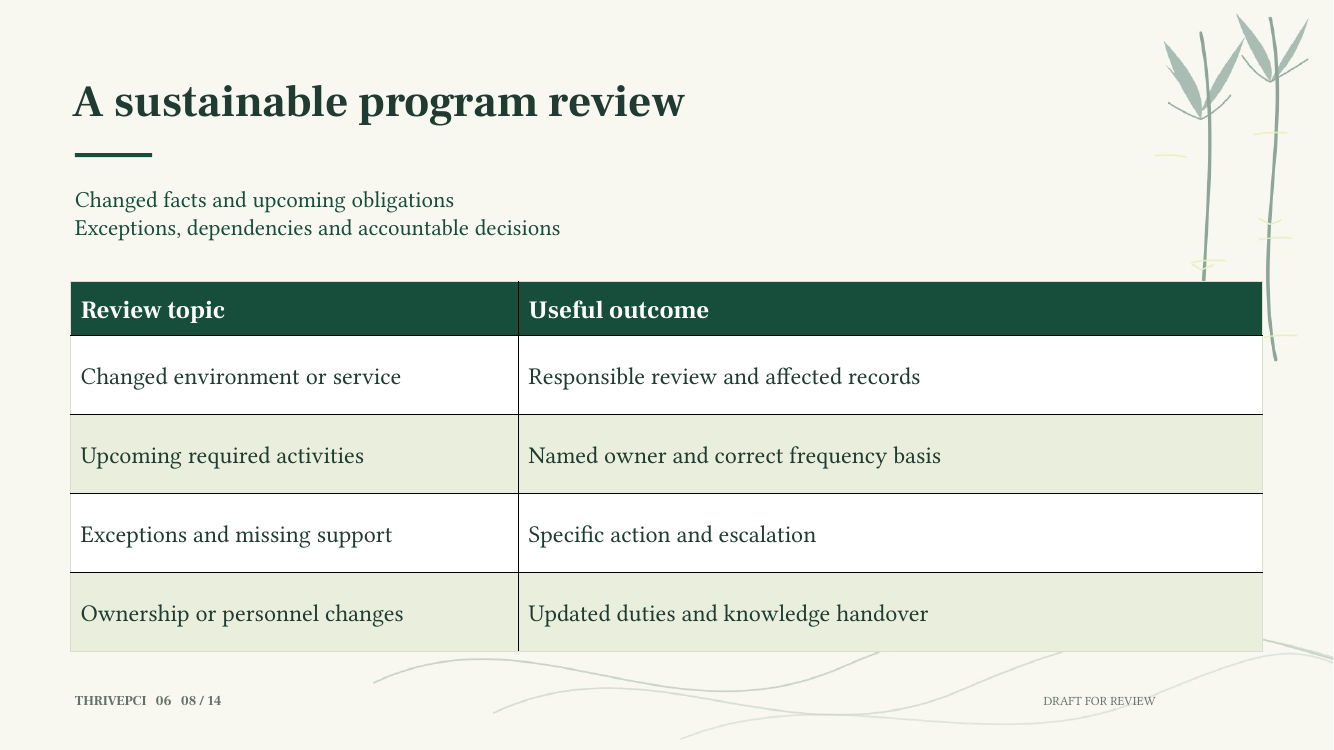
Exceptions, dependencies and accountable decisions
Review topic
Useful outcome
Changed environment or service
Responsible review and affected records
Upcoming required activities
Named owner and correct frequency basis
Exceptions and missing support
Specific action and escalation
Ownership or personnel changes
Updated duties and knowledge handover
RECORDING SCRIPT · NOT RECORDED AUDIO
Beacon’s internal program review focuses on changed facts, upcoming obligations and unresolved exceptions. The team checks whether responsibilities remain understood and whether a provider or system change affects existing records. It follows up on missing inputs and records decisions within the proper authority. This meeting can be short if the underlying information is current. The schedule is an internal coordination choice. It does not replace annual policy review under 12.1.2, provider status monitoring under 12.8.4 or any other applicable activity. A useful agenda helps the team notice when specific work needs attention and identify who must perform it.
The tracker still shows last year’s evidence as complete
RECORDING SCRIPT · NOT RECORDED AUDIO
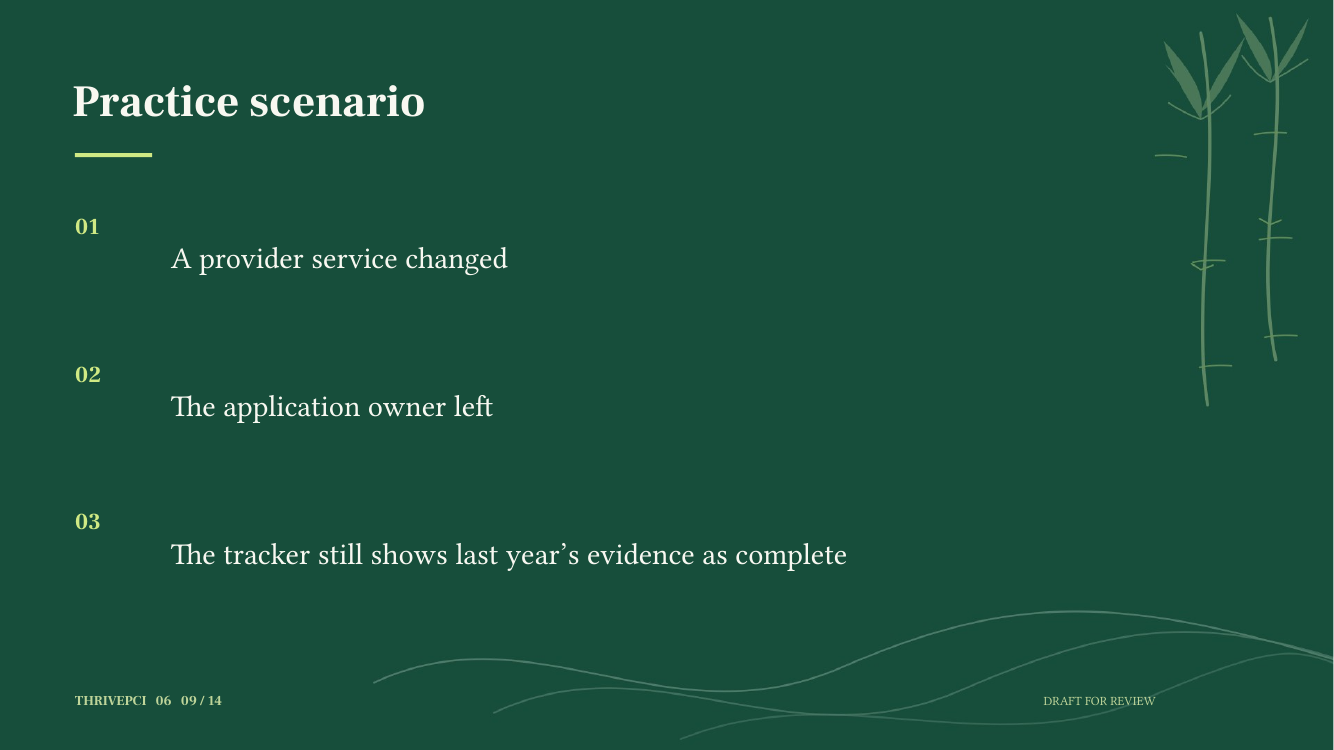
Pause and consider Beacon’s situation. A provider service changed, the application owner left and the task tracker still shows last year’s evidence as complete. The new coordinator wants to copy the old records into this year’s folder. Identify the preparation questions that should come first. Who can describe the changed service? Who now owns the application activity? Which records and timing obligations need review? Write a short action list with owners. Do not declare the business compliant or non-compliant from this scenario. The point is to recognize that historical status and current operating facts require different kinds of support.
Source note (not spoken): Practitioner exercise based on PCI DSS v4.0.1, section 5, 12.1.3, 12.5.2 and 12.8.5
SLIDE 10 · content
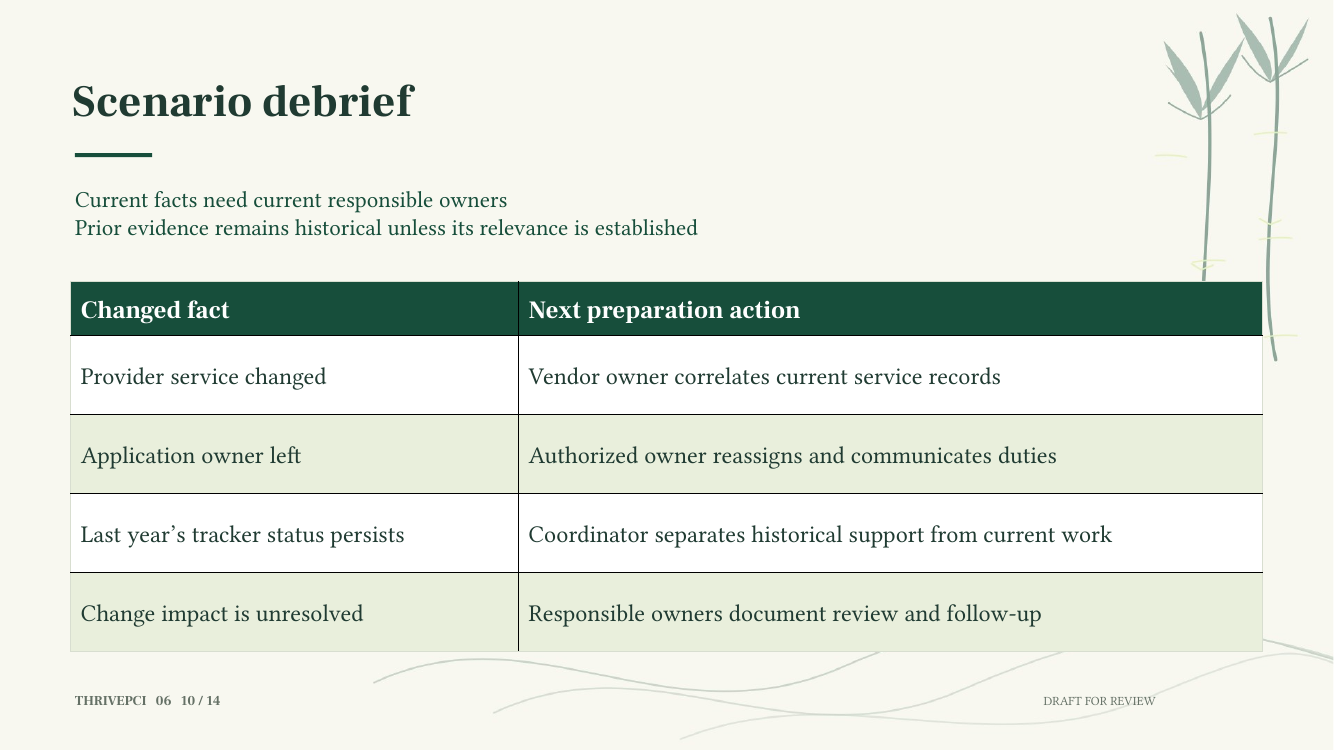
Scenario debrief
Current facts need current responsible owners
Prior evidence remains historical unless its relevance is established
Changed fact
Next preparation action
Provider service changed
Vendor owner correlates current service records
Application owner left
Authorized owner reassigns and communicates duties
Last year’s tracker status persists
Coordinator separates historical support from current work
Change impact is unresolved
Responsible owners document review and follow-up
RECORDING SCRIPT · NOT RECORDED AUDIO
The vendor owner should describe the changed provider service and obtain relevant current coverage and responsibility information. The organization should assign and communicate the application responsibilities through its appropriate process. The relevant owners should review the impact of the change and identify which records need updating or new operating evidence. The coordinator preserves historical records accurately and avoids relabeling them as evidence of a new activity. A task can remain useful as a tracking reference while its current support needs review. This debrief produces owned next actions without treating the course as the authority that decides scope or the final assessment conclusion.
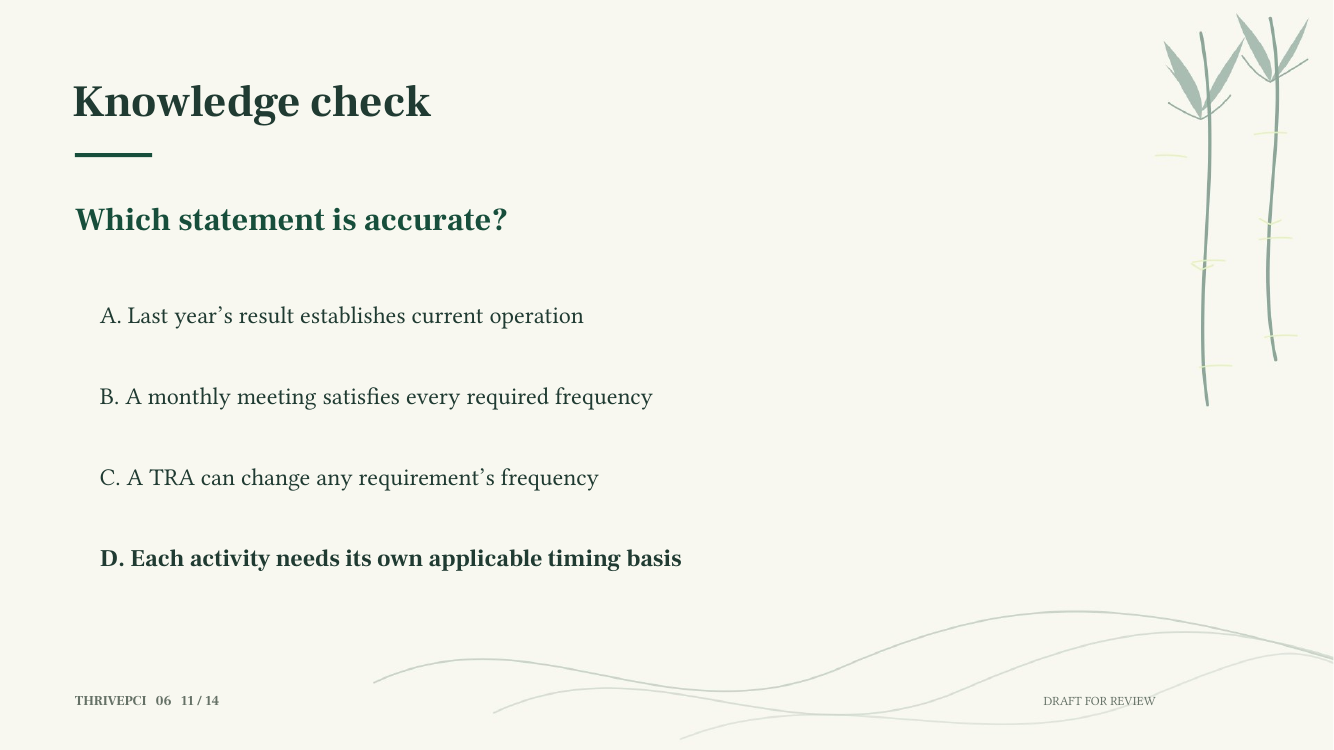
A. Last year’s result establishes current operation
B. A monthly meeting satisfies every required frequency
C. A TRA can change any requirement’s frequency
D. Each activity needs its own applicable timing basis
RECORDING SCRIPT · NOT RECORDED AUDIO
Choose the accurate statement. A treats last year’s result as proof of current operation. B treats one monthly meeting as satisfying every required frequency. C assumes a targeted risk analysis can change any requirement’s timing. D says each activity needs its applicable timing basis. Pause before advancing. Explain which assumption makes the other options unreliable. A targeted risk analysis is used where the relevant requirement permits it and must satisfy the applicable conditions. Internal scheduling can help coordinate the work, but it does not automatically change those conditions. Recognizing the source of a timing decision is a useful program ownership skill.
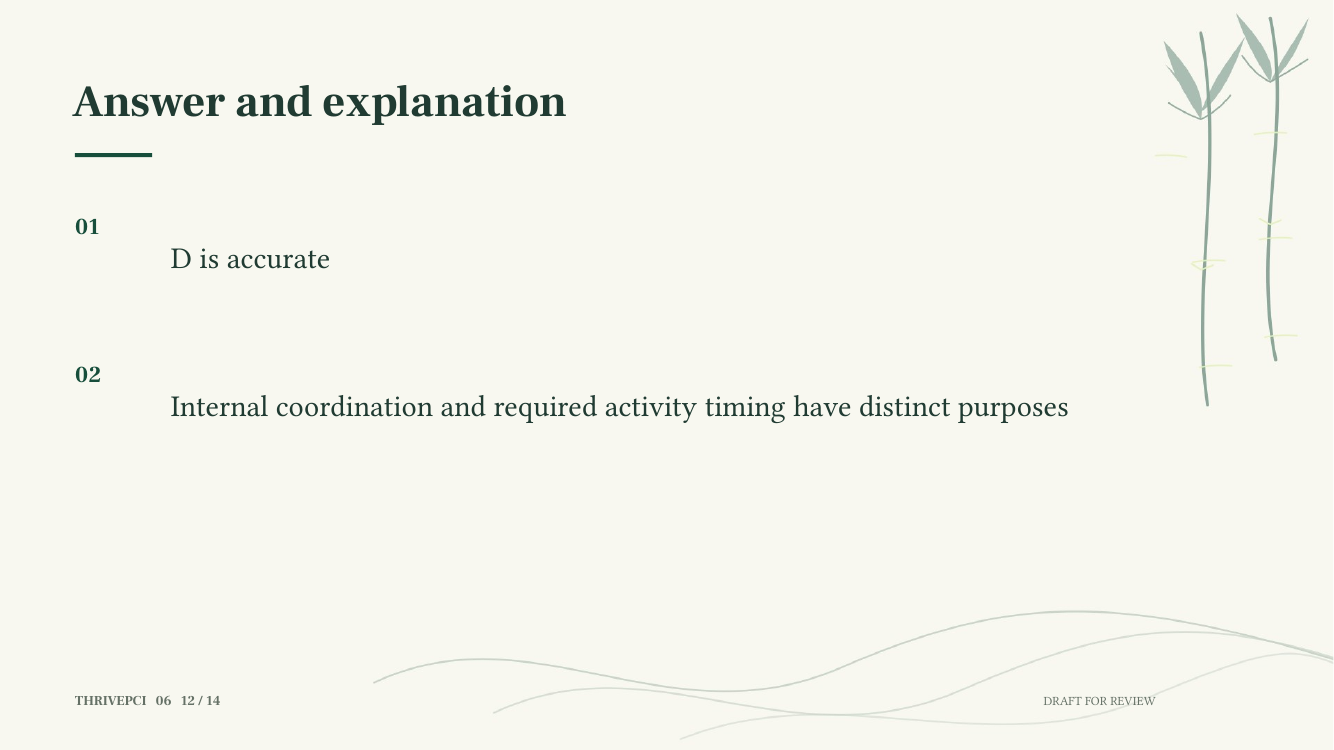
Internal coordination and required activity timing have distinct purposes
RECORDING SCRIPT · NOT RECORDED AUDIO
D is accurate. An activity’s timing needs the basis that applies to that activity. Some frequencies are explicit, and some use the risk analysis conditions permitted by the requirement. An internal program meeting can support coordination without replacing the underlying activity. Last year’s assessment information also cannot prove every later operating condition or change. Beacon benefits from recording the timing basis beside the owner and evidence location. That makes it easier to notice when a new owner inherits a duty or when a changed service affects the program’s assumptions. The actual compliance evaluation still depends on the applicable requirements and supporting evidence.
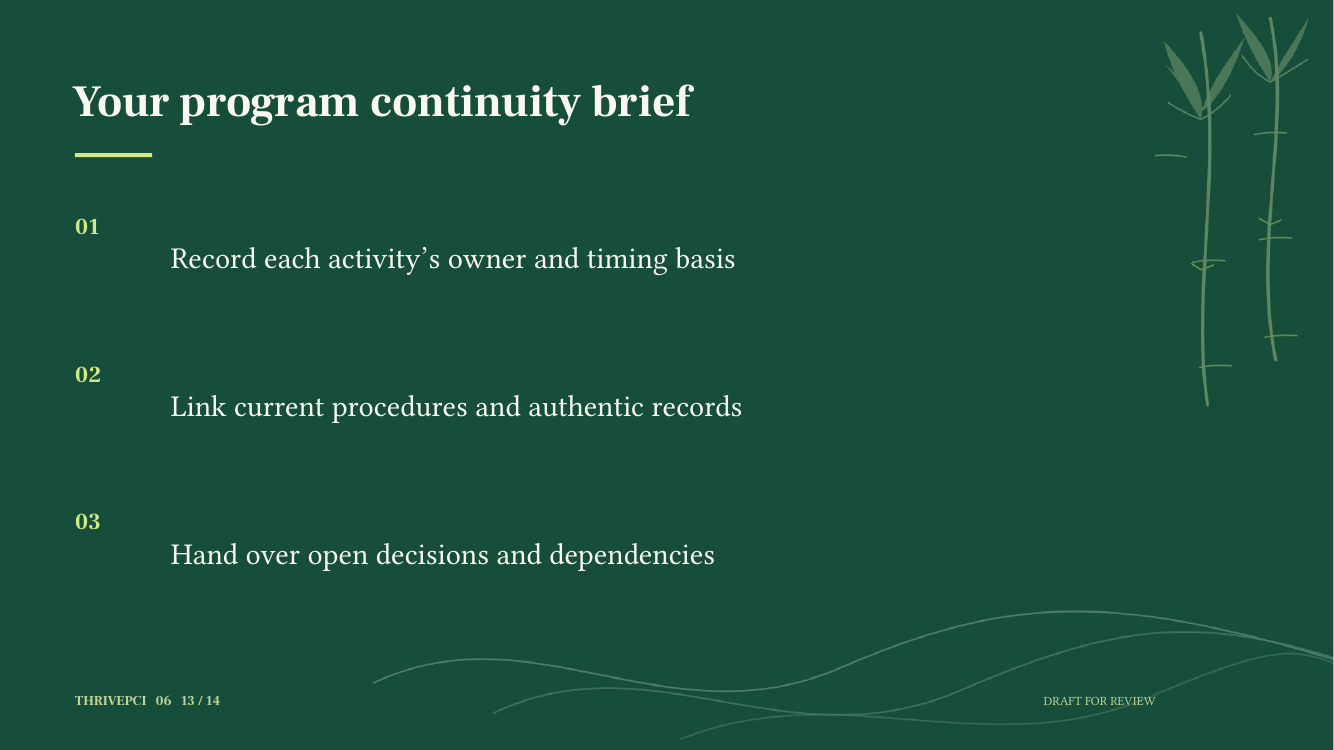
Create a continuity brief for one fictional workstream. Record the current owner, the applicable timing basis and the source of the procedure. Identify where authentic operating records are retained through the approved process. Add open decisions, provider dependencies and known changes that the next owner needs to understand. Check the brief against formal responsibilities rather than treating it as a replacement for them. Keep access permissions and confidential records in their approved systems. A good handover lets a successor continue the work accurately and recognize unresolved questions. It should not hide missed activities or imply that a historical result guarantees current compliance.
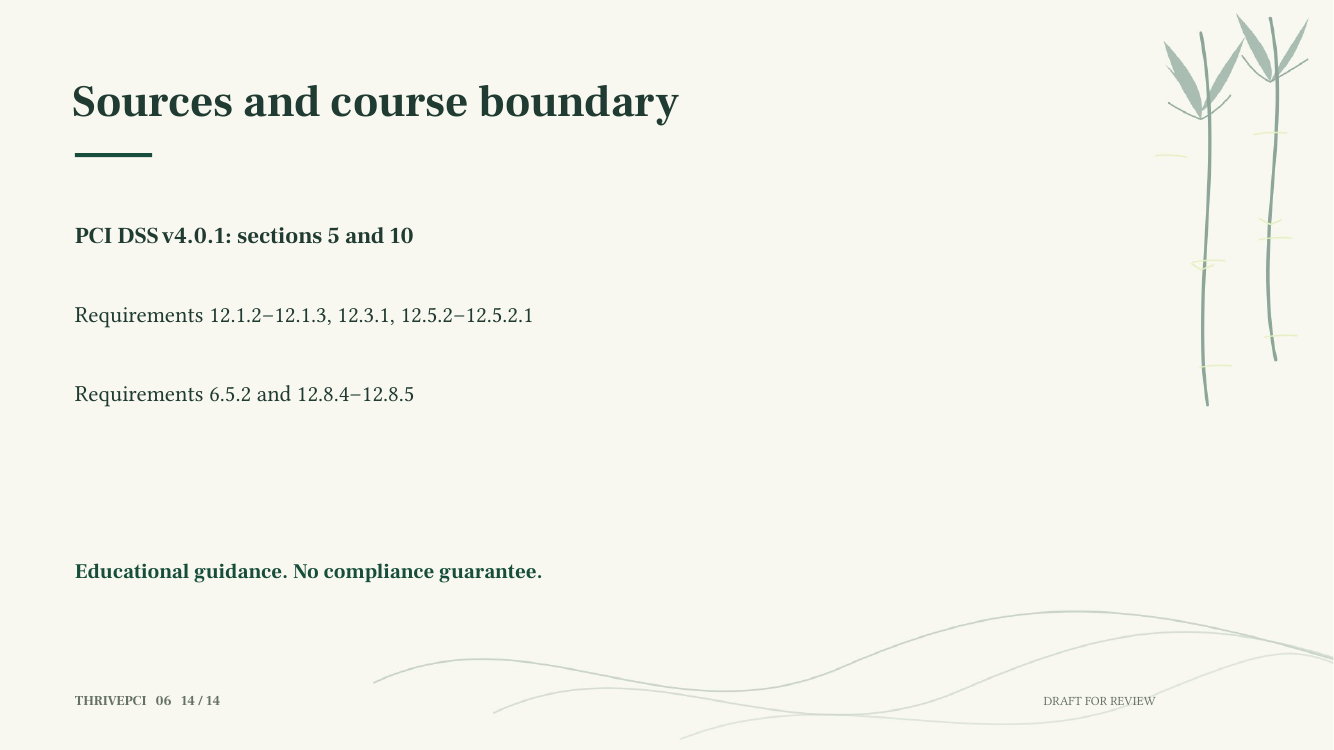
The reference baseline is PCI DSS version 4.0.1. Section five discusses business-as-usual considerations, while the cited requirements address policy review, responsibilities, targeted risk analysis, scoping confirmation, change-related verification and provider oversight. Use the exact requirement text and applicability notes for an actual activity. Our meeting agenda, timing register and continuity brief are practitioner teaching aids. They do not establish a universal program schedule or replace formal records. This deck remains a review draft. It does not determine current compliance, choose scope or guarantee a favorable assessment. Continue with the responsible owners and current authoritative sources when applying the course to a real organization.
This course does not replace requirement-specific frequencies, decide risk treatment applicability, determine compliance, or guarantee an assessment outcome. Apply the supplied PCI DSS v4.0.1 text and actual engagement instructions to the circumstances.